
By the The Bulldog Law Criminal Defense Team • Reviewed by a licensed California criminal defense attorney
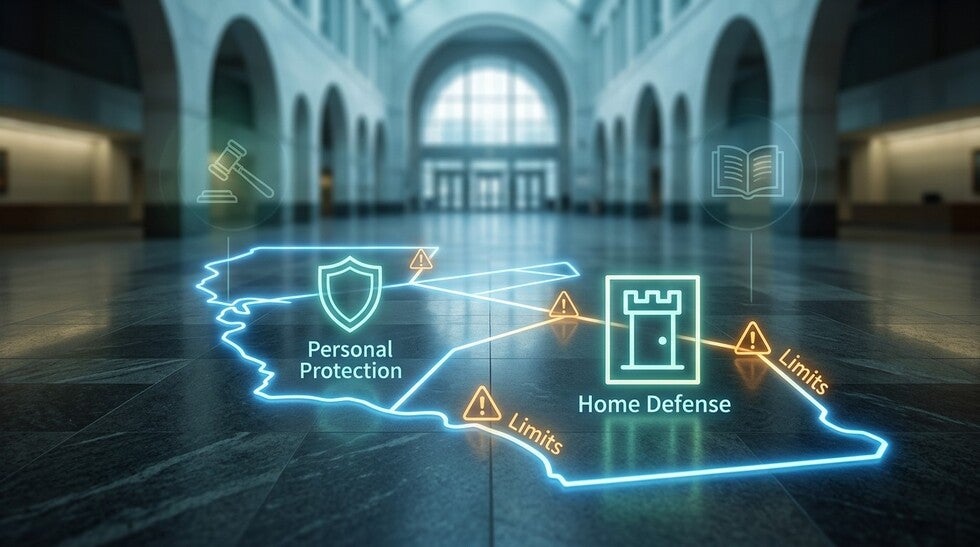
California law lets you use reasonable force to defend yourself or another person when you reasonably believe you're in imminent danger of suffering bodily injury and, despite decades of confusion, California IS effectively a stand-your-ground state: you have NO duty to retreat before defending yourself in a place you're lawfully entitled to be, and the jury is instructed that you may stand your ground and even pursue an attacker if reasonably necessary for safety. Inside your home, the Castle Doctrine (Penal Code § 198.5) goes further, PRESUMING your fear of death or great bodily injury was reasonable when someone unlawfully and forcibly breaks in.
But the doctrine has edges that surprise people on both sides of a trigger: deadly force is never justified to protect PROPERTY alone, the castle presumption does not follow you into your car or onto the sidewalk, an “honest but unreasonable” belief gets you manslaughter rather than acquittal, and a perfectly justified shooting can still leave you charged for the GUN. This complete guide from The Bulldog Law's criminal defense team covers the real rules the elements prosecutors must disprove, the doctrines by name, defense of others and property, and the ten minutes after an incident that decide the next two years of your life.
The Three Elements of Lawful Self-Defense
California's standard (built into the jury instructions every violence case uses) has three parts, and every contested case is a fight about at least one of them:
- Imminent danger you reasonably believed you (or someone else) were in IMMINENT danger of being killed, suffering great bodily injury, or being the victim of a forcible crime. Imminent means NOW an attack unfolding or about to not a threat for tomorrow, not retaliation for five minutes ago, not a person walking away. The imminence line is where preemptive strikes and revenge blows lose their legal cover, and where timing evidence (video, witness sequence, wounds' direction) becomes the whole case.
- Reasonable belief the belief must be both HONESTLY held (subjective) and REASONABLE for a person in your situation (objective). Your knowledge counts: the attacker's prior threats and violence toward you, size and number disparities, weapons displayed all feed reasonableness. What doesn't: fear built on bias, intoxicated misreading, or danger a sober bystander wouldn't have perceived. When the belief is honest but a jury finds it unreasonable, you land in ‘imperfect self-defense' covered below which reduces murder to manslaughter rather than acquitting.
- Proportional force you may use only the force reasonably necessary to stop the threat: deadly force answers deadly threats and forcible felonies; fists answer fists. The proportionality element is where ‘winning too hard' creates liability the fight you lawfully joined becomes YOUR crime when you keep striking a downed, finished attacker, and prosecutors charge exactly that pattern under ADW and battery theories every week. Force stops when the threat stops; the law's stopwatch is unforgiving.
Is California a Stand-Your-Ground State? Yes Here's the Fine Print
California has no statute titled “Stand Your Ground” which is why headlines say it isn't one but the substance lives in the state's pattern jury instructions and a century of case law: a person who is attacked in a place they have a right to be has NO duty to retreat, may stand their ground and defend themselves, and may even pursue the assailant if reasonably necessary to secure safety. Functionally, that's stand-your-ground stronger, in the pursuit language, than some states' statutes. What California does NOT import from the Florida-style regimes: there's no special pretrial immunity hearing that ends prosecutions before trial self-defense here is decided by the ordinary process, meaning the DA charges, the case proceeds, and the doctrine wins at preliminary hearing, negotiation, or trial. Two practical consequences follow.
First, the burden architecture favors you more than people realize: once self-defense is properly raised, the PROSECUTION must disprove it beyond a reasonable doubt you don't prove you were justified; they must prove you weren't. Second, because there's no immunity shortcut, the quality of the self-defense presentation assembled by counsel from day one, not improvised at trial determines whether the case dies at the charging desk, the prelim, or two years later. The doctrine is real; the process is where it's won.
The Castle Doctrine (PC § 198.5): What Your Home Actually Protects
Penal Code § 198.5 creates a PRESUMPTION: when someone unlawfully and FORCIBLY enters your residence, and you knew or reasonably believed an unlawful forcible entry occurred, and the intruder is not a household member your fear of imminent death or great bodily injury is presumed reasonable if you use deadly force inside the home.
In plain terms: against the 2 a.m. window-breaker, the law starts on your side the prosecution must overcome the presumption rather than you having to justify your fear from scratch. Now the edges, because they decide real cases: the presumption requires FORCIBLE entry (the invited guest who won't leave, the door left open, the household member in a rage are all OUTSIDE it ordinary self-defense rules apply instead); it protects the RESIDENCE's interior (the porch, yard, and driveway confrontations get ordinary analysis, and your CAR gets no castle treatment in California at all); and it is a presumption, not a license executing a fleeing or incapacitated intruder, or force plainly untethered from any threat, can still be charged, with the presumption argued and sometimes overcome.
The doctrine's companion principle (§ 197's justifiable-homicide grounds) extends lawful deadly force to resisting forcible felonies robbery, home-invasion burglary, rape which is why the intruder cases and the doctrine travel together. If you've used force in your home: the presumption is your shield, but it's raised BY counsel, with the entry evidence preserved the broken lock, the window glass, the doorbell video before anyone cleans up.
Defending Others, Defending Property Two Different Universes
DEFENSE OF OTHERS mirrors self-defense exactly: you may use reasonable force to protect anyone family, friend, stranger whom you reasonably believe faces imminent harm, judged from what YOU reasonably perceived (the doctrine forgives reasonable mistakes: intervening in what genuinely looked like an assault is protected even if the facts were other than they appeared).The recurring real-world version is the domestic-violence intervention the relative or neighbor who steps in and the doctrine is why those interveners are defensible when charged.
DEFENSE OF PROPERTY is the opposite universe, and the source of the most dangerous myths in this field: California permits REASONABLE, NON-DEADLY force to protect property you may eject a trespasser, block a taking, recover property in fresh pursuit but deadly force is NEVER justified for property ALONE. Shooting at the fleeing car thief, the porch-pirate, the tagger those are prosecutions, not defenses, and juries convict on them. The line that reconciles the doctrines: when a property crime involves or threatens PEOPLE the robbery, the occupied-home invasion, the carjacking attempt the analysis shifts from property to person, and deadly-force rules (and § 198.5's presumption, where the home is entered) come alive. The question is never ‘what were they taking' it's ‘who was in danger.'
Imperfect Self-Defense: Honest but Unreasonable the Murder Reducer
When you HONESTLY believed in the need for deadly self-defense but a jury finds the belief UNREASONABLE the threat you perceived wasn't objectively there, the force was disproportionate to what a reasonable person would've used California's imperfect self-defense doctrine negates malice and reduces murder to VOLUNTARY MANSLAUGHTER: 3, 6, or 11 years instead of 15-to-life.It is among the most consequential doctrines in homicide law the difference between a defined sentence and an indeterminate one and it lives in fear-saturated cases: abusive-relationship killings (where battered-person-syndrome expert testimony explains why the defendant's perception of imminence was honest), escalating confrontations misread in the dark, threats history made believable.
The full doctrine, with heat-of-passion's parallel reduction, is covered in the firm's manslaughter guide here, the strategic point: in any homicide case, perfect self-defense (acquittal) is argued first and imperfect self-defense (manslaughter) is preserved as the floor, which is why the self-defense investigation the attacker's record, prior threats, the physical sequence pays twice no matter how the reasonableness fight ends.
After You've Defended Yourself: The Ten Minutes That Decide the Case
- Call 911 FIRST the first reporter frames the incident; be the caller, not the subject of the call. State the essentials: location, medical aid needed, ‘I was attacked and defended myself,' weapon secured.
- Secure and step back holster or set down the weapon before officers arrive (arriving police see a scene, not a story), render or summon aid, touch nothing else the scene's geometry (casings, positions, the intruder's tool at the window) is YOUR evidence.
- Say the frame, then stop ‘He attacked me / broke in. I was in fear for my life. I'll cooperate fully, but I want my attorney before a statement.' That sentence claims self-defense preserving the narrative while invoking properly. Adrenaline is a confession machine: shocked defenders talk for an hour and hand prosecutors the inconsistencies; the discipline is the frame, then silence.
- Preserve everything doorbell and security video (auto-deletes in days!), the threatening texts that preceded it, names of witnesses, your own injuries photographed that night.
- Counsel immediately not after charges: self-defense cases are won at the CHARGING DESK more than anywhere a defense presentation to the DA (evidence, law, the attacker's record) prevents filings that, once made, take a year to unwind. And two collateral fronts need managing from day one: the GUN a justified shooting doesn't erase carry violations or public-carry counts, which get charged separately when the weapon's possession itself was unlawful and the CIVIL suit, where the attacker (or their estate) can sue under a lower standard even after criminal justification. Handled together, from the first day, these cases end quietly; improvised, they metastasize.
Frequently Asked Questions
Is California a stand-your-ground state?
Functionally yes: no statute carries the name, but California's jury instructions and case law impose NO duty to retreat a person attacked where they lawfully stand may hold their ground, defend with reasonable force, and even pursue the attacker where reasonably necessary for safety. What California lacks is the Florida-style pretrial immunity hearing; self-defense here wins through the normal process charging decisions, preliminary hearings, trial with the prosecution bearing the burden to DISPROVE self-defense beyond a reasonable doubt once it's raised. Practical translation: the doctrine protects you, but the presentation of it early, evidence-backed, attorney-built is what actually ends cases.
Can I shoot someone breaking into my house in California?
If someone unlawfully and forcibly enters your occupied home, PC 198.5 presumes your fear of death or great bodily injury was reasonable the strongest legal position self-defense law offers, and the reason genuine intruder shootings are rarely charged. The boundaries matter: the presumption needs FORCIBLE entry (not the invited guest or household member), covers the residence's interior (not the yard, porch, or your car), and is not a license to execute a fleeing or incapacitated person force must still answer a threat. After any home-defense incident: call 911 first, secure the weapon, preserve the entry evidence (broken glass, forced lock, video), state the self-defense frame, and get counsel before giving a full statement.
Can I use deadly force to protect my property or my car?
For property ALONE no, ever: California permits reasonable NON-deadly force to protect property (ejecting trespassers, preventing a taking), and shooting at a fleeing thief, a package stealer, or someone breaking into your unoccupied car is a prosecution, not a defense. The analysis changes the moment PEOPLE are endangered: an occupied-vehicle attack is a carjacking a forcible felony against a person and defending yourself inside your car follows ordinary self-defense rules (no castle presumption, but full stand-your-ground and proportionality doctrine). The reliable compass: deadly force answers danger to people, never loss of things and the cases that ignore that compass fill prison terms.
What if I started the argument can I still claim self-defense?
Sometimes. An initial aggressor or mutual combatant regains the right of self-defense in two situations: (1) you genuinely tried to stop fighting AND clearly communicated withdrawal by words or conduct and the other person kept attacking; or (2) your non-deadly conflict was answered with sudden DEADLY force (you shoved; they drew a knife) the escalation restores your right to respond in kind. What never works: engineering a confrontation to ‘defend' yourself, or claiming withdrawal you never communicated. These doctrines are jury-instruction battles decided on sequence evidence who escalated, when, and what each moment looked like which is why video, witnesses, and injury patterns get fought over so hard in mutual-fight prosecutions.
Do I need a lawyer if the shooting was clearly justified?
Yes precisely because it was justified, and staying that way isn't automatic. Three reasons: charging decisions turn on presentations DAs file marginal cases when they hear only the police version, and a counsel-built self-defense package (evidence, law, the attacker's history) is how justified incidents die at the desk instead of at trial; collateral counts survive justification the unregistered carry, the prohibited-person issue, the public-place discharge can each be charged even when the defensive act itself was lawful; and the civil suit attackers and estates sue under a preponderance standard where criminal justification isn't a complete shield. The pattern across real cases is unambiguous: represented defenders resolve quietly; unrepresented ones give the hour-long adrenaline statement that becomes the case against them.
California's self-defense law is stronger than its reputation no retreat, a castle presumption, a burden on the prosecution and less forgiving than the myths: proportionality is policed, property is never worth a life in the law's eyes, and the ten minutes after an incident write the next two years. Know the doctrine before you need it, and if you've already needed it, let counsel present it before anyone else frames the story.
The Bulldog Law's criminal defense team handles self-defense cases from charging-desk advocacy through trial across California. Contact the firm online or call (888) 928-1609, 24/7.