
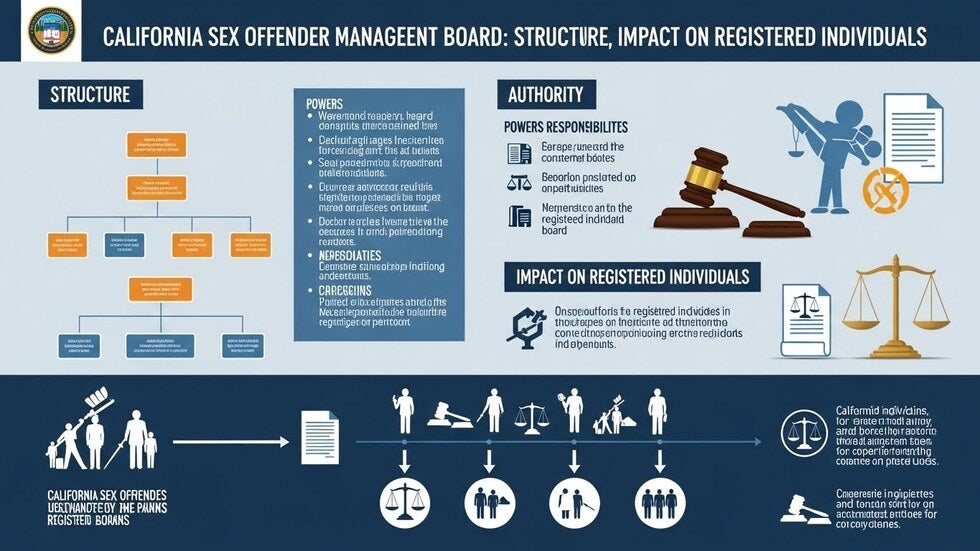
California established the Sex Offender Management Board to develop comprehensive policies governing the treatment, supervision, and management of individuals required to register under Penal Code Section 290. Section 9001 of the Welfare and Institutions Code creates the board's structure, defines its membership composition, and establishes operational procedures that shape how California approaches sex offender management statewide. Understanding this board's authority and composition proves essential for registered individuals and defense attorneys navigating California's complex regulatory landscape.
At Bulldog Law, we monitor developments from the Sex Offender Management Board and understand how its policies affect our clients' lives. The board's decisions influence supervision conditions, treatment requirements, and enforcement practices that impact thousands of Californians subject to registration obligations. Our team provides informed representation grounded in comprehensive knowledge of the regulatory framework governing sex offender management.
Board Composition and Multidisciplinary Representation
The California Sex Offender Management Board operates under the jurisdiction of the Department of Corrections and Rehabilitation and consists of nineteen members representing diverse perspectives from government agencies, local entities, and nongovernmental organizations. This multidisciplinary composition ensures that policies reflect input from law enforcement, treatment providers, prosecutors, defense attorneys, victim advocates, and other stakeholders involved in sex offender management.
The legislature deliberately structured board membership to balance competing interests and incorporate expertise from multiple disciplines. Rather than allowing any single perspective to dominate policy development, the statute requires representation from groups with fundamentally different approaches to sex offender issues. This diversity theoretically produces more comprehensive policies that account for public safety, treatment effectiveness, constitutional rights, and practical implementation challenges.
Geographic diversity also shapes board composition. The statute directs that membership reflect representation from northern, central, and southern California as well as both urban and rural areas. This geographic distribution recognizes that sex offender management challenges differ significantly between densely populated urban centers and sparsely populated rural communities. Policies that work effectively in Los Angeles may prove impractical in rural counties with limited resources and different population dynamics.
Each board member must possess substantial prior knowledge of sex offender issues related to their agency's practices, maintain decision making authority or direct access to decision makers within their organization, and demonstrate willingness to serve with commitment to contributing meaningfully to the board's work. These qualifications ensure that members can speak authoritatively for their constituencies and implement board recommendations within their respective agencies.
State Government Agency Representatives
State government representation on the board includes senior officials from multiple departments whose agencies play central roles in sex offender management. The Attorney General or a designee with expertise in sex offender registration, notification, and enforcement serves on the board. This position brings statewide law enforcement perspective and ensures that policies align with registration and notification systems that the Attorney General's office oversees.
The Secretary of the Department of Corrections and Rehabilitation or a designee with parole expertise represents the state corrections system. Given that many registered sex offenders serve parole terms after prison release, representation from corrections leadership ensures that board policies reflect practical realities of post release supervision and integrate with existing parole structures.
The Director of the Division of Adult Parole Operations or a designee provides specialized knowledge about parole supervision practices. This position focuses specifically on the operational aspects of monitoring individuals released from state prison, bringing frontline supervisory experience to policy discussions.
One California state judge appointed by the Judicial Council contributes judicial perspective to board deliberations. Judges regularly make decisions about sentencing, probation conditions, violation allegations, and petitions for relief from registration requirements. Judicial representation helps ensure that board recommendations remain legally sound and practically implementable within court processes.
The Director of State Hospitals or a licensed mental health professional designee with expertise in sex offender treatment represents the state's mental health system. This position brings clinical perspective grounded in evidence based treatment approaches and understanding of what interventions effectively reduce recidivism.
The Executive Director of the Office of Youth and Community Restoration or a designee with expertise in juvenile sex offender treatment and supervision represents the state's approach to younger offenders. Juvenile sex offenders present distinct challenges requiring different interventions than adult offenders, making specialized representation essential for developing age appropriate policies.
Local Government and Criminal Justice System Representatives
Local government agencies contribute nine members to the board, reflecting the reality that counties and cities bear primary responsibility for supervising most registered sex offenders. Three law enforcement representatives appointed by the Governor include one member with investigative expertise, one with registration and notification duties, and one chief probation officer. This law enforcement representation ensures that policies account for practical enforcement challenges and resource limitations facing local agencies.
One prosecuting attorney appointed by the Senate Committee on Rules brings expertise in dealing with adult sex offenders from the perspective of those who file criminal charges and seek accountability through the justice system. Prosecutor representation helps balance perspectives by including voices focused on protecting victims and maintaining public safety through aggressive enforcement.
One probation officer appointed by the Speaker of the Assembly represents the professionals who directly supervise most registered sex offenders living in communities. Probation departments manage thousands of individuals subject to court ordered conditions, making their operational perspective crucial for developing implementable policies.
One criminal defense attorney appointed by the Speaker of the Assembly provides representation for individuals subject to registration requirements. This position ensures that constitutional rights, procedural fairness, and individual interests receive consideration alongside public safety priorities. Defense attorney participation helps identify policies that may create constitutional problems or impose unnecessarily harsh restrictions.
One county administrator appointed by the Governor brings budgetary and administrative perspective from local governments that must fund and implement sex offender management programs. County administrators face competing demands for limited resources and must balance sex offender management costs against other public priorities.
One city manager or designee appointed by the Speaker of the Assembly represents municipal governments that also face sex offender management responsibilities within their jurisdictions. City perspective differs from county viewpoint given different governmental structures and service delivery models.
Mental Health Treatment Provider Representation
Licensed mental health professionals comprise three board positions, reflecting the central role that specialized treatment plays in sex offender management. Two members appointed by the Senate Committee on Rules represent those who provide evaluation and treatment for adult sex offenders through their involvement in formal statewide professional organizations. These positions ensure that treatment policies reflect current clinical knowledge and evidence based practices.
One licensed mental health professional appointed by the Speaker of the Assembly specifically represents those who treat juvenile sex offenders. Adolescent development, brain maturation, and responsiveness to intervention create distinct considerations for younger offenders. Specialized representation ensures that policies addressing juvenile sex offenders incorporate developmentally appropriate approaches rather than simply applying adult focused strategies.
The requirement that treatment provider representatives maintain established involvement in formal statewide professional organizations ensures connections to broader clinical communities. These representatives can consult colleagues, access research, and bring collective professional wisdom to board deliberations rather than offering only individual opinions.
Victim Advocacy and Sexual Assault Expertise
Two members appointed by the Governor serve as recognized experts in sexual assault who represent victims and rape crisis centers. These positions ensure that victim perspectives inform all board deliberations and that policies account for trauma impacts on survivors and community safety concerns.
Victim representative participation creates important balance by incorporating voices of those most directly harmed by sexual offenses. While other board members focus on managing offenders, treatment effectiveness, or system efficiency, victim representatives maintain focus on preventing future victimization and supporting survivors.
The statute specifies that victim representatives should have expertise addressing both adult and child victims, recognizing that sexual assault affects people across all age groups and that different victim populations may have distinct needs and concerns.
Board Operations and Decision Making Authority
The board selects its own chair from among the nineteen members. This internal selection process allows the board to choose leadership based on members' demonstrated commitment, effectiveness, and ability to facilitate productive collaboration among diverse stakeholders. The chair serves at the pleasure of the board, meaning members can change leadership if necessary.
All board members serve without compensation, reflecting the expectation that participation constitutes public service rather than paid employment. Members presumably receive their regular salaries from their employing agencies or professional practices while contributing time to board work as part of their broader responsibilities.
The statute establishes accountability mechanisms for board members who fail to fulfill their duties. Members who cannot adequately perform required responsibilities or who miss more than three meetings within any twelve month period face removal through majority vote of the full board. This provision ensures that membership remains active and engaged rather than nominal.
When vacancies occur through member removal, the original appointing authority must fill the position within thirty days. This expedited replacement process maintains full board membership and prevents prolonged gaps in representation from particular constituencies.
Subcommittees, Task Forces, and Expert Consultation
The board possesses discretion to create subcommittees or task forces addressing specific issues. These working groups may include board members as well as invited experts and other participants who contribute specialized knowledge. Subcommittee structures allow focused examination of complex topics while enabling participation from individuals beyond the core nineteen member board.
Task force flexibility permits the board to respond to emerging issues, investigate particular problems in depth, or develop detailed recommendations requiring sustained attention. By incorporating outside experts into task force work, the board accesses specialized knowledge that may not exist among its regular membership.
The statute encourages the board to utilize resources from research agencies including the Legislative Analyst's Office, the California Research Bureau, California State University system schools focusing on public policy and criminology, and similar institutions. This research support enhances evidence based policy development by grounding recommendations in empirical data rather than assumptions or anecdotes.
Staffing and Administrative Support
The board hires a coordinator with relevant policy research experience to manage its operations. This professional staff position ensures continuity, coordinates meetings, facilitates communication, and supports the board's analytical work. The coordinator serves as the board's primary staff member responsible for translating board directives into action.
The board may hire additional staff as funding permits, allowing expansion of professional support when resources allow. However, the conditional nature of additional hiring acknowledges budgetary limitations that may constrain staffing levels.
The Department of Corrections and Rehabilitation provides staff support services as directed by the secretary. This administrative infrastructure leverages existing departmental resources rather than requiring the board to develop independent operational capacity.
Impact on Individuals Subject to Registration
The Sex Offender Management Board's composition and authority create significant implications for registered individuals. Board policies influence supervision intensity, treatment requirements, enforcement priorities, and numerous other aspects of how California manages people subject to registration obligations. Understanding the board's multidisciplinary makeup helps contextualize why policies sometimes reflect competing tensions between public safety, treatment effectiveness, and individual rights.
The inclusion of defense attorney representation provides some voice for individual interests within board deliberations. However, defense perspective constitutes only one of nineteen votes, and board policies generally prioritize public safety and victim protection over minimizing burdens on registered individuals.
If you are subject to sex offender registration requirements or face charges that may trigger registration obligations, contact Bulldog Law to discuss your situation. Our experienced team provides strategic defense representation and understands how the Sex Offender Management Board's policies affect your rights and obligations under California's complex regulatory framework.