
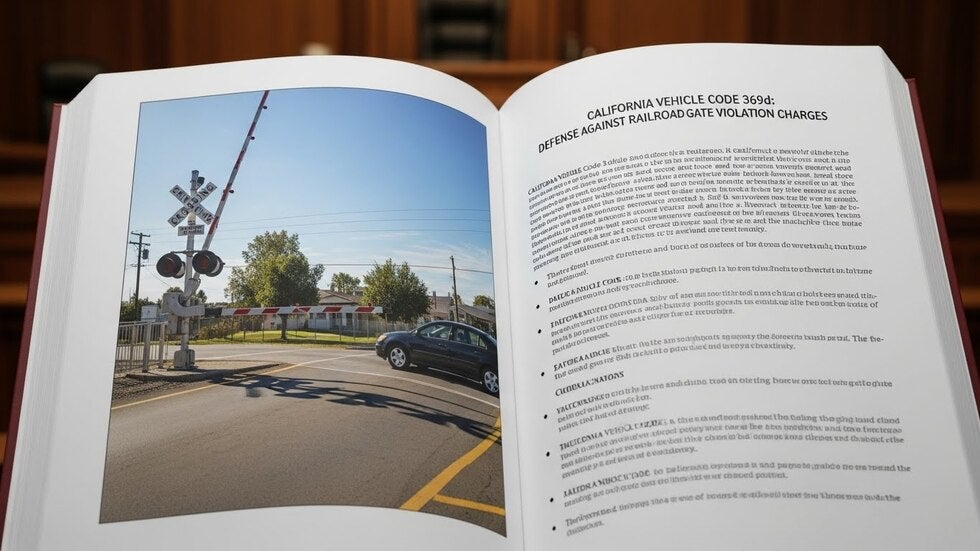
Rural California contains thousands of private railroad crossings where roads and passageways cross train tracks on private property. When these crossings are protected by bars or gates, California Vehicle Code 369d makes it a misdemeanor to leave them open after passing through. While this may seem like a minor offense, a misdemeanor conviction can have serious consequences for your record and future opportunities. If you're facing charges under this statute, understanding the law and available defenses is crucial to protecting your rights.
Understanding the Elements of Vehicle Code 369d
California Vehicle Code 369d addresses a specific situation that occurs primarily in agricultural, industrial, and other rural settings where private property contains railroad crossings. The statute criminalizes conduct that creates safety hazards by leaving protective barriers open after crossing railroad tracks.
To secure a conviction under this law, the prosecution must prove several distinct elements beyond a reasonable doubt. First, they must establish that you entered upon or crossed a railroad at a private passway. This means the location must be a private crossing rather than a public railroad crossing. The distinction matters because different laws govern public crossings, and Vehicle Code 369d applies exclusively to private situations.
Second, the prosecution must prove the private passway was enclosed by bars or gates. The physical presence of these barriers is an essential element of the offense. If no gates or bars existed at the crossing, or if they were not functioning as barriers at the time, the statute does not apply regardless of your other actions.
Third, the evidence must show that you neglected to leave the gates or bars securely closed after passing through. The word "neglected" is important because it suggests a failure to do something you should have done, rather than an intentional act. However, the law does not require prosecutors to prove you acted with malicious intent. Simple negligence in failing to close the gates sufficiently satisfies this element.
The statute exists to prevent dangerous situations where livestock might wander onto railroad tracks, unauthorized vehicles might enter railroad property, or trains might encounter unexpected obstacles. When someone leaves gates open at private railroad crossings, they potentially create hazards that can lead to accidents, property damage, and even loss of life.
Why This Statute Matters in Rural California
California's vast agricultural regions rely on railroad transportation for moving crops, livestock, and supplies. Many farms and ranches have private roads that cross railroad tracks, and these crossings must be managed carefully to ensure both railroad safety and property security. Gates and bars serve multiple purposes at these locations.
From a railroad perspective, these barriers help ensure that only authorized vehicles and individuals cross the tracks at private locations. Railroads need to maintain security along their rights of way, and uncontrolled access creates liability concerns and safety hazards. Trains traveling through rural areas often move at high speeds, and engineers may not expect to encounter obstacles at private crossings.
From a property owner's perspective, gates protect against trespassing, prevent livestock from escaping, and maintain boundaries between different land uses. When someone leaves a gate open, they may not only violate Vehicle Code 369d but also create problems for the property owner in terms of escaped animals, unauthorized access, or other complications.
The intersection of railroad operations and private property rights creates unique legal obligations. Understanding these obligations helps explain why a seemingly simple act like leaving a gate open carries criminal penalties.
Penalties for Violating Vehicle Code 369d
Vehicle Code 369d classifies violations as misdemeanors, which may sound less serious than felony charges but still carry substantial consequences. A misdemeanor conviction in California can result in up to six months in county jail, fines of up to one thousand dollars, or both jail time and fines at the court's discretion.
Beyond the direct criminal penalties, a misdemeanor conviction appears on background checks conducted by employers, landlords, and others. Many people underestimate how much a misdemeanor conviction can affect future opportunities. Jobs requiring security clearances, positions involving transportation or safety responsibilities, and professional licenses may all be impacted by a criminal record.
For individuals who work in agriculture, transportation, or industries that regularly interact with railroad properties, a conviction under Vehicle Code 369d can be particularly damaging. Employers in these fields may view such a conviction as evidence of carelessness in safety matters, making it harder to find or maintain employment.
Immigration consequences can also arise from misdemeanor convictions for individuals who are not United States citizens. While Vehicle Code 369d violations are unlikely to be classified as deportable offenses on their own, any criminal conviction can complicate immigration proceedings and should be taken seriously.
Probation is common for first time offenders convicted of misdemeanors. While probation allows you to avoid jail time, it comes with conditions you must follow, and any violations can result in additional penalties including incarceration. The stress and restrictions of probation should not be underestimated even when they seem preferable to jail.
Common Defenses to Railroad Gate Charges
Successfully defending against charges under Vehicle Code 369d requires careful analysis of what actually occurred and strategic presentation of evidence. Several defense approaches may be effective depending on the specific circumstances of your case.
One fundamental defense challenges whether the location qualifies as a private passway enclosed by bars or gates. If the crossing was actually on public property, or if the gates were not functioning as enclosures at the time you crossed, the essential elements of the offense are not met. Evidence about the property boundaries, the condition of the gates, and the nature of the crossing becomes critical to this defense.
Photographs, property records, and testimony from people familiar with the location can help establish that the crossing does not meet the statute's requirements. Sometimes areas that appear to be private railroad crossings are actually public rights of way, or gates that once functioned as enclosures have fallen into disrepair and no longer serve that purpose.
Another important defense addresses whether you actually neglected to close the gates. If you did close them but they subsequently opened due to mechanical failure, wind, or other causes beyond your control, you have not violated the statute. Evidence might include testimony about the condition of the gate mechanism, weather conditions at the time, or the gate's history of not staying closed properly.
Mistaken identity provides a defense in situations where someone else left the gate open and you were incorrectly identified as the responsible party. In rural areas where multiple people may use the same crossing, determining who failed to close the gates can sometimes be unclear. If the prosecution cannot prove beyond a reasonable doubt that you were the person who left the gates open, their case fails.
Emergency situations may justify conduct that would otherwise violate Vehicle Code 369d. If you can demonstrate that you faced an urgent situation requiring immediate departure, and that stopping to secure the gates would have significantly increased danger or harm, this may provide a defense. However, the standards for emergency defenses are strict, and the circumstances must be genuinely compelling.
Lack of knowledge that the gates needed to be closed can sometimes support a defense, particularly if signage was absent or unclear, the gates were not obviously part of a functioning enclosure system, or you were unfamiliar with the area and had no reason to know about the requirement. While ignorance of the law is generally not a defense, lack of knowledge about specific factual circumstances can sometimes be relevant.
The Importance of Investigating the Crossing Location
Building a strong defense often requires thoroughly investigating the railroad crossing where the alleged violation occurred. Your attorney should visit the location, document its condition, and gather evidence about its characteristics and history.
Key questions to investigate include whether the gates actually function as an enclosure, whether signage provides notice about closing requirements, what the property boundaries are and whether the crossing is truly private, how well maintained the gate mechanism is, and whether there is a history of the gates failing to stay closed. Answers to these questions can reveal defenses that are not apparent from the charging documents alone.
Witness testimony from people who regularly use the crossing can provide valuable insights. They may be able to confirm problems with the gate mechanism, clarify whether the crossing is actually private, or provide other information supporting your defense. In agricultural communities, neighbors and other local residents often have extensive knowledge about property boundaries and crossing usage that can be helpful.
Negotiating Alternative Resolutions
In many Vehicle Code 369d cases, particularly those involving first time offenders with no criminal history, negotiating an alternative resolution may be possible. Prosecutors and courts recognize that these cases often involve momentary carelessness rather than intentional wrongdoing or disregard for safety.
Diversion programs, which allow you to complete certain requirements in exchange for dismissal of charges, may be available depending on your jurisdiction and circumstances. These programs typically involve some combination of community service, educational programs, and a period of staying out of legal trouble. Successfully completing diversion results in no conviction on your record.
Reduced charges represent another potential outcome in appropriate cases. Your attorney may be able to negotiate a reduction from the misdemeanor charge to an infraction, which carries less serious penalties and does not result in a criminal record. This option can be particularly attractive for individuals concerned about employment or professional licensing implications.
Even when conviction is likely, your attorney may be able to negotiate favorable sentencing recommendations. Courts have discretion in imposing penalties within the statutory range, and effective advocacy can result in minimal fines, no jail time, and probation terms that minimize disruption to your life.
Why Legal Representation Is Essential
Many people charged with Vehicle Code 369d violations assume the case is too minor to justify hiring an attorney. This is a serious mistake that can lead to unnecessary convictions and consequences that affect your life for years to come.
An experienced criminal defense attorney brings several advantages to your case. First, they understand the technical elements prosecutors must prove and can identify weaknesses in the evidence against you. Details that seem insignificant to someone without legal training may actually provide strong defenses in the hands of a skilled attorney.
Second, attorneys have experience negotiating with prosecutors and know what alternative resolutions may be available in your jurisdiction. They understand what arguments and evidence persuade prosecutors to offer favorable plea deals or dismiss charges entirely. This institutional knowledge is invaluable and cannot be easily replicated by self representation.
Third, if your case goes to trial, having an attorney who understands courtroom procedures, rules of evidence, and effective cross examination techniques dramatically improves your chances of success. Prosecutors have extensive training and experience, and facing them without qualified representation places you at a severe disadvantage.
Finally, an attorney can help you understand the full consequences of various options and make informed decisions about how to proceed. The choice between fighting charges at trial, accepting a plea deal, or pursuing diversion involves complex considerations that benefit from professional guidance.
Related Railroad Safety Violations in California
Vehicle Code 369d exists as part of California's comprehensive framework for railroad safety. Understanding how this statute relates to other railroad laws can provide helpful context. For instance, regulations governing rail transit safety programs and violations reflect similar priorities in preventing accidents and protecting public safety around railroad operations.
Other statutes address public railroad crossings, requirements for stopping before crossing tracks, and penalties for interfering with railroad operations. If you work in agriculture, transportation, or industries that regularly interact with railroads, familiarizing yourself with these various requirements can help you avoid future legal problems.
Practical Steps After Being Charged
If you've been charged with violating Vehicle Code 369d, taking prompt action to protect your rights is essential. First, avoid making statements to law enforcement or prosecutors without consulting an attorney. Anything you say can be used against you, and even explanations that seem helpful may create problems for your defense.
Second, document everything you remember about the incident while details are fresh in your memory. Write down what crossing you used, what time of day it was, what the weather conditions were, what you remember about the gates and their condition, and any other relevant facts. This information will help your attorney evaluate your case and prepare your defense.
Third, gather any physical evidence that might be relevant. Photographs of the crossing, receipts or records showing your location at particular times, and contact information for potential witnesses should all be preserved. Do not trespass or damage property to gather evidence, but collect what you legally can.
Fourth, consult with a criminal defense attorney as soon as possible. Early involvement of an attorney provides more time to investigate, negotiate, and prepare for court proceedings. Many attorneys offer free initial consultations where you can discuss your case and understand your options without financial commitment.
Moving Forward After Railroad Gate Charges
Facing criminal charges for leaving railroad gates open may seem disproportionate to what appears to be a minor oversight. However, the law treats these violations seriously because of the genuine safety concerns they create. The good news is that many defenses and alternative resolutions may be available, particularly for individuals with otherwise clean records.
Understanding the technical elements prosecutors must prove, the potential defenses that may apply to your situation, and the importance of thorough investigation and skilled advocacy helps you approach your case strategically rather than simply accepting whatever outcome prosecutors propose.
If you're facing charges under California Vehicle Code 369d or any other railroad safety violation, protecting your rights and your future requires experienced legal representation. Every case involves unique facts and circumstances, and early consultation with a knowledgeable criminal defense attorney can make all the difference in achieving the best possible outcome. Don't face railroad safety charges alone. Visit thebulldog or call (888) 928-1609 today to speak with an experienced defense attorney who can evaluate your case and protect your rights from the very start.