
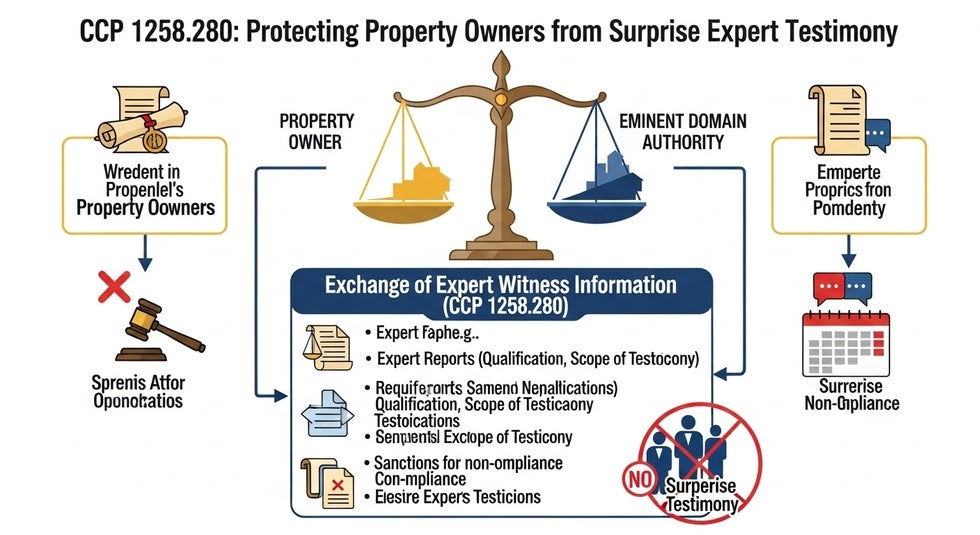
Eminent domain trials are built on a foundation of competing expert opinions. The government brings in its appraiser. The property owner brings in theirs. Both sides argue over what the condemned property is worth, and a judge or jury ultimately decides. It sounds straightforward but in practice, the process can be manipulated by a party that tries to introduce expert testimony or valuation data that was never properly disclosed before trial.
California Code of Civil Procedure Section 1258.280 exists to prevent exactly that. It is a statute with real teeth, and from a defense standpoint, it may be one of the most useful procedural tools available to property owners who have followed the rules.
Understanding how it works, when it applies, and how to invoke it correctly can make the difference between a trial where the government is held to what it actually disclosed and one where it tries to expand its case on the fly.
The Core Principle Behind CCP 1258.280
The statute operates on a straightforward principle: if you were required to exchange expert witness information and you failed to do it properly, you lose the right to use that information at trial. The protection runs specifically in favor of any party who has fully complied with the expert exchange requirements under CCP 1258.230. In other words, if you did your part and served complete, timely lists and valuation statements, you are entitled to hold the other side to the same standard.
This matters enormously for property owners. Government agencies in condemnation cases often have large legal and appraisal teams. The statute ensures that the size and resources of the condemning agency do not translate into a courtroom advantage built on late or incomplete disclosures. Once you have served your materials in compliance with the exchange rules, you have standing to object and CCP 1258.280 gives those objections real force.
Three Layers of Protection for the Defense
The statute creates three distinct but related protections, each targeting a different way that a noncompliant party might try to introduce evidence at trial. Together, they form a comprehensive shield against surprise testimony.
Blocking Undisclosed Expert Witnesses Entirely
The first protection is the broadest. If the government or any other party was required to serve you a list of expert witnesses and failed to include a particular witness on that list, you can object to that witness testifying on direct examination during the case in chief. The court cannot allow that testimony to go forward if the witness's information was not included in the list served on you.
This is significant because the government's case in an eminent domain trial is usually carried by its expert witnesses. If the government's appraiser was not properly listed, or if the government tries to add an expert after the exchange has already occurred without court approval, that witness can be excluded entirely. Losing a key appraiser mid-trial can fundamentally change the government's ability to support its offered compensation figure.
Excluding Opinion Testimony on Undisclosed Valuation Matters
The second protection targets a more subtle form of noncompliance. Even if a witness was listed as an expert, that witness cannot testify on direct examination about any valuation opinion listed under CCP 1258.250 unless a proper statement of valuation data was served for that witness. Listing a witness's name is not enough the substantive valuation opinions that witness plans to offer must have been disclosed in the required statements.
This closes a loophole that a savvy opposing party might try to exploit. Simply getting a witness's name on a list does not unlock the full scope of their testimony. If the government's appraiser was listed but the statement of valuation data provided for that appraiser was incomplete or failed to address a particular valuation theory, the appraiser cannot testify to that undisclosed theory on direct examination. For property owners challenging a government valuation, this creates a meaningful opportunity to limit the scope of what the government's expert can say in court.
To better understand how appraisal methodologies are challenged in condemnation proceedings, explore the Bulldog Law Blog for detailed discussions of how valuation disputes unfold at trial.
Restricting the Specific Opinions and Data a Witness Can Present
The third protection operates at the most granular level. Even for a properly listed expert who has an accompanying statement of valuation data, that witness is still restricted on direct examination to the opinions and data that were actually included in the statement served. Any opinion or piece of data that should have been listed but was not listed cannot come in through direct examination testimony.
There is one important nuance built into the statute here. Testimony that merely explains or elaborates on data that was properly listed is not automatically excluded. The law recognizes that experts cannot reduce every aspect of their analysis to a single line in a document some degree of explanation is inevitable and appropriate.
But there is a meaningful distinction between explaining disclosed data and introducing entirely new data or opinions that were never disclosed at all. That distinction is where the defense has room to draw the line and where a skilled attorney can make targeted objections that shape what the jury ultimately hears.
Invoking the Protection: What the Defense Must Do
CCP 1258.280 does not operate automatically. The protections it provides are triggered upon objection by the complying party. This means your legal team must be paying close attention throughout trial and must be prepared to raise timely, well-grounded objections when the government attempts to elicit testimony that goes beyond what was disclosed.
This requires preparation long before trial begins. Your attorneys need to thoroughly review the government's expert witness list and valuation statements as soon as they are received. Any gaps, omissions, or areas where the disclosed statements fall short of what CCP 1258.250 requires should be identified and documented. Going into trial with a clear map of what the government was and was not allowed to disclose puts your legal team in a strong position to object the moment the government tries to step outside those boundaries.
If you want to understand what a thorough review of government valuation disclosures looks like in practice, the Bulldog Law covers the strategic side of eminent domain litigation in depth.
Why This Statute Rewards Property Owners Who Follow the Rules
There is something fundamentally fair about how CCP 1258.280 is structured. It rewards compliance. A property owner who takes the time to properly prepare and serve complete expert lists and valuation statements earns the right to hold the government to exactly the same standard. The statute does not give either side special treatment it simply says that the rules apply equally, and the party that followed them gets to enforce them.
For property owners, this creates a real incentive to invest in proper preparation from the beginning of the litigation. The more carefully your legal team prepares your exchange materials, the stronger your position is to challenge anything the government failed to properly disclose. And because eminent domain cases almost always come down to competing valuations of property, the ability to limit the government's expert testimony to what was actually disclosed can shift the entire dynamic of the trial in your favor.
A government appraiser who is prevented from testifying to certain comparable sales, or blocked from offering a valuation theory that was absent from the disclosed statements, is a less effective witness. A less effective government witness means a better chance that the jury returns a compensation figure that actually reflects what your property is worth.
Protecting Your Rights Before Trial Even Begins
The strategic value of CCP 1258.280 starts well before you ever walk into a courtroom. It starts the moment the government's expert disclosures arrive. How thoroughly your legal team analyzes those disclosures, how clearly they identify what was and was not properly disclosed, and how prepared they are to object at the right moments in trial all flow directly from the work done in preparation.
Eminent domain is one area of law where procedural precision translates directly into financial outcomes for property owners. Visit the our blog to learn more about how the expert witness rules in California condemnation cases affect what you are ultimately entitled to receive and how a defense focused legal team puts those rules to work for you.
Eminent domain trials are built on a foundation of competing expert opinions. The government brings in its appraiser. The property owner brings in theirs. Both sides argue over what the condemned property is worth, and a judge or jury ultimately decides. It sounds straightforward but in practice, the process can be manipulated by a party that tries to introduce expert testimony or valuation data that was never properly disclosed before trial.
California Code of Civil Procedure Section 1258.280 exists to prevent exactly that. It is a statute with real teeth, and from a defense standpoint, it may be one of the most useful procedural tools available to property owners who have followed the rules. Understanding how it works, when it applies, and how to invoke it correctly can make the difference between a trial where the government is held to what it actually disclosed and one where it tries to expand its case on the fly.
The Core Principle Behind CCP 1258.280
The statute operates on a straightforward principle: if you were required to exchange expert witness information and you failed to do it properly, you lose the right to use that information at trial. The protection runs specifically in favor of any party who has fully complied with the expert exchange requirements under CCP 1258.230. In other words, if you did your part and served complete, timely lists and valuation statements, you are entitled to hold the other side to the same standard.
This matters enormously for property owners. Government agencies in condemnation cases often have large legal and appraisal teams. The statute ensures that the size and resources of the condemning agency do not translate into a courtroom advantage built on late or incomplete disclosures. Once you have served your materials in compliance with the exchange rules, you have standing to object and CCP 1258.280 gives those objections real force.
Three Layers of Protection for the Defense
The statute creates three distinct but related protections, each targeting a different way that a noncompliant party might try to introduce evidence at trial. Together, they form a comprehensive shield against surprise testimony.
Blocking Undisclosed Expert Witnesses Entirely
The first protection is the broadest. If the government or any other party was required to serve you a list of expert witnesses and failed to include a particular witness on that list, you can object to that witness testifying on direct examination during the case in chief. The court cannot allow that testimony to go forward if the witness's information was not included in the list served on you.
This is significant because the government's case in an eminent domain trial is usually carried by its expert witnesses. If the government's appraiser was not properly listed, or if the government tries to add an expert after the exchange has already occurred without court approval, that witness can be excluded entirely. Losing a key appraiser mid-trial can fundamentally change the government's ability to support its offered compensation figure.
Excluding Opinion Testimony on Undisclosed Valuation Matters
The second protection targets a more subtle form of noncompliance. Even if a witness was listed as an expert, that witness cannot testify on direct examination about any valuation opinion listed under CCP 1258.250 unless a proper statement of valuation data was served for that witness. Listing a witness's name is not enough — the substantive valuation opinions that witness plans to offer must have been disclosed in the required statements.
This closes a loophole that a savvy opposing party might try to exploit. Simply getting a witness's name on a list does not unlock the full scope of their testimony. If the government's appraiser was listed but the statement of valuation data provided for that appraiser was incomplete or failed to address a particular valuation theory, the appraiser cannot testify to that undisclosed theory on direct examination. For property owners challenging a government valuation, this creates a meaningful opportunity to limit the scope of what the government's expert can say in court.
To better understand how appraisal methodologies are challenged in condemnation proceedings, explore the Bulldog Law Blog for detailed discussions of how valuation disputes unfold at trial.
Restricting the Specific Opinions and Data a Witness Can Present
The third protection operates at the most granular level. Even for a properly listed expert who has an accompanying statement of valuation data, that witness is still restricted on direct examination to the opinions and data that were actually included in the statement served. Any opinion or piece of data that should have been listed but was not listed cannot come in through direct examination testimony.
There is one important nuance built into the statute here. Testimony that merely explains or elaborates on data that was properly listed is not automatically excluded. The law recognizes that experts cannot reduce every aspect of their analysis to a single line in a document some degree of explanation is inevitable and appropriate. But there is a meaningful distinction between explaining disclosed data and introducing entirely new data or opinions that were never disclosed at all. That distinction is where the defense has room to draw the line and where a skilled attorney can make targeted objections that shape what the jury ultimately hears.
Invoking the Protection: What the Defense Must Do
CCP 1258.280 does not operate automatically. The protections it provides are triggered upon objection by the complying party. This means your legal team must be paying close attention throughout trial and must be prepared to raise timely, well-grounded objections when the government attempts to elicit testimony that goes beyond what was disclosed.
This requires preparation long before trial begins. Your attorneys need to thoroughly review the government's expert witness list and valuation statements as soon as they are received. Any gaps, omissions, or areas where the disclosed statements fall short of what CCP 1258.250 requires should be identified and documented. Going into trial with a clear map of what the government was and was not allowed to disclose puts your legal team in a strong position to object the moment the government tries to step outside those boundaries.
If you want to understand what a thorough review of government valuation disclosures looks like in practice, the Bulldog Law Blog covers the strategic side of eminent domain litigation in depth.
Why This Statute Rewards Property Owners Who Follow the Rules
There is something fundamentally fair about how CCP 1258.280 is structured. It rewards compliance. A property owner who takes the time to properly prepare and serve complete expert lists and valuation statements earns the right to hold the government to exactly the same standard. The statute does not give either side special treatment it simply says that the rules apply equally, and the party that followed them gets to enforce them.
For property owners, this creates a real incentive to invest in proper preparation from the beginning of the litigation. The more carefully your legal team prepares your exchange materials, the stronger your position is to challenge anything the government failed to properly disclose. And because eminent domain cases almost always come down to competing valuations of property, the ability to limit the government's expert testimony to what was actually disclosed can shift the entire dynamic of the trial in your favor.
A government appraiser who is prevented from testifying to certain comparable sales, or blocked from offering a valuation theory that was absent from the disclosed statements, is a less effective witness. A less effective government witness means a better chance that the jury returns a compensation figure that actually reflects what your property is worth.
Protecting Your Rights Before Trial Even Begins
The strategic value of CCP 1258.280 starts well before you ever walk into a courtroom. It starts the moment the government's expert disclosures arrive. How thoroughly your legal team analyzes those disclosures, how clearly they identify what was and was not properly disclosed, and how prepared they are to object at the right moments in trial all flow directly from the work done in preparation.
Eminent domain is one area of law where procedural precision translates directly into financial outcomes for property owners. Learn more about how the expert witness rules in California condemnation cases affect what you are ultimately entitled to receive and how a defense focused legal team puts those rules to work for you.
Your situation may seem hopeless, but you do have rights and defenses. Call immediately at (888) 928-1609 or email our law firm to arrange a free consultation.