
A New Legal Frontier Is Taking Shape
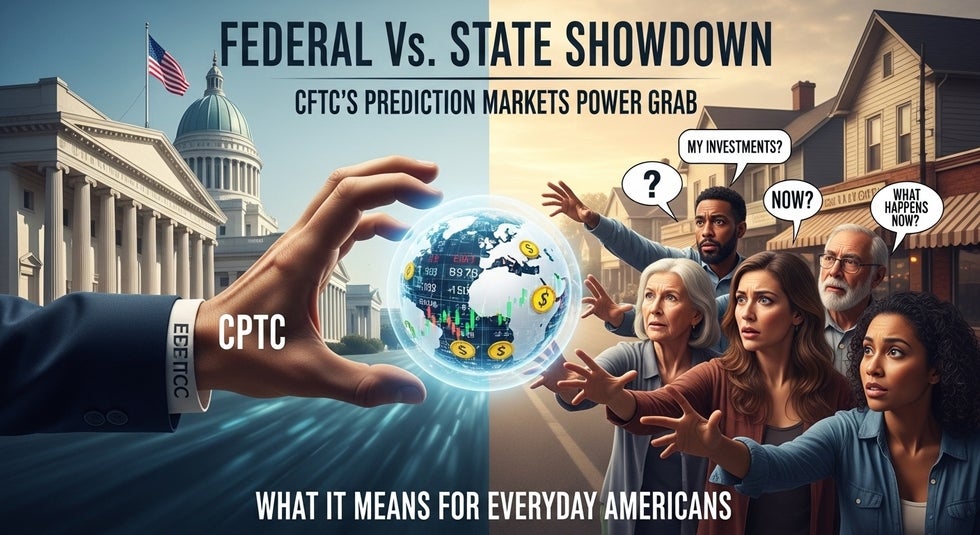
Something significant is happening in the world of financial regulation, and most Americans have no idea it could affect them. The U.S. Commodity Futures Trading Commission (CFTC) has declared war on state governments that are trying to regulate prediction markets, and the legal fallout is just beginning.
CFTC Chairman Mike Selig made his agency's position crystal clear in a video statement posted to X: "To those who seek to challenge our authority in this space, let me be clear, we will see you in court." He backed that statement by filing a legal brief asserting federal jurisdiction over the entire event contract and prediction markets space.
This is not just a turf war between regulators. It is a fast moving legal conflict with real consequences for businesses, consumers, and the states that govern them. At Bulldog Law, we are watching this situation closely because when federal and state authority collide, the people caught in the middle are the ones who need strong legal representation.
What Are Prediction Markets and Why Does This Matter?
Prediction markets are platforms where users buy and sell contracts based on the outcome of future events. These events can range from election results and economic indicators to sports outcomes and weather patterns. Major players in this space include Kalshi and Polymarket, two companies that have grown significantly in recent years.
Selig argues that the CFTC has regulated these markets for more than two decades and that they serve a legitimate social function. He pointed to examples like hedging against rising energy costs or temperature swings. His position is that these are derivative contracts under the Commodity Exchange Act, which gives his agency exclusive jurisdiction.
States see it very differently.
Nevada, Massachusetts, New York, and others have gone after these platforms arguing they are operating sports betting services without proper state licensing. A federal judge in Nevada actually sided with the state in November, ruling that the contracts fall outside the CFTC's proper authority. That ruling is currently under appeal, which means the legal picture is still very much unsettled.
The Politics Behind the Policy
It would be difficult to discuss this regulatory shift without acknowledging the political context surrounding it. Under previous leadership, the CFTC actively fought against companies like Kalshi and Polymarket, arguing their political event contracts were unlawful and contrary to the public interest. Courts pushed back on that position, and when the Trump administration took over and overhauled agency leadership, that legal fight was dropped entirely.
Shortly after, Donald Trump Jr. joined Kalshi as a strategic adviser in early 2025 and later joined Polymarket's advisory board in August. Trump Media and Technology Group, which operates the Truth Social platform, announced it was entering the prediction markets space as well.
Critics have not been subtle about pointing this out. Senator Elizabeth Warren, the ranking Democrat on the Senate Banking Committee, put it bluntly: "The CFTC should focus on ensuring our derivatives markets do not blow up the economy again, not helping corrupt political insiders cash in."
Whether or not you agree with Warren's framing, the regulatory landscape has shifted dramatically in a short period of time, and that shift is now being fought out in courtrooms across the country.
States Are Fighting Back Hard
The pushback from state officials has been swift and forceful. Utah Governor Spencer Cox fired back at Selig directly on X, challenging his characterization of sports outcome contracts as legitimate derivatives. "I do not remember the CFTC having authority over the derivative market of LeBron James rebounds," Cox wrote. He called prediction markets gambling that is destroying lives, particularly among young men, and vowed to fight the federal position in court.
Utah joins a growing chorus of states unwilling to hand over oversight authority without a legal battle. Coinbase, the leading U.S. cryptocurrency exchange, has also stepped into the arena by suing Connecticut, Illinois, and Michigan over those states' efforts to treat sports event contracts as gambling products subject to state gaming laws.
The result is a patchwork of overlapping legal claims, conflicting court rulings, and regulatory uncertainty that is only going to grow more complicated before it gets resolved.
Why This Legal Battle Affects More Than Just Big Platforms
You might be thinking this is a fight between regulators and billion dollar technology companies, and it has nothing to do with you. Think again.
The outcome of this jurisdictional battle will determine which consumer protections apply to prediction markets, who enforces those protections, and what remedies are available when something goes wrong. State gaming regulations tend to include stronger consumer safeguards, problem gambling resources, and enforcement mechanisms. Federal commodity regulations are structured differently and may leave gaps in protection for everyday users.
If you or someone you know has experienced financial harm through a prediction market platform, the question of whether state or federal law applies could determine whether you have a viable legal claim and where you can pursue it. This is exactly the kind of complex, evolving legal situation where having experienced counsel in your corner makes all the difference.
At Bulldog Law, we stay on top of these regulatory developments because our clients deserve representation that is current, informed, and strategic. If you want to understand more about how financial regulation intersects with consumer rights, our blog covers these issues regularly.
What Comes Next and How Bulldog Law Can Help
Selig has announced that the CFTC is pursuing a formal rulemaking process to establish new policies around prediction markets. He says the new rules will be grounded in a rational interpretation of the Commodity Exchange Act and designed to promote responsible innovation. But rulemaking takes time, court battles take longer, and the people affected by these platforms are dealing with real financial and personal consequences right now.
If you are a business operating in or adjacent to the prediction markets space, you need to understand your compliance obligations at both the state and federal level. If you are a consumer who has suffered losses on one of these platforms, you need to know what legal options are available to you and in which jurisdiction those claims can be pursued.
The federal versus state conflict at the heart of this story is not going to be resolved quickly. What we do know is that the legal arguments are becoming more sophisticated, the stakes are getting higher, and ordinary Americans need advocates who understand both sides of the regulatory divide.
Bulldog Law is built for exactly these kinds of fights. Our team understands how financial regulation, consumer protection law, and jurisdictional disputes intersect, and we know how to navigate that complexity on behalf of real people facing real problems.
Reach Out to Bulldog Law Today
If the growing prediction markets legal battle touches your life in any way, whether you are a business owner, an investor, or a consumer trying to understand your rights, do not wait for the courts to sort it out on their own. Contact Bulldog Law today for a consultation and let us help you understand where you stand and what your options are.