
Updated November 2026 | The Bulldog Law | California Criminal Defense
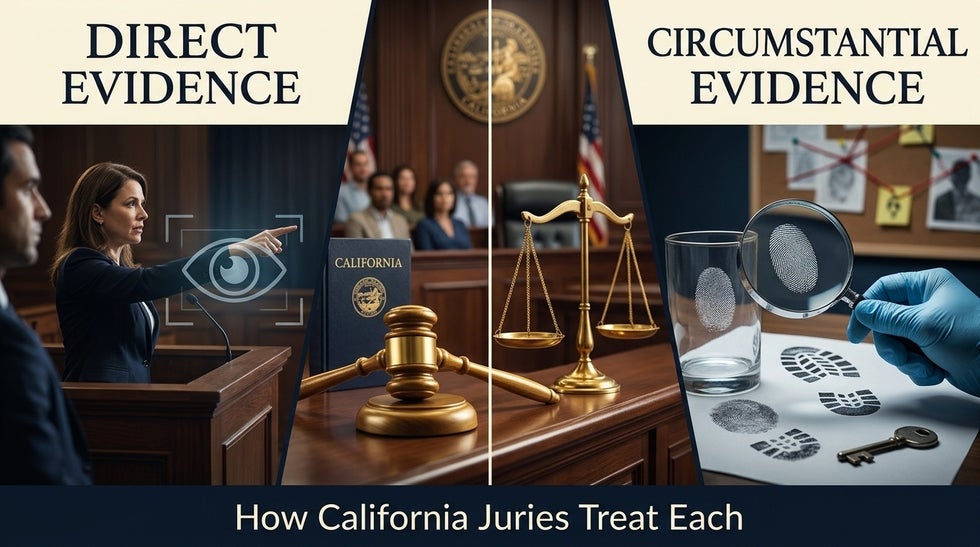
Direct evidence proves a fact outright: a witness saw it, a camera recorded it, or the defendant admitted it. Circumstantial evidence proves some other fact and asks the jury to infer the one that matters. Both can support a conviction, and the law does not treat one as better than the other. California adds a protection that federal courts do not: when the prosecution relies on circumstantial evidence and the facts allow two reasonable conclusions, one pointing to innocence, the jury must accept the one pointing to innocence.
Most criminal cases our attorneys defend are circumstantial at least in part, because the most important question, what the person intended, can almost never be proved any other way. Understanding the distinction shows where a case can be contested.
The two kinds of evidence
California's Evidence Code defines both. Under Evidence Code 410, direct evidence is evidence that directly proves a fact, without an inference or presumption, and which in itself, if true, conclusively establishes that fact. Under Evidence Code 600, an inference is a deduction of fact that may logically and reasonably be drawn from another fact. Circumstantial evidence is evidence that works through such an inference. The Legal Information Institute describes it as evidence that is not drawn from direct observation of a fact in issue.
California jurors hear a simple illustration. If a witness testifies that it was raining outside, that is direct evidence that it was raining. If a witness testifies that someone came inside wearing a raincoat covered with drops of water, that is circumstantial evidence that it was raining.
Which is which
|
Evidence |
Type |
Why |
|
Eyewitness who saw the act |
Direct |
Proves the act if believed; still subject to mistake |
|
Video or audio recording of the act |
Direct |
Shows the event itself |
|
Confession or admission |
Direct |
The defendant's own account of the act |
|
Fingerprints at the scene |
Circumstantial |
Proves contact with a surface, not when or why |
|
DNA on an object or person |
Circumstantial |
Proves presence of biological material, not conduct |
|
Cell tower or GPS location records |
Circumstantial |
Proves where a device was, not who held it or what happened |
|
Possession of recently stolen property |
Circumstantial |
Supports an inference of theft; other explanations exist |
|
Video of a person near the scene |
Circumstantial |
Proves presence in the area only |
|
Motive, threats, or prior arguments |
Circumstantial |
Supports an inference of intent or identity |
|
Flight, hiding evidence, false statements to police |
Circumstantial |
Offered as consciousness of guilt |
|
Internet searches, messages, financial records |
Circumstantial |
Support inferences about planning, knowledge, or intent |
The same item can be direct evidence of one fact and circumstantial evidence of another. A surveillance video is direct evidence that a person entered a store at 9:02 p.m. and circumstantial evidence that the person committed the robbery that occurred at 9:05.
Is one stronger than the other?
The law says no. Jurors are instructed that both are acceptable types of evidence to prove or disprove the elements of a charge, including intent and mental state, and that neither is necessarily more reliable than the other. The United States Supreme Court said the same in Holland v. United States, observing that circumstantial evidence is intrinsically no different from testimonial evidence.
Experience supports the rule. Direct evidence depends on the honesty, perception, and memory of a person, and mistaken eyewitness identification has contributed to a large share of convictions later overturned by DNA. Circumstantial evidence does not misremember, but it has a different weakness: the inference. Every piece of circumstantial evidence proves a small fact, and the question is always what else that fact is consistent with.
California's rule for circumstantial cases
California gives juries specific directions when the prosecution's case rests substantially on circumstantial evidence.
- Before relying on circumstantial evidence to conclude that a fact necessary for guilt has been proved, the jury must be convinced that the prosecution has proved each fact essential to that conclusion beyond a reasonable doubt.
- Before relying on circumstantial evidence to find the defendant guilty, the jury must be convinced that the only reasonable conclusion supported by the evidence is that the defendant is guilty.
- If the jury can draw two or more reasonable conclusions from the circumstantial evidence, and one of them points to innocence and another to guilt, it must accept the one that points to innocence.
- The jury must accept only reasonable conclusions and reject any that are unreasonable.
A parallel instruction applies the same reasoning to proof of intent or mental state. Federal courts do not give this instruction; a federal jury is told only about reasonable doubt. For a person charged in California state court, the two-conclusions rule is a real advantage, and a judge's failure to give it when the case is circumstantial can be grounds for reversal.
Intent is almost always circumstantial
No witness can see into a person's mind. Unless the defendant announced a purpose, criminal intent is proved from conduct and circumstances: what the person did before, during, and after; what tools were carried; what was said; how the act was carried out. That is why so many trials turn on inference even when the physical act is on video. A person is recorded leaving a store with merchandise. Whether that is theft depends on intent, and intent depends on circumstances such as whether the item was concealed and whether the person passed the registers.
Consciousness of guilt
Prosecutors often rely on what a person did after the event. California juries may be told that flight, hiding or destroying evidence, attempting to influence a witness, or making false statements may show awareness of guilt. The same instructions carry limits that the defense emphasizes: such conduct cannot prove guilt by itself, and it is for the jury to decide its meaning and importance. People run, lie, and panic for reasons that have nothing to do with the crime charged, including fear of the police, immigration status, an unrelated warrant, or embarrassment.
Convictions on circumstantial evidence alone
A conviction can rest entirely on circumstantial evidence. California courts have upheld murder convictions where no body was recovered, no weapon was found, and no one saw the killing. On appeal, the question is whether substantial evidence supports the verdict, and the reviewing court will not substitute its own inferences for the jury's. That makes the trial the place where a circumstantial case has to be won.
One related safeguard applies to direct evidence. Under the corpus delicti rule, a defendant's own statements are not enough; some independent evidence must show that a crime was committed.
How a circumstantial case is defended
- **Offer the other reasonable conclusion.** The defense does not have to prove an alternative. It has to show one that is reasonable on the evidence: a fingerprint left on an earlier visit, a phone carried by someone else, DNA transferred by contact.
- **Attack the underlying facts.** An inference is only as good as the fact it starts from. Forensic evidence can be mistaken, contaminated, or overstated, and location data has margins of error measured in miles.
- **Break the chain.** A circumstantial case is a series of inferences. If one link fails, the conclusion that depends on it fails too.
- **Explain the conduct afterward.** Give the jury the innocent reason for leaving, for the inconsistent statement, or for the deleted messages.
- **Insist on the instruction.** Make sure the jury is told about the two-conclusions rule and argue the case in its terms.
- **Challenge sufficiency.** Where the inferences are speculative, a motion for acquittal at the close of the prosecution's case asks the judge to end it.
Thin or purely inferential proof on a required element is one of the signs a case will be dismissed or reduced.
Frequently asked questions
What is circumstantial evidence?
Circumstantial evidence is evidence of a fact from which another fact can be inferred. It does not prove the disputed fact directly. A fingerprint on a window proves the person touched the window; a jury must infer from that, and from other facts, that the person committed the burglary. It is also called indirect evidence.
What is the difference between direct and circumstantial evidence?
Direct evidence proves a fact without any inference: an eyewitness who saw the act, a recording of it, or a confession. Circumstantial evidence proves a different fact from which the jury is asked to draw a conclusion. The standard example is rain: a witness who saw rain falling gives direct evidence that it rained; a witness who saw someone walk in wearing a wet raincoat gives circumstantial evidence of the same thing.
Can you be convicted on circumstantial evidence alone?
Yes. California and federal courts allow a conviction based entirely on circumstantial evidence, including in murder cases where no body was found. The law does not rank one kind of evidence above the other. In California, however, a jury relying on circumstantial evidence must be convinced that the only reasonable conclusion is guilt.
Is circumstantial evidence weaker than direct evidence?
Not as a matter of law, and often not in fact. Eyewitness identification is direct evidence and is one of the leading causes of wrongful convictions. DNA and fingerprints are circumstantial and can be very strong. The strength of circumstantial evidence depends on how many reasonable explanations the facts allow.
Is DNA direct or circumstantial evidence?
Circumstantial. DNA shows that a person's biological material was on an object or at a place. It does not show when it got there, how, or what the person did. The same is true of fingerprints, cell phone location records, and gunshot residue.
What are examples of circumstantial evidence?
Fingerprints or DNA at a scene, possession of recently stolen property, cell tower and GPS records, surveillance video of a person near the scene, motive, threats made earlier, flight after the event, false statements to police, internet searches, financial records, and the absence of forced entry.
What is the circumstantial evidence jury instruction in California?
Jurors are told that before they may rely on circumstantial evidence to find a fact necessary for guilt, the prosecution must have proved each fact essential to that conclusion beyond a reasonable doubt, and that if they can draw two or more reasonable conclusions and one points to innocence, they must accept the one pointing to innocence. They must reject unreasonable conclusions.
Is a confession direct evidence?
Yes. A defendant's admission that he or she committed the act is direct evidence. California adds a safeguard: a person cannot be convicted on his or her own statements alone. There must be some independent evidence that a crime occurred.
Related reading from our attorneys
- Presumption of innocence and reasonable doubt
- The corpus delicti rule in California
- Forensic evidence in criminal cases: its role and limits
Charged on inference? The other reasonable explanation is the defense
The Bulldog Law's criminal defense attorneys take apart circumstantial cases fact by fact and make sure juries are told the rule that favors the accused. Call (888) 928-1609 or reach us online.