
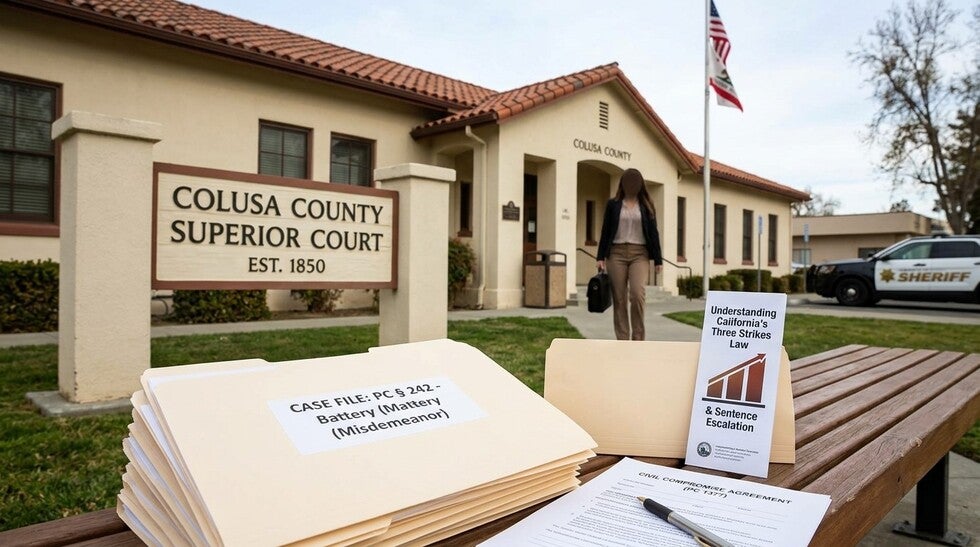
One fight. One bad moment. And suddenly you are staring at a criminal charge that could follow you for the rest of your life. Assault and battery charges in Colusa County are serious, especially when a farm tool, a piece of equipment, or any nearby object gets labeled a deadly weapon by the prosecutor. I have seen good, hardworking people in this county lose sleep over charges that had real solutions. The right defense changes everything, and knowing your options early is the most powerful thing you can do right now.
The Escalation From Misdemeanor Battery to Felony Strike
in Colusa County Depends on One Legal Question Was the Object Used as a Deadly Weapon? but the Resolution That Best Serves the Defendant Looks Different in the Sikh Community Where Civil Compromise Serves Ongoing Gurdwara and Family Relationships, in the 22,000-Person Community Where the Parties Will Continue to Encounter Each Other, and in the Agricultural Workplaces Dense With Tools.
One question sits at the center of almost every assault case in Colusa County, was any object near the fight actually used as a deadly weapon?
That answer decides everything. It decides whether you face a small misdemeanor or a serious felony. It decides whether you carry a permanent strike on your record for the rest of your life.
Simple battery under PC § 242 is a misdemeanor. Up to six months in jail. No strike. That is serious, but it is something a good defense can work with.
PC § 245 assault with a deadly weapon, or force likely to cause serious bodily injury, is a completely different situation. It is what lawyers call a "wobbler." That means the prosecutor can charge it as either a misdemeanor or a felony. As a felony, it can bring up to four years in prison and a permanent serious felony strike that never goes away.
The difference comes down to one thing. The prosecutor must prove that a specific object was actually used, or directly and clearly threatened to be used, in a way that could cause real serious harm. Just being near the object is never enough. The law is very clear on that.
In Colusa County, two situations come up often. The Punjabi Sikh community and the wider 22,000-person small county community both produce battery cases where civil compromise is often the smartest solution. And the county's farms and agricultural workplaces produce confrontations where prosecutors try to turn everyday tools into deadly weapons, and we fight those charges hard.
Small-County and Sikh Community Civil Compromise
Civil compromise serving ongoing community relationships in Colusa County: Here is something that surprises a lot of people. Some battery cases in Colusa County can be fully dismissed, no conviction, no record, nothing on your background check. The legal path that makes this possible is called civil compromise, and it is especially powerful in a small, tight-knit community like this one.
Think about what life looks like in a county of 22,000 people. The other person in your case might be your neighbor, your coworker on the same farm, or someone from the same Gurdwara your family has attended for years. The criminal case will end one day, but your life in this community goes on. You will see these people again. Your families will cross paths. A long court battle often makes everything harder for everyone.
For the Punjabi Sikh community in Colusa County, this matters even more. The same Gurdwara congregations, the same extended family networks that stretch across the whole Sacramento Valley, the same relationships that connect families for generations, all of this continues after any court case ends. Civil compromise lets both sides move forward without a conviction dividing the community.
Under PC § 1377, a misdemeanor battery charge can be fully dismissed when the other party gets fair payment and tells the Colusa County Superior Court at 532 Oak Street in Colusa that they are satisfied. Full dismissal. No conviction. No record.
I once spoke with a farm worker in Colusa County who had a confrontation with a coworker he had known for three years. Both families knew each other. The last thing either of them wanted was a conviction that would damage that relationship forever. Civil compromise was the right answer, and it protected both of them.
We check for civil compromise eligibility at the very first meeting in every qualifying Colusa County battery case. If this option is available for you, we will find it.
Agricultural Workplace Tools The Deadly Weapon Challenge
Colusa County grows rice, almonds, walnuts, and tomatoes. That means farm workers across this county work every single day surrounded by harvest tools, pruning equipment, irrigation tools, and all kinds of agricultural equipment. And when a confrontation happens on a farm, between workers, between crew members, or anywhere on an agricultural operation, prosecutors sometimes try to turn those everyday work tools into deadly weapons.
Here is the truth the law actually says. A harvest tool sitting on the ground near a fight is not a deadly weapon. A pruning tool leaning against a fence during an argument is not a deadly weapon. An irrigation tool in the field is not a deadly weapon. The law requires the prosecutor to prove that the specific tool was actually used, or directly and clearly threatened to be used, in a way that could cause serious harm. Being nearby does not count.
We challenge every Colusa County agricultural workplace deadly weapon charge at the Oak Street courthouse by looking at exactly what happened, not what tools happened to be in the area.
For H-2A workers and any non-citizen workers in Colusa County, this challenge is even more urgent. A PC § 245 felony conviction can be treated as a crime of violence under immigration law, what is called an "aggravated felony", which can lead to serious immigration consequences. A simple misdemeanor battery conviction carries far less immigration risk. We treat the deadly weapon challenge as an immigration defense priority in every case involving non-citizen workers.
Self-Defense Evidence
If you were defending yourself, time is working against you right now. Evidence does not wait.
The very first thing to do after a Colusa County assault arrest is take photos of your own injuries. Bruises fade within hours. Marks that are clear today can be almost gone by tomorrow morning. Take photos immediately, with timestamps on your phone.
Body camera footage from Colusa County Sheriff deputies, Colusa PD, and Williams PD gets deleted after a short period of time. We request that footage right away so it cannot disappear before we can use it.
We also build the full picture of everything between you and the other person. What happened before the incident? What is the history? What did every witness see? All of this is collected from day one, because in self-defense cases, the full story is everything.
The Courthouse
Your Colusa County assault or battery case will be heard at: Colusa County Superior Court 532 Oak Street, Colusa, CA 95932 We work at this courthouse regularly and know its processes, its prosecutors, and how to move your case forward effectively.
After an Assault Arrest in Colusa County
Here it is written in both bullets and paragraphs:
The steps you take right after your arrest matter more than most people realize. Every hour counts. Evidence fades, witnesses forget, and footage gets deleted faster than you think. Here is exactly what to do.
-
Take photos of your injuries right now. This is the single most time-sensitive step. Do it before you do anything else, even before you make phone calls.
-
Write down every witness name you can remember. Anyone who saw the fight or knows the history between you and the other person. We need their accounts while everything is still fresh.
-
Think carefully about every object near the fight. Did you touch it? Pick it up? Even say anything about it? That detail is central to the PC § 245 deadly weapon question, and it can be the difference between a misdemeanor and a felony.
-
If the other person is someone you have a continuing relationship with, a neighbor, a Gurdwara community member, a coworker, ask us about civil compromise eligibility at your very first meeting. It could mean full dismissal with nothing on your record.
-
If this happened on a farm or worksite, write down exactly which tools were present and where they were. Then contact us right away about challenging the deadly weapon charge.
-
If you are an H-2A worker or any kind of non-citizen, call us immediately. The immigration consequences of a felony charge are serious, and acting fast gives you the best options.
Colusa County: Colusa County office | Colusa: Colusa office | Williams: Williams office | (888) 928-1609
Final Thoughts on Assault and Battery Charges in Colusa County
Facing an assault or battery charge in Colusa County is frightening. But it does not have to end badly.
In a county this small, the right defense is not just about the courtroom. It is about your job, your community, your family, and your future. Whether you work on a farm, worship at a Gurdwara, or simply live here and want to protect your record, the options available to you depend on acting fast and getting the right help.
I have seen cases that looked serious from the outside end with full dismissals through civil compromise. I have seen deadly weapon charges against farm workers get knocked down to misdemeanors because we showed exactly what really happened. Every detail in your case matters, and every detail can work in your favor.
Do not wait. Photos fade. Footage gets deleted. Witnesses forget. The sooner we start building your defense, the more options you have on the table.
Call (888) 928-1609 or visit The Bulldog Law today. We are here to help you through this.
For more on small-county and Sikh community civil compromise serving ongoing relationships, agricultural workplace tool PC § 245 deadly weapon challenges, H-2A immigration considerations, self-defense evidence, and assault defense at the Colusa County Superior Court in Colusa, visit The Bulldog Law criminal defense blog.
FAQ's
How does civil compromise work in Colusa County's small and Sikh communities?
Civil compromise under PC § 1377 is available for misdemeanor battery when the other party gets fair payment and tells the Colusa County Superior Court at 532 Oak Street that they are satisfied. The result is full dismissal, no conviction, no record, nothing on your background check.
In Colusa County's 22,000-person community and Punjabi Sikh agricultural community, people involved in battery cases almost always continue to live and work near each other. The same Gurdwara. The same farms. The same family networks. A long court battle damages those relationships for everyone. Civil compromise lets both sides move forward with dignity.
We check for civil compromise eligibility at the very first consultation in every qualifying Colusa County battery case.
Can agricultural workplace tools be charged as deadly weapons in Colusa County?
Only if the tool was actually used, or directly and clearly threatened to be used, in a way likely to cause serious harm. A harvest tool, a pruning tool, or an irrigation tool that was simply present near a fight is not a deadly weapon under the law. The prosecutor has to prove what was actually done with the specific tool, not just that it was nearby.
We challenge every Colusa County agricultural workplace deadly weapon charge at the Oak Street courthouse through the real evidence of what actually happened.
For H-2A workers and non-citizen workers, this challenge is an immigration defense priority. A PC § 245 felony can carry serious immigration consequences. A simple misdemeanor battery carries far less risk. We fight to keep cases at the misdemeanor level in every agricultural workplace case involving non-citizen workers.
What makes the difference between misdemeanor battery and felony assault in Colusa County?
Simple battery under PC § 242 is a misdemeanor with no strike. PC § 245 assault with a deadly weapon, or force likely to produce great bodily injury, is a wobbler that can bring up to four years in prison and a permanent serious felony strike.
The difference comes down to whether the prosecutor can prove a specific object was actually used, or directly threatened to be used, in a way that could cause serious harm. The object just being present is never enough.
We challenge every deadly weapon charge through the real evidence of what happened. Our goal is always to keep the case at the misdemeanor level, protect you from a permanent strike, and where both parties have an ongoing community relationship, to get the case resolved through civil compromise.
What should I do right away if I was arrested for assault in Colusa County?
Move fast. Take photos of any injuries on your body right now, before bruises fade. Write down every witness name you can remember. Think about every object near the confrontation and whether you touched it or not.
If you are an H-2A or non-citizen worker, call us immediately, the immigration side of a felony charge needs to be addressed right away. If the other person is someone you have a community relationship with, ask about civil compromise at the first consultation.
Call (888) 928-1609 as soon as possible. Every hour matters when it comes to protecting evidence.
Does a battery conviction affect immigration status in Colusa County?
It can, and seriously. For H-2A workers and other non-citizens, a PC § 245 felony assault with a deadly weapon conviction can be treated as a crime of violence under immigration law. That category, called an "aggravated felony", can lead to major immigration consequences.
A simple misdemeanor battery under PC § 242 carries far less immigration risk. That is why the deadly weapon challenge is an immigration defense priority in every Colusa County case involving non-citizen workers. We fight to keep the charge at the misdemeanor level from day one.