
Three Distinct Contexts.
The Sacramento and Colusa National Wildlife Refuge Waterfowl Hunting Season Transport. The Rice Country Ranching Community's Firearms Culture. The Lautenberg Trap in a County Where Firearms Are a Routine Part of Agricultural and Hunting Life.
You finished a waterfowl hunt on the Sacramento National Wildlife Refuge. You drove your farm truck down Highway 20 the same way you have done for years, shotgun in the back. Or you were passing through Colusa County on I-5 with a firearm and an out-of-state permit you thought covered you. And then the lights came on. A weapons charge in Colusa County can blindside people who have done nothing that felt wrong, because the rules change the exact moment your tires hit a California public road. I have seen this happen to good hunters and hardworking ranchers who genuinely did not know the line existed. The right defense starts with understanding exactly where that line is.
The Only Legal Way to Transport a Firearm in Colusa County
California's PC § 25400 concealed carry prohibition applies uniformly throughout Colusa County, on Interstate 5, on Highway 20 and Highway 45 through the rice country, and on every California public road.
The statute creates no exceptions. Not for the waterfowl hunter returning home from the Sacramento National Wildlife Refuge. Not for the rancher who has carried a rifle in the same truck for thirty years. Not for the visitor passing through with an out-of-state CCW permit.
The only legal transport is simple but strict, an unloaded firearm stored in a locked container, separated from ammunition, and not reachable from the passenger compartment. Everything else is potential criminal exposure.
The defense in every Colusa County weapons case begins in two places: the constitutional validity of the stop itself, and the specific hunting or agricultural context that surrounds it.
National Wildlife Refuge Waterfowl Hunting, Federal Land Transport
Federal land firearms rules and the Colusa County waterfowl hunting season
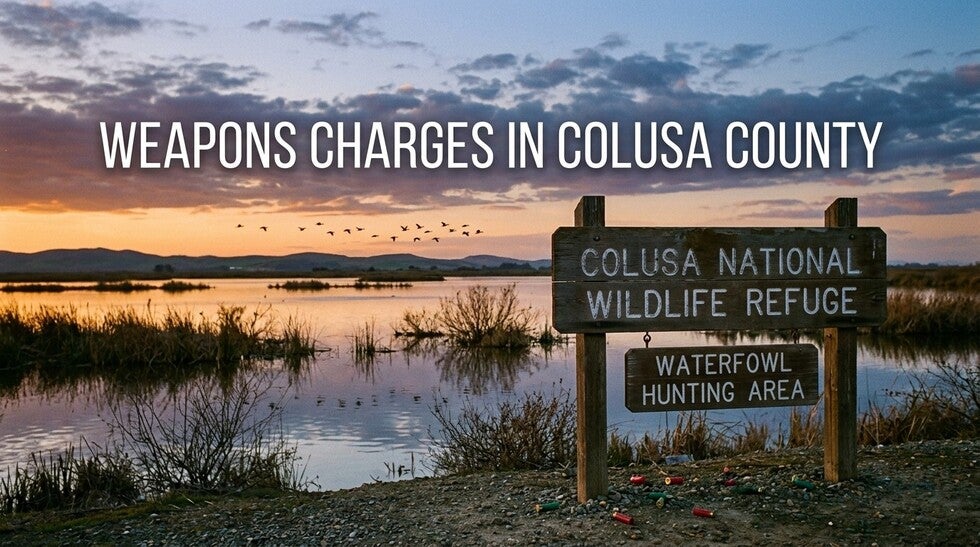
The Sacramento National Wildlife Refuge and the Colusa National Wildlife Refuge are among California's best waterfowl hunting destinations. Duck and goose hunters from across the region come to the Sacramento Valley flyway throughout the season, and these are federal lands managed by the U.S. Fish and Wildlife Service, operating under federal regulations and refuge-specific hunt programs.
Here is where things get confusing fast. When you are on the refuge during a legal licensed waterfowl hunt, you are operating under the federal refuge hunt framework. Federal rules apply. A loaded shotgun during a legal hunt on federal refuge land is not a problem.
But the moment you load your shotgun into your truck and pull onto Highway 20 or I-5 for the drive home, California law takes over completely. Unloaded. Locked container. Separated from ammunition. A loaded or improperly stored shotgun on that drive home is a PC § 25400 violation, even if you just left the refuge five minutes ago.
I once had a client who had hunted the Sacramento National Wildlife Refuge every season for over a decade. He had his federal duck stamp, his refuge reservation, his California hunting license, everything exactly right. And on the way home, a routine stop turned into a weapons charge because his shotgun was not stored correctly in the cab. He had no idea the rules changed the second he left refuge land. That is exactly the kind of case we handle.
The specific location of every Colusa County hunting-related firearms contact determines which legal framework applies. Were you on the refuge during the hunt, or already on a California public road heading home? That one question changes everything. We confirm jurisdiction and the transport circumstances at the very first meeting in every waterfowl hunting season firearms case at the Oak Street courthouse.
A valid California hunting license, the required federal duck stamp, state validations, a refuge hunt reservation where applicable, and a clean prior record all give us strong context to work with at the Colusa County Superior Court. We combine that hunting community context with every available constitutional challenge to the stop itself.
According to the U.S. Fish and Wildlife Service, firearms for lawful licensed hunting are permitted on national wildlife refuges subject to applicable federal and state regulations, with California's transport requirements applying once hunters return to public roads.
The Rice Country Ranching Community Firearms Culture
Out in Colusa County's rice country, the farms, ranches, and rural properties that define this agricultural community, carrying a rifle in the farm or ranch truck is simply part of daily life. Wildlife management. Predator control protecting livestock and crops. Checking remote corners of a large agricultural property. These are real, practical needs that farmers and ranchers here have had for generations.
The problem is straightforward but catches people off guard. The moment that truck rolls onto a public road, even just to reach a neighboring field or drive to the feed store in town, California's transport rules apply in full. A farmer who has carried the same rifle in the same truck on the same property for thirty years is technically violating PC § 25400 the second those tires hit a public road.
Honestly, most farmers and ranchers have never given this a second thought. Why would they? Their whole life operates on private agricultural land. The law feels distant until the day of a traffic stop.
The good news is that good-faith agricultural purpose, a legitimate wildlife management reason, and a clean prior record all provide real context we work with at the Oak Street courthouse. We combine that ranching community background with a full constitutional challenge to the validity of the stop in every applicable case.
The Lautenberg Trap in Colusa County
Here is something that catches people completely off guard, and it is serious. Under 18 U.S.C. § 922(g)(9), known as the Lautenberg Amendment, a prior domestic violence conviction permanently bans you from owning or possessing a firearm. Misdemeanor or felony. From any court. At any time in your life. Even decades ago.
And here is the part that surprises most people. Even if California restored your firearms rights at the state level, the federal Lautenberg prohibition still applies independently. Two completely separate systems. California giving your rights back does not touch the federal ban.
This matters enormously in Colusa County, where waterfowl hunting at the refuges, ranching the rice country, and protecting rural property make firearms a routine part of everyday life. When a traffic stop on I-5, Highway 20, or anywhere in the county turns up a firearm alongside a prior qualifying domestic violence conviction, the state PC § 25400 charge suddenly has a serious federal layer underneath it. Mandatory minimum sentences in the Eastern District of California, not at the Oak Street courthouse.
We identify Lautenberg exposure at the very first consultation in every applicable Colusa County weapons case, before any statement is made that could create additional federal exposure on top of the state charge.
According to the U.S. Department of Justice, the Lautenberg Amendment permanently prohibits firearm possession by anyone convicted of a qualifying misdemeanor domestic violence offense under federal law, regardless of state firearms rights restoration.
Federal vs. California Firearms Rules in Colusa County, At a Glance
Most people do not realize how sharply the rules change depending on exactly where you are. Here is a simple breakdown of the key situations:
|
Situation |
Location |
Rules That Apply |
Legal? |
|
Carrying loaded shotgun during waterfowl hunt |
Sacramento or Colusa National Wildlife Refuge federal land |
Federal U.S. Fish and Wildlife rules |
✅ Yes, with valid license, duck stamp, and refuge reservation |
|
Driving home with loaded shotgun after hunt |
California public road, Highway 20 or I-5 |
California PC § 25400 |
❌ No, must be unloaded and locked |
|
Farmer carrying rifle on private agricultural property |
Private farm or ranch land |
No transport restriction |
✅ Yes |
|
Farmer driving rifle to feed store or neighboring field |
Public road in Colusa County |
California PC § 25400 |
❌ No, must be unloaded and locked |
|
Prior DV conviction, possessing any firearm |
Anywhere |
Federal Lautenberg — 18 U.S.C. § 922(g)(9) |
❌ No, permanent federal ban |
|
Out-of-state CCW permit holder driving through |
California public road |
California law, no exceptions |
❌ No, out-of-state permits not valid in California |
The simple rule: the moment you are on a California public road, California law applies, no matter what you were just doing on federal refuge land.
The Courthouse
Your Colusa County weapons case will be heard at:
Colusa County Superior Court 532 Oak Street, Colusa, CA 95932
We work at this courthouse regularly and know the local prosecutors, the local judges, and how to build the strongest possible defense for your specific situation.
After a Weapons Arrest in Colusa County
The steps you take right after a weapons arrest in Colusa County can seriously affect how your case turns out. Here is exactly what to do:
-
Do not make any statement about the firearm, its purpose, or how it was stored, not without an attorney present first. In Lautenberg situations especially, anything you say can create immediate federal exposure on top of the state charge.
-
Write down exactly how the firearm was stored at the time of the stop. Was it in a locked container? Where in the vehicle? Was it loaded? Where was the ammunition? Every detail matters.
-
If you have any prior domestic violence conviction, from any court, at any time, even decades ago, contact us immediately about Lautenberg federal exposure before you do anything else.
-
If you hold a valid hunting license, federal duck stamp, and refuge hunt reservation, save all of that documentation right now. Your credentials give us powerful context at the Oak Street courthouse.
-
If the contact related to a refuge waterfowl hunt, write down exactly where you were at the moment of the stop. Were you still on the Sacramento or Colusa National Wildlife Refuge federal land? Or were you already on a California public road? That location detail can change your entire case.
-
Call (888) 928-1609 now. The sooner we start building your defense, the more options you have.
Colusa County: Colusa County office | Colusa: Colusa office | Williams: Williams office | (888) 928-1609
Final Thoughts on Weapons Charges in Colusa County
A weapons charge in Colusa County does not mean you are a criminal. For most people we work with, it was a genuine misunderstanding about where federal refuge rules end and California law begins. A waterfowl hunter who did everything right on the refuge, valid license, duck stamp, refuge reservation, but did not know the rules flipped the moment he drove onto the highway. A farmer who has carried the same rifle in the same truck for thirty years without ever thinking about it.
But the law does not grade on good intentions or long habits. And the Lautenberg trap especially, turning what looks like a minor state charge into a serious federal case with mandatory minimums, can catch people completely off guard years after they thought a past conviction was behind them.
The right defense starts with two things: the exact location of the contact and the full context surrounding it. Your hunting credentials. Your agricultural purpose. The constitutional validity of the stop. And in any case involving a prior domestic violence conviction, the Lautenberg exposure needs to be identified and addressed before any statement is made.
I would love to hear from you about your specific situation. Every Colusa County weapons case has details that matter, and every detail can work in your favor.
Call (888) 928-1609 or visit The Bulldog Law today. We are ready to help.
Weapons Defense Questions in Colusa County
Can Colusa County waterfowl hunters be charged for transporting a loaded shotgun?
Yes, on any California public road. California's transport rules apply on every public road no matter what. A valid hunting license, federal duck stamp, and refuge hunt reservation do not create an exemption.
A hunter who finishes a waterfowl hunt on the Sacramento National Wildlife Refuge and drives home on Highway 20 or I-5 with a loaded or improperly stored shotgun is violating PC § 25400, even if everything was perfectly legal on federal refuge land five minutes earlier.
Your valid credentials are strong context at the Colusa County Superior Court in Colusa. They are not a legal excuse, but they shape how the case gets resolved. We use that hunting community context alongside every available constitutional challenge to the stop itself.
How do National Wildlife Refuge firearms rules differ from California's transport requirements?
The Sacramento and Colusa National Wildlife Refuges are federal lands managed by the U.S. Fish and Wildlife Service. Firearms possession for lawful licensed waterfowl hunting operates under the federal refuge hunt framework on those lands.
California's transport requirements, unloaded, locked container, separated from ammunition, apply on California public roads. The critical line is between the refuge and the public road. On federal refuge land during a legal hunt, federal rules. On a public highway heading home, California rules.
The exact location of the firearms contact determines which legal framework applies. We confirm that specific location at the very first meeting in every Colusa County hunting-related firearms case at the Oak Street courthouse.
How does Lautenberg exposure work in Colusa County?
A prior domestic violence conviction, misdemeanor or felony, from any court, at any time, permanently bans firearms possession under 18 U.S.C. § 922(g)(9). This applies even if the conviction was decades ago. Even if you believed it was fully behind you. Even if California restored your firearms rights at the state level.
When a traffic stop in Colusa County turns up a firearm alongside a prior qualifying domestic violence conviction, the state PC § 25400 charge now has a serious federal Lautenberg layer underneath it, with mandatory minimum sentences in the Eastern District of California.
We identify Lautenberg exposure at the very first consultation, before any statement is made that could create more federal problems on top of the state charge.
What is the only legal way to transport a firearm in Colusa County?
Clear and strict. Your firearm must be unloaded. It must be stored in a locked container. It must be fully separated from your ammunition. And it must not be reachable from the passenger compartment of the vehicle.
No exceptions for hunters returning from the refuges. No exceptions for farmers and ranchers. No exceptions for out-of-state CCW permit holders. On any California public road in Colusa County, all four of those conditions must be met. If even one is missing, you are facing a potential PC § 25400 charge. When in doubt, unload it and lock it before you drive. Every single time.
Does an out-of-state CCW permit protect you on Highway 20 or I-5 in Colusa County?
Not at all. California does not recognize out-of-state concealed carry permits. If you are driving through Colusa County on Highway 20, I-5, or Highway 45 with a firearm and relying on a permit from another state, you have zero protection under California law.
The same transport rules apply to you as to every other driver on that road, unloaded, locked container, separated from ammunition. We see this mistake regularly with visitors and travelers passing through the county. Your home state permit does not follow you into California. Do not assume it does.
For more on National Wildlife Refuge waterfowl hunting federal land firearms rules, Highway 20 and I-5 hunting season transport defense, the rice country ranching community firearms culture, the Lautenberg trap, and weapons defense at the Colusa County Superior Court in Colusa, visit The Bulldog Law criminal defense blog.