
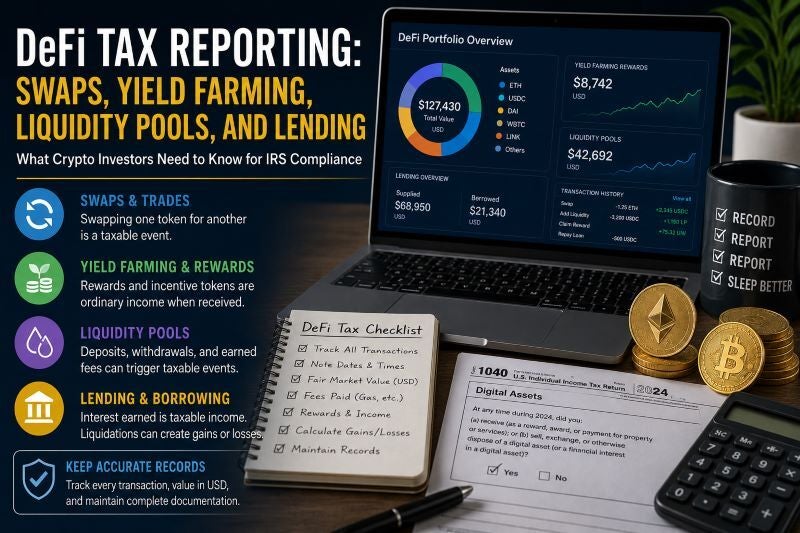
DeFi tax reporting is one of the most difficult areas of crypto tax compliance because decentralized finance transactions often combine trading, income, lending, staking, wrapping, and smart contract activity in a single wallet history. California crypto investors may use a decentralized exchange, provide liquidity, earn governance tokens, lend stablecoins, borrow against collateral, bridge assets, and harvest rewards without receiving a traditional year-end tax form.
The absence of a tax form does not mean the activity is tax-free. For federal income tax purposes, digital assets are generally treated as property. That means swaps, sales, exchanges, income receipts, and certain transfers can create taxable events. The challenge is identifying what happened legally and economically, then reporting it consistently on the tax return.
How DeFi tax reporting works
DeFi tax reporting begins with classification. Each transaction should be sorted into a category such as a swap, liquidity pool deposit, liquidity pool withdrawal, farming reward, lending payment, borrowing transaction, liquidation, bridge transfer, fee payment, or wallet-to-wallet transfer.
A simple transfer between wallets you own is generally not a sale by itself. However, paying gas or protocol fees with crypto may create a disposition of the asset used to pay the fee. A swap from ETH to USDC is generally treated as a taxable exchange, even if no U.S. dollars are received. A reward token may be ordinary income when the taxpayer has dominion and control over it. A later sale of that reward token may create capital gain or loss.
The digital asset question on the federal tax return is also important. Taxpayers generally must answer “Yes” when they receive digital assets as rewards, sell or exchange digital assets, or otherwise dispose of them during the tax year. A DeFi user who only held assets without any transaction may be in a different position, but active DeFi activity usually requires careful reporting.
DeFi tax reporting for swaps
A crypto swap usually creates a taxable event because the taxpayer disposes of one digital asset and receives another. The gain or loss is generally the difference between the fair market value of what the taxpayer received and the adjusted basis in what the taxpayer gave up.
For example, if an investor bought 1 ETH for $2,000 and later swapped it for tokens worth $3,200, the investor may have a $1,200 capital gain, assuming the ETH was held as a capital asset. If the ETH was held for more than one year, long-term capital gain rules may apply. If it was held for one year or less, short-term capital gain rules may apply.
DeFi swaps can become difficult when transactions involve slippage, routed trades, aggregator transactions, MEV effects, failed transactions, taxable fee payments, or tokens with thin market data. Investors should maintain records showing the date, time, token quantities, transaction hash, wallet address, fair market value in U.S. dollars, and basis calculation.
As broker reporting expands, centralized platforms and certain custodial intermediaries may provide more information to the IRS. However, many non-custodial DeFi transactions may still require self-reporting by the taxpayer. Investors should understand how Form 1099-DA crypto reporting rules may affect matching notices, basis disputes, and future examination risk.
Yield farming and reward income
Yield farming can involve staking, liquidity mining, incentive rewards, governance token emissions, fee sharing, or protocol points that later convert into tokens. The tax treatment depends on what the taxpayer receives, when the taxpayer can control it, and whether the reward has an ascertainable fair market value.
Reward tokens are often treated as ordinary income when received and controlled. The fair market value at that time may become the taxpayer's basis in the rewarded tokens. If the tokens are later sold, swapped, or spent, the taxpayer may recognize capital gain or loss based on the difference between the sale value and that basis.
Staking-like arrangements inside DeFi can overlap with ordinary staking tax principles, especially when a wallet receives new tokens from protocol validation or reward mechanics. Investors comparing yield farming income to staking rewards tax treatment should focus on dominion and control, token availability, and later disposition records.
Not every DeFi reward is easy to value. Some tokens have little liquidity, volatile pricing, vesting limits, anti-transfer rules, or restrictions embedded in smart contracts. Those facts do not automatically remove tax exposure, but they may affect valuation and timing arguments.
Liquidity pools and LP tokens
Liquidity pool activity is often the hardest part of DeFi tax reporting. When a taxpayer deposits assets into a pool, the protocol may issue LP tokens or another receipt token representing the user's pool position. The tax question is whether that deposit is a taxable exchange, a non-taxable contribution-like transfer, or another form of property transaction.
There is no universal answer for every pool. The analysis may depend on whether the taxpayer receives a new token with independent market value, whether the taxpayer retains the same economic ownership, whether the pool can change asset composition, and whether the protocol terms create different rights from the assets originally deposited.
Withdrawals can also create tax issues. A taxpayer may receive back different quantities or types of assets due to trading activity, impermanent loss, accrued fees, or reward mechanics. Those differences can affect gain, loss, income, and basis. If the investor receives trading fees or incentive tokens, those amounts may need to be tracked separately from capital gain or loss on the LP position.
Liquid staking and receipt-token structures can raise similar issues because the investor may hold a tokenized claim instead of the original asset. Understanding crypto liquid staking legal implications can help frame whether a transaction looks like a deposit, exchange, reward arrangement, or separate property interest.
DeFi lending, borrowing, and liquidations
Borrowing against crypto collateral is not usually taxable merely because a loan is received, assuming the transaction is respected as debt. However, DeFi lending protocols do not always follow traditional loan documentation. Smart contract terms, liquidation rights, collateral control, rehypothecation, and interest mechanics may affect the analysis.
Interest or yield earned by a lender may be taxable income. If the lender receives payment in tokens, the fair market value of those tokens at the time of receipt may be income. If the lender later sells those tokens, the later sale may create a capital gain or loss.
Liquidations can create taxable dispositions. If a protocol sells or transfers collateral to repay a loan, the taxpayer may recognize gain or loss as if the taxpayer disposed of that collateral. Liquidations can be especially painful because they may occur during market stress, when records are incomplete and the taxpayer may not have cash available to pay any resulting tax.
Losses, bad tokens, and abandoned DeFi positions
DeFi users often hold tokens that collapse in value, become illiquid, are exploited, or lose market support. A decline in value alone is generally not enough to create a deductible loss. A taxable loss usually requires a sale, exchange, or other recognizable disposition, unless a specific rule applies.
If a taxpayer swaps a failed token for another asset, sells it, or disposes of it in a transaction with economic substance, the transaction may establish a capital loss. However, investors should be cautious with sham transactions, related-party transfers, or artificial loss harvesting that lacks real economic effect.
Loss reporting becomes more complex when assets are stolen, frozen, bridged to a failed chain, trapped in an exploited protocol, or tied to bankruptcy proceedings. A careful record review is necessary before claiming a loss. Investors with collapsed positions should connect DeFi records with cryptocurrency loss reporting rules before filing an aggressive or unsupported return position.
DeFi records investors should keep
Good DeFi tax reporting depends on records that explain the transaction path. Investors should preserve wallet addresses, transaction hashes, protocol names, exchange exports, bridge records, screenshots, tax software files, fair market value sources, basis calculations, and notes explaining unusual transactions.
Because DeFi transactions can route through multiple smart contracts, the visible wallet history may not clearly show the tax result. A single user action may include a token approval, a swap, a fee payment, a liquidity pool interaction, and a reward claim. Tax software may help, but it can misclassify transfers, duplicate income, omit rewards, or treat non-taxable movements as sales.
Investors should also maintain cybersecurity and fraud records. Scam farms, wallet-draining schemes, fake front ends, and malicious approvals can create financial losses, tax reporting problems, and evidence issues. Where cybercrime intersects with wallet activity, digital warfare and crypto scam legal issues may become relevant to documenting what happened and whether a claimed loss is supportable.
Audit risks for DeFi users
DeFi users can face IRS scrutiny when reported income does not match known exchange activity, when a taxpayer answers the digital asset question incorrectly, when large wallet flows appear unexplained, or when losses are claimed without adequate support. The risk can increase when a taxpayer on-ramps through a centralized exchange, moves assets into DeFi, then later returns assets to the exchange without a clear basis history.
An audit response should not begin with guesses. The taxpayer should reconstruct the wallet history, identify taxable events, separate income from capital transactions, and preserve evidence supporting valuations and timing. When the IRS contacts a taxpayer, crypto tax audit defense strategy should address both the numbers and the legal theory behind the reporting position.
Potential consequences can include additional tax, interest, accuracy-related penalties, late-filing penalties, late-payment penalties, and collection activity. In serious cases involving false returns, concealment, or fabricated records, the risk can become more severe. Most DeFi reporting errors are not criminal cases, but taxpayers should treat IRS communications carefully.
Legal uncertainty in decentralized finance
DeFi tax law is still developing. The IRS has issued broad digital asset guidance, but many protocol-specific issues remain unresolved. Liquidity pool deposits, receipt tokens, cross-chain bridges, automated market maker fees, governance rewards, protocol points, and wrapped assets can raise questions that do not fit neatly into older tax categories.
Legal classification also matters outside tax. A protocol may claim to be decentralized, neutral, autonomous, or non-custodial, but those labels do not automatically resolve tax, securities, consumer protection, or litigation questions. For platform participants and sophisticated investors, credible neutrality in DeFi compliance can influence how legal obligations, defenses, and disputes are evaluated.
Investors should be cautious about one-size-fits-all tax advice. Two DeFi transactions that look similar on a dashboard may have different legal consequences because of token rights, custody structure, smart contract mechanics, lockups, redemption rights, or market value evidence.
Planning for future crypto tax changes
Crypto reporting rules continue to change. Broker reporting, basis reporting, information exchange, and digital asset tax enforcement are moving toward more visibility, even where non-custodial DeFi remains difficult for regulators to track. Taxpayers should assume that wallet activity may become easier to analyze over time.
California investors should build reporting systems before tax season. That means using consistent wallet labels, exporting records regularly, saving protocol terms, tracking basis by lot, separating personal wallets from business wallets, and documenting why certain transactions were treated as non-taxable transfers.
Investors preparing for upcoming filings should evaluate how crypto taxes in 2026 may affect reporting expectations, broker forms, basis records, and audit exposure.
DeFi tax reporting lawyers in California
DeFi tax reporting requires more than importing a wallet into tax software. Swaps, yield farming, liquidity pools, lending, borrowing, liquidations, bridge transfers, and reward claims must be classified under tax rules that were not designed for decentralized protocols.
Bulldog Law helps California crypto investors, founders, and businesses evaluate DeFi tax exposure, organize transaction records, respond to IRS inquiries, and develop defensible reporting positions. The firm does not promise outcomes, but it can help identify legal risks, preserve arguments, and pursue practical strategies when decentralized finance activity creates tax uncertainty or audit pressure.