
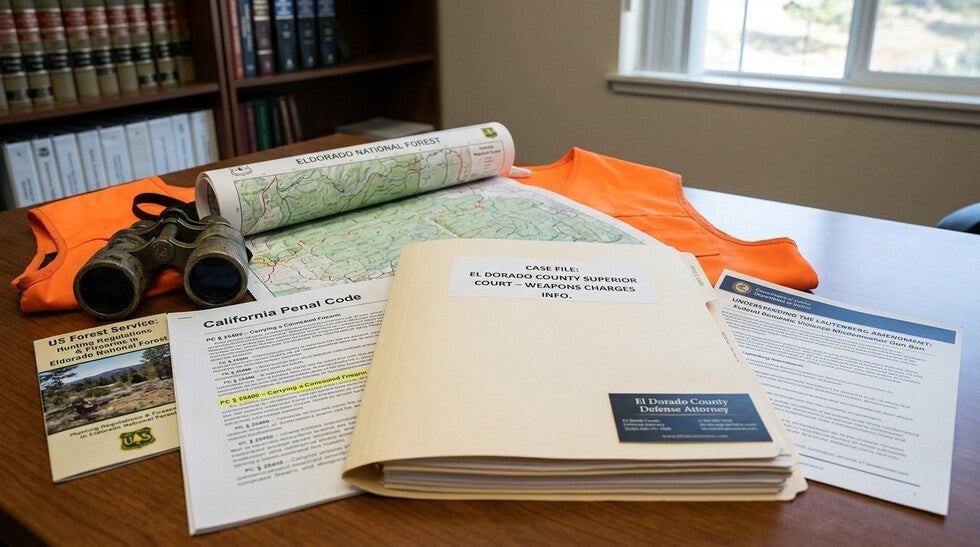
California's PC § 25400 concealed carry prohibition applies uniformly throughout El Dorado County, on Highway 50 over Echo Summit, on Highway 49 through the Gold Country, on every road in the Tahoe Basin, and on every California public road in between.
The statute does not create exceptions for the Eldorado National Forest deer hunter driving home, the Western Slope rancher who has carried a rifle in their truck on the same property for decades, or the visitor passing through El Dorado County with an out-of-state CCW permit. Many people who are charged with weapons violations in this county are genuinely law-abiding members of the hunting and ranching community who did not understand where California's transport rules begin and where federal land rules end.
The only legal transport in California: an unloaded firearm stored in a locked container, separated from ammunition, inaccessible from the passenger compartment. Everything else is potential criminal exposure. The defense begins with the constitutional validity of the stop and the specific hunting or agricultural context that surrounds the case.
Eldorado National Forest and Desolation Wilderness: Hunting Season Transport
Eldorado National Forest and the Desolation Wilderness cover vast portions of El Dorado County's high country between the Western Slope and the Tahoe Basin, prime hunting terrain for deer and bear during the seasons. This is where some of the most genuinely fact-specific weapons cases in the county arise.
Firearms contacts occurring within national forest boundaries are subject to U.S. Forest Service regulations that differ from California state law in important ways. USFS regulations permit the possession of firearms on national forest land for lawful purposes including hunting with a valid license. That is a significantly more permissive framework than California's transport requirements on public roads.
The Desolation Wilderness, as a designated wilderness area, has its own specific access and use rules on top of the general national forest framework.
The critical boundary, the line that produces most El Dorado County backcountry firearms cases, is the transition between national forest land (where federal rules apply) and California public roads (where California's transport requirements apply). A hunter on Eldorado National Forest land with a loaded rifle during deer or bear season is in full compliance with federal forest rules. The same hunter driving that rifle home on Highway 50 toward Placerville without unloading and locking it is violating California's transport statute.
The specific location of every El Dorado County backcountry firearms contact determines which legal framework applies. We confirm jurisdiction at the first consultation in every backcountry case at the appropriate courthouse. For context on how federal land jurisdiction changes the legal framework in neighboring national forest counties, the Trinity County federal charges and Shasta-Trinity National Forest defense page covers the same jurisdictional analysis for similar Sierra Nevada hunting terrain.
Good faith hunting purpose combined with a current California hunting license, a valid deer or bear tag for the specific zone, and a clean prior record provides powerful disposition context at the appropriate El Dorado County courthouse. We combine this hunting community context with every available constitutional stop challenge in every applicable hunting season transport case. Hunting accidents and forest incidents involving firearms carry their own separate exposure covered under PC § 384h hunting accident defense.
The Western Slope Ranching Community: Firearms Culture and California Law
El Dorado County's Western Slope ranching and rural community, the cattle operations and rural properties spread throughout the Gold Country foothills, generates weapons cases where rural firearms culture runs directly into California's civilian transport requirements.
Carrying a rifle in a ranch truck for wildlife management, predator control to protect livestock, and the practical realities of working remote foothills property is just part of how ranching works. It has been for generations. A rancher who has carried a rifle in the same truck on the same property for thirty years is violating California's transport statute the moment they drive onto a public road, even just to reach a neighboring ranch or the feed store in Placerville.
Honestly, this is one of those situations where the law and the lived reality of rural El Dorado County do not align in an obvious way. The law does not care how long someone has done something or how practical the reason is. But the good-faith agricultural purpose, the legitimate wildlife management context, and a clean prior record all provide meaningful disposition context at the Placerville Building C courthouse.
We combine this context with the constitutional stop challenge in every applicable ranching community weapons case. Was the stop itself valid? Was there documented reasonable suspicion? Those questions are asked in every case, and in rural El Dorado County traffic stops, the answers are not always yes. For a full overview of what PC § 25400 covers and the available defense options, the California Penal Code § 25400 concealed firearm charges defense page is the starting point.
The Lautenberg Trap in El Dorado County
This is the part of El Dorado County weapons cases that catches people completely off guard, and the consequences are federal.
Under 18 U.S.C. § 922(g)(9), a prior qualifying domestic violence conviction, misdemeanor or felony, from any court, at any time, permanently prohibits firearms possession. This is the Lautenberg Amendment. It does not expire. It does not go away after a certain number of years. And California state firearms restoration does not override it.
For El Dorado County residents whose prior DV conviction sits somewhere in their history, sometimes from decades ago, sometimes resolved as a misdemeanor in proceedings the defendant may not have fully understood as creating a permanent federal firearms prohibition, the Lautenberg prohibition applies independently of anything California has done or not done with their firearms rights.
This trap carries particular weight in El Dorado County's firearms culture. Hunting in the national forest, ranching on the Western Slope, and rural property protection all make firearms a normal part of daily life in the foothills and mountains. When a traffic stop on Highway 50, Highway 49, or any El Dorado County road produces a firearms discovery and the defendant has a prior qualifying DV conviction, the state PC § 25400 charge has a federal Lautenberg dimension beneath it, with mandatory minimum sentences in the Eastern District of California rather than at the appropriate state courthouse.
We identify Lautenberg exposure at the first consultation in every applicable El Dorado County weapons case, before any statement is made that could create additional federal exposure. If a firearm is discovered during a domestic violence incident, even before a conviction exists, California's firearm seizure laws also come into play. The California firearm seizure law during domestic violence incidents defense page explains those rights and procedures.
According to the U.S. Department of Justice Bureau of Justice Statistics, the federal Lautenberg Amendment has been consistently upheld and actively enforced in the federal courts, including in the Eastern District of California, which covers El Dorado County. Federal prosecution under § 922(g)(9) carries a mandatory maximum of 10 years in federal prison, making early identification of this exposure in any El Dorado County weapons case essential.
If a firearms restraining order has been issued in connection with a DV matter, the intersection of that order with any weapons possession is separately addressed on the California Penal Code § 29825.5 firearm possession while under a restraining order page.
The Two Courthouses
El Dorado County Superior Court, Placerville (Building C, Criminal Division)
2850 Fairlane Court, Suite 120, Placerville, CA 95667
Weapons cases from the Western Slope, including Highway 50 and Highway 49 transport stops, Western Slope ranching community cases, Eldorado National Forest hunting season transport cases, and all Lautenberg-exposure cases where the contact occurred on the Western Slope, proceed at this courthouse. Good-faith agricultural and hunting context is developed and presented for every applicable case here.
El Dorado County Superior Court, South Lake Tahoe Branch
1354 Johnson Blvd, South Lake Tahoe, CA 96150
Weapons cases from the Tahoe Basin, including Highway 50 Tahoe Basin transport stops, Tahoe area out-of-state CCW cases, and any Lautenberg-exposure case where the contact occurred in the basin, proceed at this branch courthouse.
The Bulldog Law appears at both courthouses. Our El Dorado County office handles the full range of PC § 25400 concealed weapons defense, Lautenberg federal exposure analysis, and hunting and ranching community defense across both the Western Slope and the Tahoe Basin.
According to a legal analysis by the U.S. Forest Service Office of General Counsel, federal firearms regulations on national forest lands permit lawful possession for hunting and recreation, a framework that directly affects how El Dorado County backcountry firearms contacts must be analyzed from the first consultation.
After a Weapons Arrest in El Dorado County
Do not make any statement about the firearm, its purpose, or how it was stored without an attorney present. In Lautenberg situations, any statement can create immediate federal exposure that makes the case dramatically more serious.
Document exactly how the firearm was stored at the time of the contact.
If you have any prior DV conviction from any court at any time, contact The Bulldog Law immediately about Lautenberg federal exposure, before any further contact with law enforcement.
If you hold a valid hunting license and current tags, preserve that documentation. It matters for disposition context.
If the contact occurred in the high country, note whether it was on Eldorado National Forest or Desolation Wilderness federal land or on a California public road. The specific location determines which legal framework applies.
Call (888) 928-1609.
Placerville: Placerville office | South Lake Tahoe: South Lake Tahoe office | El Dorado County: El Dorado County office | (888) 928-1609
Weapons Defense Questions in El Dorado County
Can El Dorado County hunters be charged for transporting a loaded firearm?
Yes, on California public roads. California's transport requirement applies on every public road regardless of hunting license, valid tags, or hunting destination: unloaded, locked container, separated from ammunition. A hunter who loads at camp in Eldorado National Forest and drives back on Highway 50 toward Placerville without unloading is violating the statute. Good faith hunting purpose and valid credentials are powerful disposition context at the appropriate El Dorado County courthouse, not a legal exemption from the charge. We combine this hunting community context with every available constitutional stop challenge in every applicable hunting season transport case.
How do Eldorado National Forest firearms rules differ from California's transport requirements?
USFS regulations on Eldorado National Forest permit possession of firearms for lawful purposes including hunting with a valid license, a different and more permissive framework than California's transport requirements on public roads. The Desolation Wilderness has its own specific access and use rules as a designated wilderness area. The critical boundary is between federal land (federal rules apply) and California public roads (California rules apply). The specific location of the firearms contact, whether on national forest land, wilderness land, or a public highway, determines which legal framework governs. We confirm the specific location and applicable framework at the first consultation in every El Dorado County remote-location firearms case at the appropriate courthouse.
How does Lautenberg exposure work in El Dorado County?
A prior domestic violence conviction, misdemeanor or felony, from any court, at any time, permanently prohibits firearms possession under 18 U.S.C. § 922(g)(9). For El Dorado County residents whose prior DV conviction sits in their history, sometimes from decades ago and resolved as a misdemeanor, the federal Lautenberg prohibition applies regardless of California state firearms restoration. When an El Dorado County traffic stop produces a firearms discovery alongside a prior qualifying DV conviction, the state PC § 25400 charge has a federal Lautenberg dimension beneath it, with mandatory minimum sentences in the Eastern District of California. We identify this dimension at the first consultation before any statement creates additional federal exposure.
For more on Eldorado National Forest and Desolation Wilderness federal land firearms rules, hunting season transport defense, the Western Slope ranching community firearms culture, the Lautenberg trap, and weapons defense at the El Dorado County Superior Court's Placerville and South Lake Tahoe courthouses, visit The Bulldog Law criminal defense blog.