
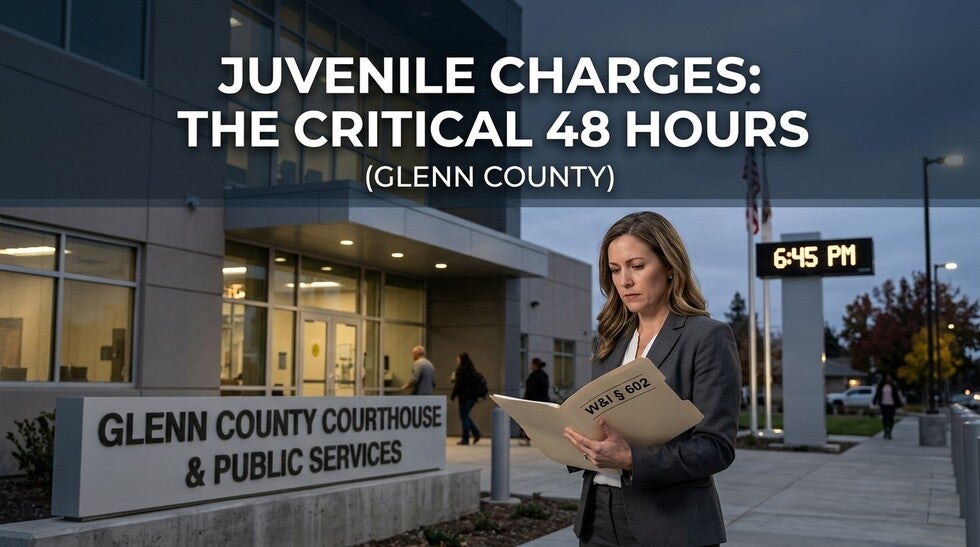
Juvenile Charges in Glenn County: W&I § 602 and What the First 48 Hours Determine
Your child was just arrested. Your mind is going a hundred directions at once. What happens next, what this means for school, what it means for the future, all of it is hitting you at the same time. Here is what you need to know right now: the most important moment in a Glenn County juvenile case is not the court hearing. It is the Probation Department's intake assessment, and it happens before any petition is filed or any court date is set.
If you have a lawyer working for your child before that assessment ends, you change what the Probation Department recommends to the DA. That recommendation shapes everything that follows.
California's juvenile justice system under Welfare & Institutions Code § 602 was built around rehabilitation, not punishment. Records are confidential by default. Diversion pathways exist because the legislature recognized that young people deserve second chances that adult prosecution does not give them. But those pathways do not open automatically. They require active, early advocacy, beginning at the intake assessment.
What Happens in the First 48 Hours After a Juvenile Arrest in Glenn County?
The clock starts the moment your child is taken in. The Glenn County Probation Department begins an intake assessment that determines two things right away: whether your child is detained or released to you, and what the department will recommend to the DA about diversion, petition filing, and program placement.
The DA then decides whether to file a W&I § 602 petition or refer the case to diversion without filing anything. That decision is heavily shaped by what the Probation Department recommends. And that recommendation is heavily shaped by what information is presented during the intake assessment.
A sustained petition creates a juvenile record. That record carries real consequences, for DACA renewal, for H-2A family situations, for college applications, and for the employment history that follows a young person for years. Getting in front of that process is not optional. It is everything.
What Outcomes Are Actually Available?
The range of possible outcomes in a Glenn County juvenile case is wide. Informal diversion can resolve the case with no petition filed at all. W&I § 654 informal probation provides six months of supervision with no sustained petition and no adjudication on record. Beyond those, outcomes include formal probation, camp or ranch placement, and, reserved for only the most serious cases with prior adjudication history, a Division of Juvenile Justice commitment.
In most first-offense Glenn County juvenile cases that do not involve serious violence, informal diversion or W&I § 654 informal probation are the outcomes that early, effective representation produces. Building the case for those outcomes means presenting school records, family circumstances, community support, and every factor that shows this young person's rehabilitation potential, at the intake assessment, not after the fact.
We start that work from the first consultation, before the intake assessment concludes. That is how the outcomes shift.
Our page on California PC 707, defending against juvenile transfer proceedings explains what happens when the prosecution tries to move a case out of the juvenile system entirely, and why keeping it in juvenile court matters so much.
How Does a Juvenile Arrest Affect Willows High and Orland High Students?
A school-based arrest does not just start a juvenile court case. It starts a school disciplinary proceeding at the same time, running on a completely separate track under completely separate rules.
Willows High School and Orland High School generate school-based arrests where both tracks, the criminal proceeding and the school disciplinary process, begin simultaneously. For a Glenn County student whose academic record and college prospects matter, both tracks can cause damage independently. And an adverse outcome on one track can feed directly into the other.
Coordinating Both Tracks at Once
A juvenile adjudication does not automatically produce suspension or expulsion. But it can provide evidence used in the school disciplinary proceeding. And a school expulsion creates educational disruption that affects the student's academic trajectory long after the juvenile case resolves.
We represent Glenn County minors in both proceedings simultaneously wherever both arise from the same incident. The strategy has to be coordinated from the start, because what happens in the school disciplinary hearing affects the court case, and what happens in court affects the school proceeding. Running two separate defenses without coordinating them is a mistake that costs students.
If you are trying to understand how a probation violation interacts with either of these tracks, our overview of probation violations under California Penal Code PC 1203.3 explains the mechanics and what happens when conditions are not met.
How Does a Juvenile Case Affect H-2A and DACA Agricultural Families in Glenn County?
Glenn County's H-2A and Latino agricultural community is large, and the families in it face stakes in juvenile cases that go well beyond the criminal proceeding itself.
For a DACA-status youth, certain juvenile adjudications involving conduct classified as a significant misdemeanor or a felony-equivalent offense can be treated as adverse factors in the USCIS discretionary analysis during DACA renewal. A sustained petition is substantially worse for that analysis than a diversion outcome that produces no formal adjudication. The difference between a dismissed diversion and a sustained petition can be the difference between DACA renewal and denial.
The H-2A Parent Dimension
For H-2A parents whose guestworker status is already subject to scrutiny, a serious juvenile case involving their child can create family-level immigration attention that affects the parent's situation as well as the minor's. These cases require analysis of the complete family immigration context, not just the juvenile charge in isolation.
We address the DACA and H-2A implications at the first consultation in every applicable Glenn County agricultural family juvenile case. We pursue informal diversion or no-petition outcomes wherever the minor qualifies, because for these families, that clean outcome is the only one that truly protects everyone.
According to U.S. Citizenship and Immigration Services (USCIS), DACA renewal decisions involve a discretionary assessment that considers criminal history, including certain juvenile adjudications, as a negative factor. Avoiding a formal adjudication through diversion is the outcome that keeps the DACA renewal pathway clear.
When Can Glenn County Try a Minor as an Adult?
This is the scenario every family dreads, and it is the highest-stakes situation in juvenile court. It happens when the Glenn County DA files a PC § 707 fitness motion, a request to transfer the case to adult criminal court.
A fitness motion is only available when the charge involves a specified serious offense and the minor is at least fourteen years old. The Juvenile Court must then find that the minor is not amenable to rehabilitation within the juvenile system. If that finding is made, the case moves to adult court, and with it, the juvenile confidentiality protections disappear entirely.
Fighting the Fitness Motion
We fight fitness motions through comprehensive rehabilitation amenability evidence. That means school records, community support documentation, family stability evidence, and every resource available that demonstrates this young person's capacity for rehabilitation within the juvenile system.
Keeping the case in Juvenile Court keeps the record confidential, the outcomes rehabilitative, and the long-term pathway open. An adult conviction at fourteen or fifteen follows a person for the rest of their life in ways a sealed juvenile record does not.
The evidence we build for fitness hearings overlaps with what we present at the intake assessment, which is one more reason early representation matters so much. The narrative we build in the first 48 hours becomes the foundation for every stage that follows.
Can a Glenn County Juvenile Record Be Sealed?
Yes. Most Glenn County minors who complete juvenile probation can petition to seal their records under W&I § 781. Sealing means the record is treated as if it never existed for most purposes, college applications, employment, housing, and immigration profiles all benefit from a sealed record.
We pursue dispositions from the earliest stage of every juvenile case that preserve sealing eligibility. That means the decisions we make about how to resolve the case, which outcomes to pursue, which admissions to avoid, are always made with the sealing pathway in mind.
According to the California Courts Self-Help Guide, a minor may petition to seal their juvenile record after turning 18, after the jurisdiction of the juvenile court has terminated, or after five years have passed, whichever comes first. Not every case qualifies, but protecting that eligibility from the beginning is one of the most important things we do.
Keeping DACA renewal profiles, college admission prospects, and employment opportunities as clean as possible through every stage of proceedings is not just a legal goal, for Glenn County's young people and their families, it is the whole point.
If you want to understand the broader landscape of how juvenile records interact with adult opportunities, our overview of juvenile justice in California, what to expect covers the full trajectory of the system from arrest through resolution and beyond.
The Juvenile Court
Glenn County Superior Court
526 W Sycamore Street, Willows, CA 95988
What Should Families Do Now?
Ask to be present with your child immediately. Parents have the right to be present during law enforcement questioning of a minor.
Invoke your child's right to remain silent explicitly. A juvenile has the same Fifth Amendment protection as an adult.
Call The Bulldog Law at (888) 928-1609 before the Probation Department's intake assessment concludes.
Contact your child's school immediately to determine whether a parallel disciplinary process has begun.
If your child is DACA-status or from an H-2A agricultural family, contact The Bulldog Law about specific immigration implications at the first consultation.
Willows: Willows office | Orland: Orland office | Glenn County: Glenn County office | (888) 928-1609
Frequently Asked Questions: Juvenile Defense in Glenn County
How does a juvenile adjudication affect Willows High or Orland High enrollment and college admission?
A sustained juvenile petition does not automatically produce suspension or expulsion, but the school disciplinary proceeding that often accompanies a juvenile arrest operates independently under the school district's own policies. A juvenile adjudication can provide adverse evidence for the school proceeding, and a school expulsion creates educational disruption that affects academic trajectory and college admission prospects. We represent Glenn County minors in both proceedings simultaneously wherever both arise from the same incident, coordinating strategy so that an adverse outcome in one does not create adverse consequences in the other.
How does an agricultural family juvenile case affect immigration in Glenn County?
Certain juvenile adjudications involving conduct classified as significant misdemeanors or felony-equivalent offenses are treated as adverse factors in DACA renewal discretionary analysis by USCIS. H-2A parents can also face family-level immigration scrutiny from serious juvenile cases involving their children. Diversion that produces dismissal without a sustained petition is substantially better than a formally sustained petition for both DACA and H-2A considerations. We address these implications at the first consultation in every applicable Glenn County agricultural family case.
When can Glenn County try a minor as an adult?
The Glenn County DA can file a PC § 707 fitness motion when the charge involves specified serious offenses and the minor is at least fourteen years old. The Juvenile Court must find the minor not amenable to juvenile rehabilitation. We fight fitness motions through comprehensive rehabilitation amenability evidence, school records, community support documentation, family stability, and the specific Glenn County community relationships that demonstrate this young person's capacity for rehabilitation within the juvenile system.
Can a Glenn County juvenile record be sealed?
Yes. Most Glenn County minors who complete juvenile probation can petition to seal their records under W&I § 781. We pursue dispositions from the earliest stage of every juvenile case that preserve sealing eligibility, keeping DACA renewal profiles, college admission prospects, and employment opportunities as clean as possible through every stage of proceedings.
What should parents do immediately after a juvenile arrest in Glenn County?
Invoke your child's right to remain silent immediately, a juvenile has the same Fifth Amendment protection as an adult. Ask to be present during any questioning. Call The Bulldog Law at (888) 928-1609) before the Probation Department's intake assessment concludes. Contact the school immediately to find out whether a parallel disciplinary process has started. If your child is DACA-status or your family has H-2A status, contact us immediately about the specific immigration implications.
For more on Glenn County juvenile diversion programs, Willows High and Orland High school-based arrest dual proceedings, H-2A and DACA agricultural youth immigration stakes, small-county community knowledge, fitness challenges, record sealing, and juvenile defense at the Glenn County Juvenile Court in Willows, visit The Bulldog Law criminal defense blog.