
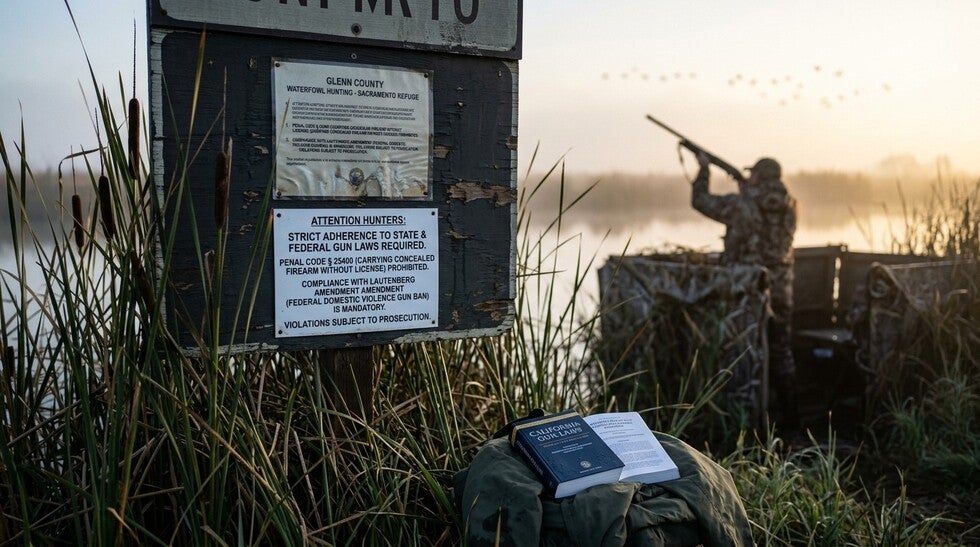
A weapons charge in Glenn County can surprise people who have been doing the same thing, hunting, ranching, driving to the feed store, for years without a problem. One traffic stop, one moment where the firearm was not stored the way California requires, and suddenly you are looking at criminal exposure that can reach the federal level. If that sounds like your situation, keep reading.
PC § 25400 is California's concealed carry prohibition, and it applies everywhere in Glenn County. On Interstate 5, on Highway 32 and Highway 162 through the dairy and rice country, and on every California public road, the law is the same. No exceptions for hunters. No exceptions for ranchers. No exceptions for out-of-state CCW permit holders. And no exceptions for the person who has carried a rifle in the same farm truck for thirty years.
Glenn County's weapons cases come from three main settings: Sacramento National Wildlife Refuge waterfowl hunting transport, Mendocino National Forest hunting access, and the agricultural and ranching community's everyday firearms culture. Underneath all three sits the Lautenberg trap, a federal prohibition that can quietly apply to anyone with an old qualifying DV conviction, sometimes one they barely remember. All of these cases proceed at the Glenn County Superior Court at 526 W Sycamore Street in Willows.
California's Transport Rule: The One Standard That Applies Everywhere
The only legal way to transport a firearm on a California public road is specific: the gun must be unloaded, stored in a locked container, separated from ammunition, and inaccessible from the passenger compartment. That is not just the rule for people who might be dangerous, it is the rule for everyone, including licensed duck hunters and third-generation ranchers.
Most people who get charged under PC § 25400 in Glenn County were not trying to break the law. They were driving home from a hunt, or running an errand with the same rifle that lives behind the seat of their truck. The problem is that California's transport statute does not ask about intent. It asks about storage.
Understanding exactly what counts as a concealed weapon in a vehicle is important for anyone who regularly travels with firearms in Glenn County. The difference between legal and illegal transport often comes down to one detail, where the gun was, whether it was loaded, and whether the container was actually locked.
Can You Be Charged for Transporting a Shotgun Home From the Sacramento Refuge?
Yes, if the shotgun was loaded or improperly stored on the drive home on a California public road. Honestly, this surprises a lot of hunters. They think that because they were hunting legally on the refuge, the whole trip is covered.
The Sacramento National Wildlife Refuge complex, including the Sacramento and Delevan refuge units in and around Glenn County, is among California's most important waterfowl destinations. Thousands of duck and goose hunters access these federal lands managed by the U.S. Fish and Wildlife Service throughout the season, hunting under federal refuge-specific hunt programs with valid licenses, federal duck stamps, and, where required, refuge hunt reservations.
The Boundary That Creates Criminal Exposure
Here is the thing that catches people: federal land rules and California road rules are two different legal frameworks, and the boundary between them is the moment you leave the refuge and pull onto a public highway.
A hunter on the Sacramento National Wildlife Refuge during a legal waterfowl hunt is operating under the federal refuge framework, which permits firearms for lawful hunting. That same hunter driving their shotgun home on Highway 162 or I-5 is now subject to California's transport requirements. Loaded or improperly stored means a PC § 25400 or related violation, regardless of the hunt that just happened.
The specific location of every Glenn County hunting-related firearms contact determines which legal framework applies. We confirm jurisdiction and the transport circumstances at the first consultation in every waterfowl hunting season firearms case at the Willows courthouse.
How Good-Faith Hunting Context Shapes the Resolution
Good-faith hunting purpose combined with a current California hunting license, required federal duck stamp, valid refuge hunt reservation, and a clean prior record all carry weight at the Willows courthouse. That combination is not a legal exemption, it is powerful disposition context that shapes the resolution discussion. We bring that hunting community context to every applicable case alongside every available constitutional stop challenge.
How Do Mendocino National Forest Firearms Rules Differ From California Road Rules?
The Mendocino National Forest covers significant portions of Glenn County's western terrain, backcountry hunting areas, recreational lands, and remote access roads. USFS regulations permit firearms possession on national forest land for lawful purposes including hunting with a valid license. That is generally more permissive than what California requires on public roads.
But the boundary matters here just as much as it does at the refuge. A hunter on Mendocino National Forest land with a loaded rifle during deer or bear season is in compliance with federal forest rules. That same hunter driving home on Highway 162 toward Willows is violating California's transport statute the moment the truck reaches a public road.
Confirming Location at the First Consultation
We confirm the specific location and applicable legal framework at the first consultation in every Glenn County backcountry firearms case. Was the contact on national forest land, on a state or county road, or somewhere in between? That single fact determines which set of rules governs the case.
If the contact happened in the western backcountry, write down where you were. GPS data from your phone, hunt logs, or any documentation of where you were on the forest that day can be critical.
Why Are Dairy Farmers and Ranchers at Risk Under California Transport Law?
Because carrying a rifle in a farm or ranch truck, completely routine for wildlife management and predator control in Glenn County's agricultural communities, violates California's transport statute the moment that truck reaches a public road.
Glenn County's dairy operations, cattle ranching, rice farming, and almond growing communities have a deep and practical relationship with firearms. A dairy operator protecting livestock from predators, a rancher managing wildlife on remote property, a farm worker running equipment between fields, these are not people looking for trouble. They are doing the job that the land requires.
The Thirty-Year Problem
Here is what I have seen in practice: a rancher or dairy operator who has carried a rifle in the same truck, on the same property, for decades. No incidents. No problems. Then one day they pull onto a public road, even just to get to a neighboring field or to reach the feed store in Willows or Orland, and get stopped. California's transport statute does not care how long you have been doing it or why.
The good-faith agricultural purpose, the legitimate wildlife management context, and a clean prior record all carry real weight in the resolution discussion at the Willows courthouse. We bring that agricultural community context into every applicable weapons case and combine it with the constitutional stop challenge that begins every defense.
According to the California Department of Fish and Wildlife, California does have specific provisions for transporting firearms to and from lawful hunting activities, but those provisions require strict compliance with unloaded and secured transport rules on all public roads, and they do not create a general agricultural exemption.
What Is the Lautenberg Trap and Who Does It Catch in Glenn County?
The Lautenberg Amendment under 18 U.S.C. § 922(g)(9) is a permanent federal firearms ban that attaches to anyone with a prior qualifying domestic violence conviction, misdemeanor or felony, from any court, at any time. It applies independently of any California state firearms restoration. There is no expiration. There is no state-level workaround.
In Glenn County, this trap catches people in a very specific way. The county's firearms culture, waterfowl hunting at the refuges, deer and bear hunting in the national forest, dairy and ranch operations, rural property protection, means that firearms are a normal part of daily life here. And somewhere in a resident's history, maybe from a case resolved as a misdemeanor twenty years ago in proceedings they did not fully understand, sits a qualifying DV conviction.
Why Prior DV Convictions Create Federal Exposure
When a traffic stop on I-5, Highway 32, or any Glenn County road produces a firearms discovery and the defendant has a prior qualifying DV conviction, the state PC § 25400 charge is no longer just a state matter. There is now a federal Lautenberg dimension beneath it, with mandatory minimum sentences in the Eastern District of California rather than at the Willows courthouse.
According to the Bureau of Alcohol, Tobacco, Firearms and Explosives (ATF), the Lautenberg Amendment prohibits any person convicted of a misdemeanor crime of domestic violence from shipping, transporting, possessing, or receiving firearms or ammunition. The prohibition is permanent and applies regardless of when the conviction occurred.
We identify Lautenberg exposure at the first consultation in every applicable Glenn County weapons case, before any statement is made that could create additional federal exposure.
If you have any prior DV conviction from any court at any time and you were found with a firearm in Glenn County, contact The Bulldog Law immediately. The conversation with law enforcement needs to stop until you have spoken with us.
For context on how domestic violence convictions create lasting legal consequences beyond the immediate case, our page on 3 ways domestic violence charges can change your life explains exactly why the Lautenberg dimension is one of the most serious.
The Courthouse
Glenn County Superior Court
526 W Sycamore Street, Willows, CA 95988
What Should You Do After a Weapons Arrest in Glenn County?
Do not make any statement about the firearm, its purpose, or how it was stored without an attorney. In Lautenberg situations, any statement can create immediate federal exposure.
Document exactly how the firearm was stored at the time of the contact.
If you have any prior DV conviction from any court at any time, contact The Bulldog Law immediately about Lautenberg federal exposure.
If you hold a valid hunting license, federal duck stamp, and refuge hunt reservation, preserve all that documentation.
If the contact related to a refuge waterfowl hunt or a national forest hunt, note whether you were on the federal land or on a California public road.
Call (888) 928-1609.
Willows: Willows office | Orland: Orland office | Glenn County: Glenn County office | (888) 928-1609
Frequently Asked Questions: Weapons Defense in Glenn County
Can Glenn County waterfowl hunters be charged for transporting a loaded shotgun?
Yes, on California public roads. California's transport requirement applies on every public road regardless of hunting license, federal duck stamp, or refuge hunt reservation: unloaded, locked container, separated from ammunition. A hunter finishing a waterfowl hunt on the Sacramento National Wildlife Refuge who drives home on Highway 162 or I-5 with a loaded or improperly stored shotgun is violating the statute. Good-faith hunting purpose and valid credentials are powerful disposition context at the Glenn County Superior Court in Willows, not a legal exemption. We combine that context with every available constitutional stop challenge in every applicable case.
How do National Wildlife Refuge firearms rules differ from California's transport requirements?
The Sacramento National Wildlife Refuge complex is federal land managed by the U.S. Fish and Wildlife Service, and firearms possession for lawful licensed waterfowl hunting operates under the federal refuge hunt framework. California's transport requirements, unloaded, locked container, separated from ammunition, apply on California public roads. The boundary between the refuge and the public highway determines which legal framework governs. We confirm the specific location and applicable framework at the first consultation in every Glenn County hunting-related firearms case.
How do Mendocino National Forest firearms rules differ from California road rules?
On Mendocino National Forest land, USFS regulations permit firearms possession for lawful hunting with a valid license, a more permissive standard than California's public road transport requirements. A hunter legally positioned on the forest becomes subject to California's transport statute the moment they reach a public road. The specific location of the firearms contact determines which rules apply. We confirm jurisdiction and location at the first consultation in every applicable backcountry case.
Why are dairy farmers and ranchers charged under PC § 25400 in Glenn County?
Carrying a rifle in a farm or ranch truck for predator control and wildlife management is routine practice in Glenn County's agricultural communities. But California's transport statute applies the moment that truck reaches a public road, regardless of the purpose. The good-faith agricultural context and clean prior record provide meaningful disposition context at the Willows courthouse. We bring that context into every applicable case alongside the constitutional stop challenge.
What is the Lautenberg trap and how does it apply in Glenn County?
The Lautenberg Amendment under 18 U.S.C. § 922(g)(9) permanently prohibits anyone with a prior qualifying domestic violence conviction, misdemeanor or felony, from any court, at any time, from possessing firearms. In Glenn County's firearms-oriented hunting, ranching, and agricultural culture, this prohibition catches residents who had a DV case resolved as a misdemeanor years ago, sometimes without fully understanding the permanent federal consequence. When a traffic stop reveals a firearm alongside a prior qualifying DV conviction, the state PC § 25400 charge now carries a federal dimension with mandatory minimum sentences in the Eastern District of California. We identify this exposure at the first consultation before any statement creates additional federal risk.
For more on Sacramento National Wildlife Refuge waterfowl hunting federal land rules, Mendocino National Forest hunting access, hunting season transport defense, the dairy and ranching firearms culture, the Lautenberg trap, and weapons defense at the Glenn County Superior Court in Willows, visit The Bulldog Law criminal defense .