
Updated November 2026 | The Bulldog Law | California Trial Attorneys
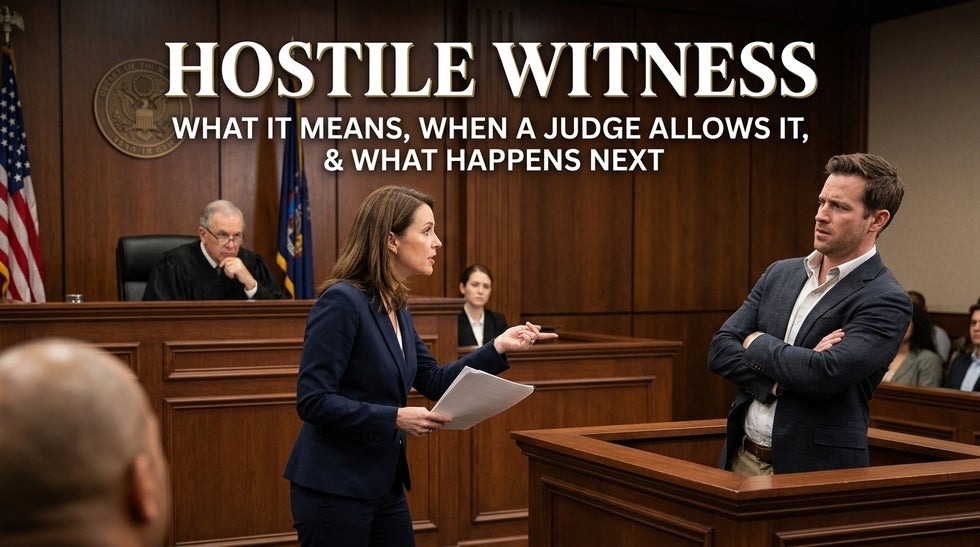
A hostile witness is a witness who, when questioned by the lawyer who called him or her, gives testimony that is antagonistic, evasive, or contrary to what that side expected. When the judge agrees, the lawyer may treat the witness as hostile, which means asking leading questions and confronting the witness with earlier statements, as in cross-examination. Being declared hostile is not a punishment and not a finding of dishonesty. It changes the rules of questioning so the jury can hear what the witness said before.
The phrase is familiar from courtroom dramas and widely misunderstood. Our attorneys see it most often when a prosecution witness, frequently the complaining witness in a domestic violence case, takes the stand and tells a different story from the one in the police report.
Why the label matters: leading questions
Lawyers question their own witnesses on direct examination and the other side's witnesses on cross-examination, and the rules differ. On direct, a lawyer generally may not ask leading questions, meaning questions that suggest the answer: "You saw him hit her, didn't you?" The witness is supposed to tell the story in his or her own words. On cross, leading questions are the normal method.
That works when a witness is cooperative. When a witness called by a party is fighting the questions, open-ended questions produce nothing. California's Evidence Code 767 allows leading questions on direct examination under special circumstances where the interests of justice require it, and a hostile witness is the classic example. The federal courts state it directly in Federal Rule of Evidence 611: leading questions should ordinarily be allowed when a party calls a hostile witness, an adverse party, or a witness identified with an adverse party.
Hostile, adverse, and reluctant witnesses
|
Type |
Who it is |
Leading questions by the calling party |
|
Hostile witness |
A witness who shows antagonism or evasiveness toward the party that called him or her, through answers or demeanor |
Allowed once the judge finds hostility |
|
Adverse party or witness identified with one |
The opposing party, or a person aligned with that party such as an employee, relative, or the investigating officer |
Allowed from the start |
|
Reluctant or unwilling witness |
A witness who does not want to testify but answers truthfully when asked |
Not allowed unless the reluctance becomes evasion |
|
Unfavorable witness |
A witness who answers honestly but whose answers do not help |
Not allowed; an unhelpful answer is not hostility |
In California civil cases, Evidence Code 776 lets a party call the opposing party or a person identified with that party and examine the witness as if under cross-examination. In criminal trials the defendant cannot be called by the prosecution at all, but the defense may call a police officer or other prosecution-aligned witness and ask to lead.
How a witness is declared hostile
- The lawyer begins with ordinary non-leading questions.
- The witness answers evasively, argues, claims not to remember matters he or she plainly knows, or contradicts an earlier account.
- The lawyer asks the judge for permission to treat the witness as hostile, or simply for permission to lead.
- The judge decides, based on what has happened in front of the jury, sometimes after hearing argument outside the jury's presence.
- If permission is granted, the lawyer proceeds with leading questions.
Judges have broad discretion. Surprise helps the request but is not required. In some situations the lawyer knows in advance that the witness has changed sides and asks permission at the outset.
Impeaching your own witness
At common law a party was said to vouch for its own witnesses and could not attack them. That rule is gone. Under California Evidence Code 785, the credibility of a witness may be attacked by any party, including the party who called the witness; the federal rule is the same. A lawyer faced with a witness who has turned can:
- Confront the witness with a prior statement to police, in a recorded call, or at an earlier hearing.
- Show bias, such as a relationship with the defendant, fear, or a financial interest.
- Call other witnesses, such as the officer who took the original statement, to prove what was said.
The earlier statement comes in for its truth
California's rule on prior statements is unusually strong. Under Evidence Code 1235, a statement a witness made earlier that is inconsistent with the witness's testimony is not excluded as hearsay. The jury may consider it as proof of what happened, not merely as a reason to doubt the witness. Because the witness is on the stand and can be cross-examined about both versions, the defendant's confrontation rights are satisfied.
This is the practical point of the hostile witness procedure in criminal cases. A prosecutor who expects a witness to recant can call the witness anyway, establish the change in story, and put the original account in front of the jury.
"I don't remember"
A witness who truly cannot remember has not said anything inconsistent, and the earlier statement stays out under this rule. California courts draw a line at feigned forgetfulness. If the judge finds that the witness's claimed loss of memory is deliberate evasion, it is treated as an implied denial, and the prior statement is admissible. The judge makes that call from the witness's demeanor and the plausibility of forgetting.
Where it comes up
- Domestic violence cases. The most common setting. A spouse or partner who called 911 later minimizes or denies the event. See what happens when a victim or witness refuses to testify and whether a victim can drop charges. The spousal privilege does not prevent a spouse from being called when the charge is a crime against that spouse.
- Gang and codefendant cases. Witnesses who gave statements to detectives often retreat at trial out of loyalty or fear.
- Defense use. The defense may call an officer, an informant, or an alleged victim and seek permission to lead, particularly when that witness holds information helpful to the defense and will not volunteer it.
- Civil trials. A party calls the opponent or the opponent's employee to establish facts through cross-examination style questioning.
What it means for the witness
A witness declared hostile has not been accused of a crime, and no penalty follows from the label. The risks come from conduct, not from the ruling.
- Perjury. Knowingly making a false statement under oath about a material matter is a felony under Penal Code 118. A witness who gives two sworn accounts that cannot both be true has a problem regardless of which is false.
- Contempt. Refusing to answer without a valid privilege can lead to a contempt finding.
- False report. A witness who now says the original report to police was invented may be admitting a separate offense.
- Pressure from others. If someone has threatened or persuaded a witness to change testimony, that person may have committed the crime of dissuading a witness; our page on witness intimidation definitions explains the terms.
A witness who is worried about any of these should speak with an independent lawyer before testifying. The court can appoint one when a witness's answers may be incriminating.
What it means for the defendant
When a prosecution witness turns, the instinct is to treat it as a win. It is an opening, not an outcome. The jury will usually hear the earlier statement, and jurors often believe the first account given close to the event over a later retraction, especially when they suspect the witness is protecting the defendant. The defense's work is to show why the first statement was unreliable when it was made: intoxication, anger, a motive to exaggerate, suggestive questioning, or inconsistency with the physical evidence. And the defendant must stay entirely out of the witness's decision. Any contact that looks like persuasion can become a new felony and can open the door to even more of the witness's earlier statements.
Frequently asked questions
What is a hostile witness?
A hostile witness is a witness whose testimony, when questioned by the side that called him or her, turns out to be openly antagonistic, evasive, or contrary to that side's position. When a judge agrees the witness is hostile, the lawyer who called the witness is allowed to ask leading questions, as if cross-examining.
What does it mean to treat a witness as hostile?
It means the judge has given the questioning lawyer permission to lead the witness: to ask questions that suggest the answer and can be answered yes or no. Leading questions are normally not allowed when a lawyer questions his or her own witness. The ruling changes the form of the questioning. It is not a finding that the witness is lying.
Can a hostile witness be charged with a crime?
Not for being hostile. Being uncooperative, unfriendly, or unhelpful on the stand is not an offense. A witness can be charged with perjury for knowingly lying under oath about something material, and can be held in contempt for refusing to answer without a legal privilege.
What is the difference between a hostile witness and an adverse witness?
An adverse witness is on the other side by position: the opposing party, or someone closely identified with that party, such as an employee or the arresting officer. That witness can be led from the start. A hostile witness is one who was expected to be neutral or helpful and proves otherwise through demeanor or answers; hostility has to be shown to the judge.
Can a lawyer impeach his or her own witness?
Yes. Under California Evidence Code 785 and Federal Rule of Evidence 607, any party may attack the credibility of a witness, including the party that called the witness. A lawyer can confront a witness with an earlier statement that contradicts the testimony.
What happens when a witness changes the story on the stand?
The lawyer who called the witness can ask to treat the witness as hostile, lead the witness through the earlier account, and introduce the earlier statement. In California a prior inconsistent statement is admissible for its truth under Evidence Code 1235, so the jury may believe the earlier version over the testimony in court.
Can a victim be declared a hostile witness?
Yes. It happens often in domestic violence prosecutions when a victim called by the prosecutor recants or minimizes what happened. The prosecutor may then use leading questions and bring in the victim's earlier statements to police, the 911 recording, and photographs.
What if a witness says "I don't remember"?
A real failure of memory is not inconsistent with an earlier statement. If the judge finds that the witness is being deliberately evasive and the claimed memory loss is not believable, California courts treat it as an implied inconsistency, and the earlier statement can be admitted.
Related reading from our attorneys
- What happens if a victim or witness refuses to testify
- Spousal privilege: testifying against a spouse
- Perjury under Penal Code 118
A witness in your case has changed the story? What the jury hears next depends on the lawyers
The Bulldog Law's criminal defense attorneys try domestic violence and other cases where witnesses recant, and we advise witnesses who are worried about their own exposure. Call (888) 928-1609 or reach us online.