
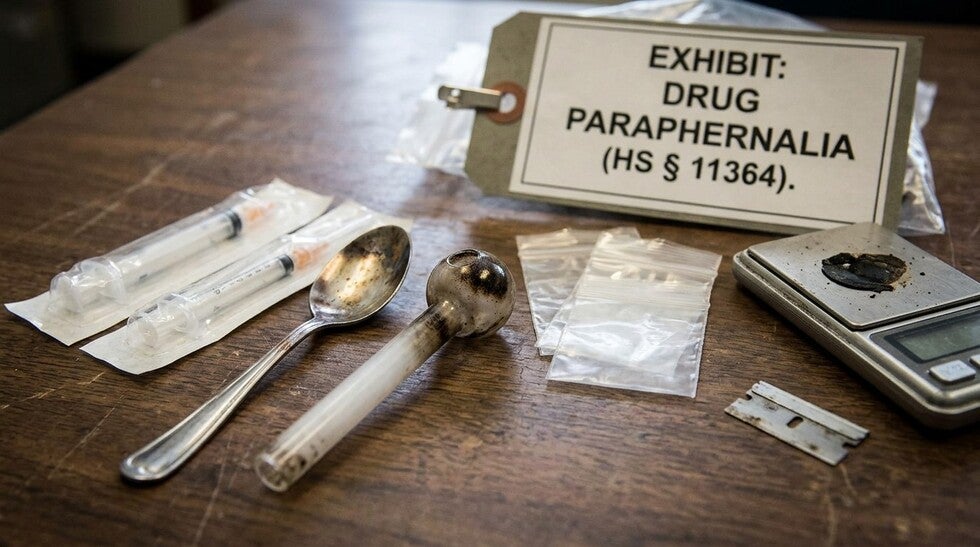
Not every pipe, glass tube, syringe, or piece of equipment automatically qualifies as illegal paraphernalia under Health and Safety Code § 11364. The prosecution must connect the item to the type of unlawful drug use covered by the statute.
California's standard jury instruction focuses on three basic points: the defendant possessed the object, knew it was present, and knew it was an object used for unlawfully injecting or smoking a controlled substance covered by § 11364.
That makes the surrounding evidence important. A prosecutor may rely on the item's appearance, residue, statements, location, or other circumstances to argue what the object was used for. The defense can challenge that evidence when the item has an ordinary use, the alleged drug connection is uncertain, or the evidence does not establish the required knowledge.
Actual Possession Is Not Required
A person does not necessarily have to be holding the item when police find it. California's jury instruction recognizes both actual and constructive possession. A person may be found to possess an item when they have control over it or the right to control it, either personally or through another person.
That distinction matters in cases involving vehicles, shared homes, backpacks, hotel rooms, or other places where more than one person has access.
Simply being near an item is not the same as automatically proving possession. The prosecution still has to establish the required knowledge and possession elements.
What Happens When Police Find Only Residue?
A paraphernalia case can become more important when the alleged drug itself is not present in a usable amount.
California's § 11364 offense is separate from a charge for possessing a controlled substance. The prosecution must still prove the elements of the drug-possession offense independently. A residue-covered pipe therefore does not automatically prove that the person possessed a usable quantity of drugs.
The defense should examine the laboratory evidence, the amount and condition of any substance recovered, the testing performed, and the exact charges filed. A case involving a pipe and residue should not be treated as though the prosecution automatically has proof of a separate drug-possession offense.
Search and Seizure Can Change the Entire Case
The legality of the police search can be one of the most important issues in a § 11364 case.
If officers discovered the alleged paraphernalia during a vehicle search, home search, probation or parole search, consent search, or another type of detention or search, the circumstances surrounding that search should be reviewed carefully.
A defense attorney may need to examine:
-
Why the police stopped or detained the person.
-
Whether the person actually consented to the search.
-
Whether officers had a warrant or another recognized legal basis for the search.
-
Where the item was found.
-
Whether multiple people had access to the location.
-
What officers knew before conducting the search.
If evidence was obtained through an unlawful search or seizure, suppression may affect the prosecution's ability to use that evidence in the case.
California's Current Syringe Exception
The syringe rule deserves special attention because California law changed effective January 1, 2026.
Health and Safety Code § 11364 now expressly states that the statute does not apply to possession solely for personal use of hypodermic needles or syringes. The statute also contains a separate provision concerning needles and syringes that have been placed in an appropriate sharps-disposal container. It further excludes individuals obtaining qualifying controlled-substance checking services from the statute.
This does not mean that every situation involving a syringe is legally protected. The facts still matter, including whether the possession was for personal use and whether another offense is alleged.
Diversion May Be Available Without a Guilty Plea
Health and Safety Code § 11364 is specifically listed in California Penal Code § 1000, which governs the state's statutory drug-diversion procedure.
That makes diversion an important issue to evaluate early in the case. Eligibility is not automatic simply because § 11364 appears in the charging document. The statutory requirements and the defendant's circumstances must be reviewed before determining whether the person qualifies.
For a defendant who is eligible, avoiding a conviction can be particularly important because the consequences of a drug-related conviction can extend beyond the California criminal case.
Immigration Status Requires Separate Review
A § 11364 case should be handled carefully when the defendant is not a U.S. citizen.
Federal immigration law contains grounds of inadmissibility and deportability involving convictions for offenses relating to controlled substances. Because immigration law uses federal definitions and has its own rules concerning convictions, admissions, and the record of the case, the immigration consequences cannot safely be determined from the California misdemeanor label alone.
For that reason, a noncitizen should not accept a plea simply because the criminal penalty appears small. Before entering a plea or accepting another disposition, the person should obtain advice from a qualified criminal defense attorney and, when appropriate, an immigration attorney who can evaluate the specific record and immigration status.
Do Not Judge the Case by the Name of the Charge
A charge for drug paraphernalia may look minor compared with a drug-possession or sales charge. But the correct strategy depends on the evidence, the search, the alleged item, the defendant's knowledge and possession, prior record, diversion eligibility, and—when applicable—immigration consequences.
The best outcome is not always a negotiated reduction. In some cases, the strongest result may come from challenging the search or an element of the offense. In others, an eligible diversion program may provide a better resolution than accepting a conviction.
That is why the defense should evaluate the case from the evidence first, rather than treating § 11364 as a routine misdemeanor.
Frequently Asked Questions
Is having a pipe illegal in California?
A pipe for smoking controlled substances (meth, crack, and the statute's list) yes, a 6-month misdemeanor under HS 11364, typically proven through residue, design, and context. A tobacco pipe is legal; cannabis gear is legal adult commerce; and syringes are exempt for personal use. The contested middle multi-use glassware and tools requires use-and-context proof the defense tests: residue analysis, honest alternative uses, and whose item it actually was. Even where the element proof is real, diversion ends these cases with no conviction the outcome nearly every simple paraphernalia file should reach.
Are syringes really legal to possess in California?
For personal use yes: California amended the law to exempt hypodermic needles and syringes from the paraphernalia statute as a public-health measure (encouraging safe possession and disposal rather than needle-sharing), so the syringe alone supports no 11364 charge. The boundaries: the drugs themselves remain governed by the possession statutes, sales and furnishing rules still apply to distribution contexts, and residue-bearing syringes can appear as evidence in possession cases even though the device itself isn't chargeable. If you were cited over syringes alone, the exemption is the defense and it wins.
Can I get diversion for a paraphernalia charge?
Yes it's a core PC 1000 offense: personal-use conduct with the full pretrial-diversion structure NO guilty plea entered, a treatment/education program, and on completion the charge dismissed with the arrest deemed never to have occurred for nearly all purposes; judicial misdemeanor diversion (1001.95) provides a second track. The strategic order still matters: where the search or attribution is weak, suppression and dismissal come first (better than any program); where the proof is real, diversion is the floor that ends the case without a conviction. Failure just returns the case with trial rights intact. For a six-month misdemeanor, the system offers a genuinely clean exit - take it in the right order.
Can a paraphernalia conviction really affect immigration status?
Severely and it's this offense's hidden danger: federal immigration law's controlled-substance grounds reach convictions ‘relating to' controlled substances, and courts have applied them to paraphernalia convictions producing deportability and inadmissibility findings over a pipe, with only the narrowest exceptions. The shield is structural: modern PC 1000 diversion enters NO plea and produces NO conviction, leaving immigration law nothing to punish which is why no non-citizen should resolve ANY paraphernalia charge, however small it looks, without dual criminal-immigration advice first, and why the quick arraignment plea is uniquely catastrophic here. If a plea already happened, post-conviction vacatur avenues exist and deserve immediate review but prevention through diversion beats every cure.
Section 11364 is the smallest drug charge with the largest hidden edge a pipe-sized misdemeanor that deports people who plead fast and clears completely for people who resolve it in order: suppress, divert, and never hand the system a conviction it doesn't require. The Bulldog Law's drug crimes defense team runs that order statewide. Contact the firm online or call (888) 928-1609.