
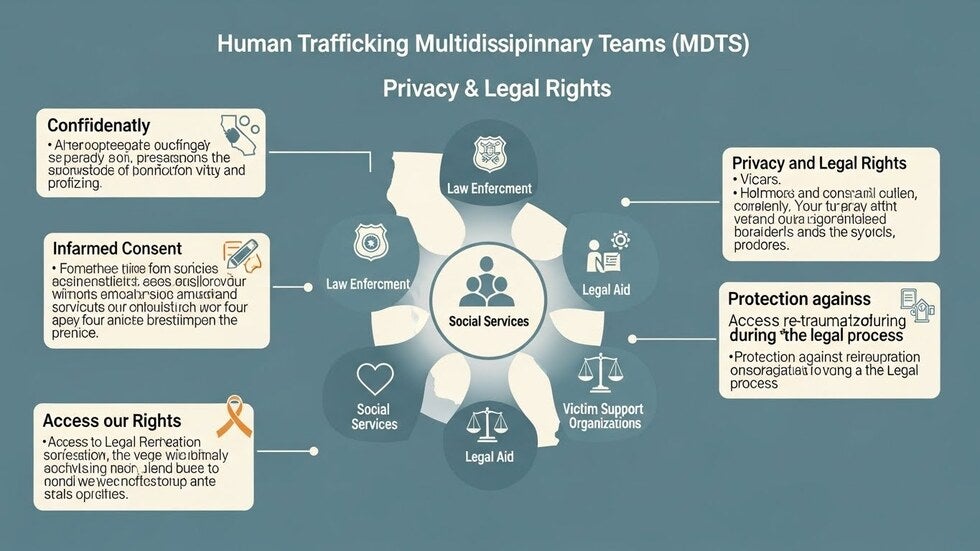
Human trafficking cases involve complex legal, medical, and social dimensions that often require coordination among multiple agencies and professionals. California law permits the establishment of human trafficking multidisciplinary personnel teams to address these complicated situations more effectively. However, if you find yourself involved in a human trafficking investigation whether as someone accused, a witness, or someone seeking assistance understanding how these teams operate and what privacy protections exist is essential for protecting your rights and making informed decisions.
The Legal Framework for Human Trafficking Teams
California Penal Code Section 13753 authorizes cities, counties, and community-based nonprofit organizations to create human trafficking multidisciplinary personnel teams. These teams must include at least two professionals trained in the prevention, identification, management, or treatment of human trafficking cases. The professionals must be qualified to provide a comprehensive range of services addressing the multifaceted challenges these cases present.
The establishment of these teams reflects California's recognition that human trafficking situations rarely fit into neat categories that single agencies can address effectively. Victims may need medical care, mental health services, housing assistance, immigration support, and legal representation simultaneously. Investigations may require coordination between local police, federal agencies, prosecutors, and specialized advocates. These teams exist to facilitate that coordination while maintaining appropriate safeguards for everyone involved.
Who Participates in Human Trafficking Multidisciplinary Teams?
The composition of human trafficking multidisciplinary teams mirrors the complexity of the cases they address. Law enforcement personnel bring investigative capabilities and public safety expertise. Medical professionals provide healthcare services and document evidence of abuse or exploitation. Mental health practitioners, including psychiatrists, psychologists, marriage and family therapists, and trained counselors, offer therapeutic support and trauma-informed care.
District attorneys and city attorneys participate when prosecution becomes necessary. Victim witness program personnel help individuals navigate the criminal justice system. Sexual assault counselors and domestic violence counselors contribute specialized knowledge about trauma and recovery. Social service agencies address housing, financial, and family support needs. Child welfare workers become involved when minors are affected. County health departments coordinate medical and public health responses.
Public assistance workers help with benefits and economic stability. Nonprofit counseling professionals provide additional therapeutic resources. Civil legal service providers assist with immigration matters, expungement petitions, victim compensation claims, and other legal issues. Human trafficking caseworkers offer specialized advocacy and case management tailored to the unique needs of trafficking survivors.
This diverse membership allows teams to address cases from multiple angles simultaneously, ideally creating more effective interventions than any single agency could provide alone.
How Information Sharing Works Within These Teams
Understanding information sharing protocols is crucial for anyone involved in a human trafficking case. Following a report of suspected human trafficking, team members engaged in prevention, identification, and treatment may share information with each other under specific circumstances. A team member can disclose information designated as confidential under state law if they reasonably believe it is generally relevant to preventing, identifying, or treating human trafficking.
This information sharing authority exists to enable coordinated responses. Without it, team members might work at cross purposes or duplicate efforts unnecessarily. However, this authority comes with significant limitations designed to protect individual privacy.
California law requires each county to develop detailed protocols governing how and what information may be shared by human trafficking multidisciplinary teams. These protocols must ensure that confidential information is not disclosed in violation of state or federal law. Each participating agency receives copies of these protocols, and all personnel involved in the team must follow them strictly.
Information can be shared telephonically or electronically, but only if adequate verification of team member identity occurs. Disclosure and exchange of information must remain limited to team members and persons specifically designated as qualified to receive such information. Sharing information with anyone outside these boundaries violates the law.
Consent Requirements Protect Individual Privacy
Despite the information sharing authority granted to these teams, California law imposes significant consent requirements that protect individual privacy. Team members who obtain confidential information from an individual cannot disclose that information to other team members unless they have obtained informed, written, reasonably time limited consent from that individual. This consent must comply with all applicable state and federal confidentiality laws.
Before obtaining consent, team members must inform the individual that information may be shared with law enforcement or other entities without consent if required by law. This notification requirement ensures that people understand the boundaries of confidentiality before agreeing to information sharing.
For anyone involved in a human trafficking investigation, understanding these consent requirements is vital. You maintain significant control over what information is shared and with whom, except when legal mandates require disclosure. If team members request your consent to share information, you have the right to understand exactly what information they want to share, with whom, and for what purpose before making that decision.
Legal Privileges Remain Protected
One of the most important protections in California's human trafficking multidisciplinary team framework involves the preservation of legal privileges. When someone consents to information sharing within the team context, this consent does not waive any privilege or confidentiality provision established under California law.
Communications with attorneys remain protected by the attorney client privilege. Discussions with therapists maintain psychotherapist patient privilege protection. Conversations with physicians stay within the physician patient privilege. Communications with sexual assault counselors, domestic violence counselors, and human trafficking caseworkers retain their respective privilege protections under the Evidence Code.
This distinction carries enormous significance for anyone working with a criminal defense attorney while involved with a multidisciplinary team. Your communications with your lawyer remain confidential and privileged regardless of what information you consent to share with team members for other purposes. You can participate in team services or interventions without compromising your ability to defend yourself legally.
Confidentiality of Team Meetings and Discussions
Team meetings themselves receive confidentiality protection under California law. Any discussion regarding the disclosure or exchange of information during a team meeting is confidential. Testimony concerning those discussions is not admissible in criminal, civil, or juvenile court proceedings unless specifically required by law.
This protection serves several important functions. It encourages honest, thorough discussion among team members about how to address complex situations without fear that their deliberations will be dissected in court. It prevents the team coordination process from becoming another source of evidence for prosecution or civil litigation. It allows professionals to consult with each other about challenging cases while maintaining appropriate boundaries between the coordination function and legal proceedings.
Privacy Obligations Extend to All Team Members
Every member of a human trafficking multidisciplinary personnel team operates under strict privacy and confidentiality obligations. When team members receive information or records regarding children or families in their capacity as team members, they become subject to the same privacy and confidentiality obligations and penalties as the person who originally disclosed or provided the information.
This creates a chain of responsibility ensuring that confidential information receives consistent protection regardless of how many team members access it. Information and records must be maintained in ways that ensure maximum protection of privacy and confidentiality rights for everyone involved.
If you discover that a team member has inappropriately disclosed your confidential information, existing civil and criminal penalties apply to that inappropriate disclosure. You may have legal recourse against the responsible parties, and your attorney can help you understand your options.
Information Created During Investigations
Information and records created during the course of investigations receive protection as private and confidential materials. These materials are protected from discovery and disclosure by applicable statutory and common law protections, except where disclosure is required by law.
This protection matters significantly in subsequent legal proceedings. Information gathered by the multidisciplinary team for coordination and service provision purposes cannot automatically be accessed by parties in criminal or civil cases. The law recognizes that the team's coordination function requires some separation from adversarial legal processes.
County Protocols Make a Difference
Because each county develops its own protocols governing human trafficking multidisciplinary teams, specific procedures can vary considerably depending on where your case is located. These protocols should clearly describe what information may be shared, under what circumstances, through what procedures, and with what safeguards.
If you are involved in a case where a human trafficking multidisciplinary team is active, reviewing the relevant county protocols with your attorney can provide valuable insights into how information about your situation may be handled. Your lawyer can identify whether team members are following the protocols correctly and can challenge any violations of those protocols.
Implications for Your Legal Defense
If you face criminal charges related to human trafficking allegations and learn that a multidisciplinary team is involved, several key considerations deserve attention. First, while these teams have authority to share certain information among members, significant consent requirements and privacy protections limit what can be disclosed without your permission. Second, your communications with your defense attorney remain privileged regardless of team involvement. Third, you have the right to understand what information is being shared about you and why.
Working with experienced legal counsel becomes critically important when multidisciplinary teams are involved in your case. An attorney who understands how these teams operate can help ensure that your privacy rights are respected, that information sharing occurs only within legal boundaries, and that any violations of protocols or confidentiality requirements are identified and addressed. Your lawyer can also help you make informed decisions about whether to consent to information sharing requests and can advise you about the potential consequences of consenting or declining.
Protecting Your Rights Throughout the Process
Human trafficking multidisciplinary personnel teams represent California's approach to coordinating complex responses across multiple systems and disciplines. While these teams have authority to share certain information to facilitate their work, they operate within a legal framework designed to protect individual privacy and maintain important legal privileges. Understanding how these teams function, what limitations apply to their information sharing authority, and what rights you maintain throughout the process empowers you to protect your interests effectively while navigating these challenging situations. Contact Bulldog Law at (888) 928-1609 to speak with experienced attorneys who can protect your rights and guide you through complex human trafficking investigations.