
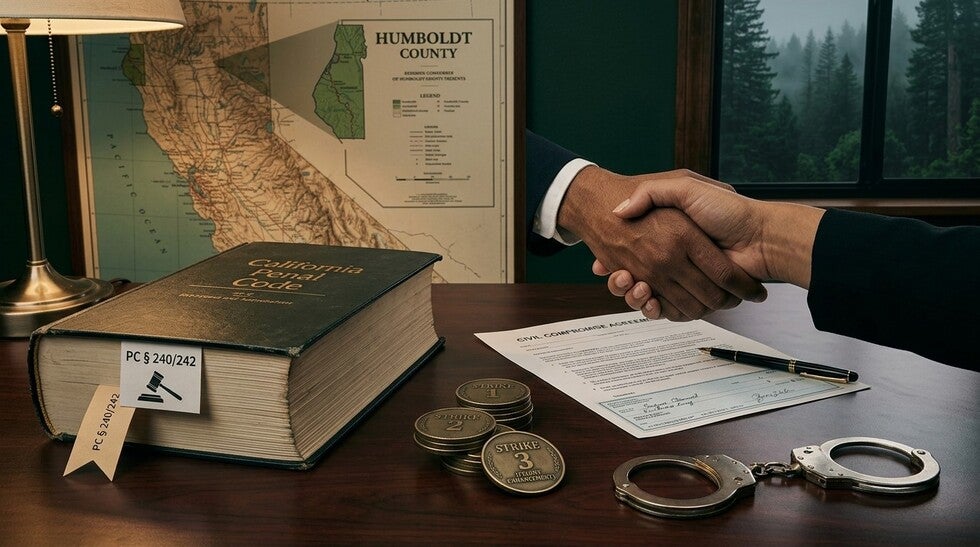
One bottle on the bar. One glass in your hand during an argument. Suddenly you're not looking at a misdemeanor anymore, you're looking at a felony strike that follows you for life. Here's the one question that actually decides which one you're facing.
The question that decides everything
Simple battery under PC § 242 is a misdemeanor, up to six months, no strike. PC § 245, assault with a deadly weapon or force likely to cause great bodily injury, is a completely different animal, a wobbler carrying up to four years as a felony, plus a permanent serious felony strike.
The entire case turns on one thing: was an object actually used as a deadly weapon, or specifically threatened in a way that was objectively likely to cause great bodily injury? Just having an object nearby is never enough on its own.
A lot of Humboldt County cases like this start in the Arcata and Eureka bar districts, where the best resolution is often civil compromise or a mutual-combat self-defense argument, not a conviction at all. These cases move through the Humboldt County Superior Court at 825 Fifth Street in Eureka.
How bar fights become felony strikes
Arcata's bar district near the Cal Poly Humboldt campus and the Arcata Plaza, and Eureka's Old Town, draw students and patrons out for an evening. Sometimes those evenings end in a confrontation, with another patron, with staff, or between groups.
These places are full of the ordinary stuff any bar has: glassware, bottles, barstools, pool cues. And here's what happens a lot more than people realize, prosecutors sometimes point to one of these objects and call it a deadly weapon, turning a misdemeanor battery into a PC § 245 felony strike.
The legal standard is clear, even if it doesn't always get applied that way: a bottle sitting on the bar isn't a deadly weapon. A glass someone was holding during an argument isn't a deadly weapon. A barstool in the room isn't a deadly weapon. The object has to have actually been used, or specifically threatened, in a way that was objectively likely to cause great bodily injury. According to NIAAA, an estimated 696,000 college students between 18 and 24 are assaulted each year by another student who's been drinking, which gives you a sense of just how common these bar-district confrontations really are, and why the object-versus-conduct distinction matters so much.
The bar setting also shapes the self-defense picture. When two people who've been drinking end up in a fight, the questions of who started it, who escalated it, and whether it was really mutual all become central to the defense. And for Cal Poly Humboldt students specifically, a strike conviction doesn't just mean prison exposure, it also means university disciplinary proceedings and background-check consequences that can follow them for years.
I've worked cases where a bar surveillance video told a completely different story than the police report, the "weapon" turned out to be a glass that never left the bar top. That's exactly the kind of detail that can change a felony case into a dismissed misdemeanor.
How civil compromise can dismiss a battery case entirely
Under PC § 1377, a misdemeanor battery charge can be fully dismissed, no conviction, no record, if the alleged victim is compensated and tells the court they're satisfied. That's a real, complete resolution, not a slap on the wrist dressed up as one.
For Cal Poly Humboldt students whose academic future depends on a clean record, for professionals whose licensing is on the line, and for anyone in Eureka, Arcata, or Fortuna dealing with a one-time incident rather than an ongoing dangerous relationship, civil compromise often genuinely serves everyone's interests better than a conviction would. We check for this option at the very first meeting, every time it's on the table.
PC § 242 vs. PC § 245: what actually separates them
PC § 242 simple battery: misdemeanor, no strike. PC § 245 assault with a deadly weapon: wobbler, up to four years, and a permanent strike. The whole distinction rests on whether the prosecution can prove a specific object was actually used or specifically threatened in a way that was objectively likely to cause great bodily injury, mere presence never gets there on its own.
The strike is really the part that matters long-term. According to California's courts, a strike counts under the state's Three Strikes law, and it doubles the sentence on any future felony conviction, meaning a single bad night at a bar could shape sentencing decades down the road, on a case that has nothing to do with the original incident. We fight every deadly weapon characterization with the actual facts, working to keep the case where it belongs: at the misdemeanor battery level, without the strike.
How self-defense actually gets proven
Self-defense cases live and die on timing. Photographs of your own injuries, taken within hours, are the single most time-sensitive piece of evidence in any two-sided assault case, bruises fade fast, and once they're gone, that evidence is gone with them.
Body camera footage from the Sheriff, Eureka PD, or Arcata PD, and any bar or business surveillance footage, all have limited retention windows too. If it's not preserved quickly, it can disappear entirely. From there, we build out the fuller picture, prior threatening behavior from the other person, the real history between the two of you, and witness accounts, starting from day one.
What to do after an assault arrest
-
Photograph your own injuries immediately. This is the single most time-sensitive step you can take.
-
Identify every witness, and note any bar or business cameras that might have caught the incident.
-
Document every object near the confrontation, specifically noting whether it was touched, used, or even mentioned.
-
If this was a one-time confrontation, ask us about civil compromise eligibility at the first consultation.
-
If you're a Cal Poly Humboldt student, reach out to us about the university disciplinary and background-check consequences you could be facing.
-
Call (888) 928-1609.
The courthouse
Humboldt County Superior Court 825 Fifth Street, Eureka, CA 95501
(Criminal Division: 421 I Street, Eureka, CA 95501)
We serve Eureka, Arcata, Fortuna, Ferndale, Trinidad, Rio Dell, Blue Lake, and the rest of Humboldt County. 📞 (888) 928-1609
Final thoughts
A single bad night out shouldn't turn into a lifelong felony strike, but it can, if the object nearby gets mischaracterized and nobody pushes back. Whether it's fighting the deadly weapon label, pursuing civil compromise, or building a real self-defense case from photographs and footage, there's almost always more room to work with than it feels like in the moment. The Bulldog Law has seen exactly how these bar-district cases unfold, and that pattern recognition matters.
Frequently asked questions
How do Arcata and Eureka bar fights become felony cases?
The bar districts near Cal Poly Humboldt and Eureka's Old Town are full of ordinary bar items, glassware, bottles, barstools, pool cues. Prosecutors sometimes characterize one of these as a deadly weapon, turning a misdemeanor battery into a PC § 245 felony strike. But the legal standard requires the object to have been actually used or specifically threatened in a way likely to cause great bodily injury, mere presence is never enough. We challenge every one of these characterizations through the actual facts of what happened.
How does civil compromise work in Humboldt County?
Under PC § 1377, a misdemeanor battery charge can be fully dismissed, no conviction, no record, when the alleged victim is compensated and confirms to the court they're satisfied. This often serves everyone's real interests better than a conviction, especially for a one-time incident rather than an ongoing dangerous situation. We check eligibility at the first consultation in every case where it might apply.
What's the difference between misdemeanor battery and felony assault?
PC § 242 simple battery is a misdemeanor with no strike. PC § 245 assault with a deadly weapon is a wobbler carrying up to four years as a felony, plus a permanent strike. Everything comes down to whether the prosecution can prove a specific object was actually used or specifically threatened in a way objectively likely to cause great bodily injury. The strike is the part with lasting impact, it doubles sentencing on any future felony under California's Three Strikes law.
What evidence matters most in a self-defense case?
Photographs of your own injuries, taken within hours, are the most time-sensitive evidence you have. Body camera and bar surveillance footage matter too, but they get overwritten fast, so they need to be preserved quickly. From there, the fuller picture, the other person's prior behavior, the real history between you, and witness accounts, builds out the case.
Will a felony strike affect me even if I never go back to prison?
Yes. A strike doesn't just affect the current case, it stays on your record and doubles the sentence on any future felony conviction under California's Three Strikes law, even one completely unrelated to the original incident. That's exactly why keeping a case at the misdemeanor level, rather than letting it become a felony strike, matters so much beyond just the immediate outcome.
For more on Arcata and Eureka bar district PC § 245 deadly weapon challenges, Cal Poly Humboldt student consequences, civil compromise, self-defense and mutual-combat evidence, and assault defense at the Humboldt County Superior Court, visit The Bulldog Law criminal defense blog.