
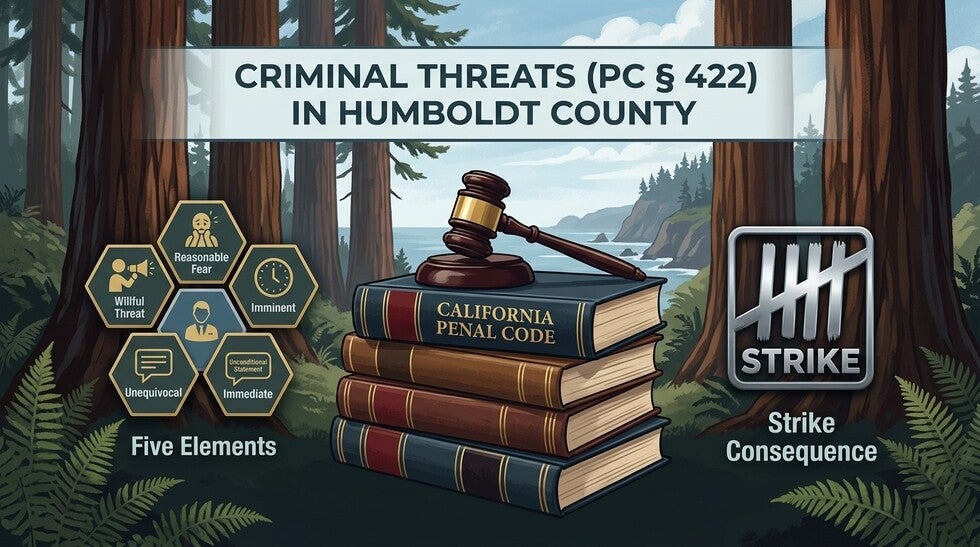
Criminal threats under PC § 422 is a strike in Humboldt County but a conviction requires the prosecution to prove five specific elements, and angry words spoken in the heat of an argument usually don't meet them. PC § 422 is a wobbler: misdemeanor up to one year, or felony carrying up to three years plus a permanent serious felony strike. It is frequently charged alongside domestic violence and in the aftermath of heated confrontations. But the statute does not criminalize anger, profanity, or vague statements made in frustration it requires proof of five specific elements, each of which is a point of defense. These cases proceed at the Humboldt County Superior Court at 825 Fifth Street in Eureka, and the defense focuses on the elements the prosecution cannot prove.
What Are the Five Elements of a Criminal Threat in Humboldt County?
A PC § 422 conviction requires all five: a threat of death or great bodily injury, specific intent that it be taken as a threat, an unequivocal and immediate threat, sustained fear, and that the fear was reasonable. The prosecution must prove every one of these elements beyond a reasonable doubt, and the failure of any single element defeats the charge. First, the defendant willfully threatened to kill or cause great bodily injury to another person. Second, the defendant specifically intended the statement to be taken as a threat (not merely that words were spoken). Third, the threat was, on its face and under the circumstances, so unequivocal, unconditional, immediate, and specific that it conveyed a gravity of purpose and an immediate prospect of execution this is where vague statements, conditional statements (‘if you ever…'), and emotional outbursts frequently fail. Fourth, the threat actually caused the alleged victim to be in sustained fear ‘sustained' meaning more than momentary or fleeting. Fifth, the alleged victim's fear was reasonable under the circumstances. Each element is a defense point: angry words in the heat of an argument frequently lack the specific intent to be taken as a threat; vague or conditional statements frequently fail the unequivocal-and-immediate element; and a fear that was momentary, or that the circumstances don't make reasonable, defeats the sustained-fear and reasonableness elements. We analyze every Humboldt County PC § 422 case element by element at the Eureka courthouse and challenge each element the evidence doesn't support.
Do Angry Words in an Argument Count as a Criminal Threat in Humboldt County?
Usually not emotional outbursts and vague or conditional statements typically fail the specific-intent and unequivocal-threat elements. The most common PC § 422 defense scenario involves words spoken in anger during a heated argument often a domestic dispute that the prosecution later charges as a criminal threat. But the statute requires a threat so unequivocal, unconditional, immediate, and specific that it conveys an immediate prospect of execution, plus the specific intent that the statement be taken as a threat. Vague statements (‘you'll be sorry'), conditional statements (‘if you ever do that again…'), and emotional venting frequently fail these elements as a matter of law. We examine the exact words, the context, and the circumstances in every Humboldt County PC § 422 case and challenge the charge where the statement doesn't meet the statutory threshold at the Eureka courthouse.
Why Does the Strike Consequence Make a PC § 422 Conviction So Serious?
A felony PC § 422 conviction is a serious felony strike that counts under California's Three Strikes law for life.When charged as a felony, PC § 422 is a serious felony under PC § 1192.7 and therefore a strike. A strike doubles the sentence on any future felony, requires serving 85% of the sentence, and limits plea options for the rest of the defendant's life. This makes the felony-versus-misdemeanor determination and the complete defeat of the charge through the elements critically important. We pursue reduction to a misdemeanor under PC § 17(b) where a felony is charged, and pursue complete defeat of the charge through the elements wherever the evidence supports it, to avoid the permanent strike at the Eureka courthouse.
The Courthouse
Humboldt County Superior Court
825 Fifth Street, Eureka, CA 95501
(Criminal Division: 421 I Street, Eureka, CA 95501)
What Should You Do After a Criminal Threats Arrest in Humboldt County?
- Invoke your right to remain silent immediately. Do not explain or characterize what you said.
- Write down, as precisely as you can recall, the exact words used and the full context of the conversation.
- Identify every witness who heard the exchange and can describe the context and tone.
- Preserve any text messages, voicemails, or recordings that show the full context of the exchange.
- If this arose from a domestic dispute, contact The Bulldog Law about the related DV exposure and the strike consequence.
- Call (888) 928-1609.
Eureka: Eureka office | Arcata: Arcata office | Fortuna: Fortuna office | Ferndale: Ferndale | Trinidad: Trinidad | Rio Dell: Rio Dell | Blue Lake: Blue Lake | Humboldt County: Humboldt County office | (888) 928-1609
Criminal Threats Defense Questions in Humboldt County
What are the five elements of a criminal threat in Humboldt County?
A PC § 422 conviction requires all five elements beyond a reasonable doubt: (1) a willful threat to kill or cause great bodily injury; (2) specific intent that the statement be taken as a threat; (3) a threat so unequivocal, unconditional, immediate, and specific that it conveyed an immediate prospect of execution; (4) that the threat actually caused sustained more than momentary fear; and (5) that the fear was reasonable. The failure of any single element defeats the charge. Vague statements, conditional statements, and emotional outbursts frequently fail the specific-intent and unequivocal-threat elements. We analyze every Humboldt County PC § 422 case element by element at the Eureka courthouse.
Do angry words in an argument count as a criminal threat in Humboldt County?
Usually not. The statute requires a threat so unequivocal, unconditional, immediate, and specific that it conveys an immediate prospect of execution, plus the specific intent that the statement be taken as a threat. Vague statements (‘you'll be sorry'), conditional statements (‘if you ever do that again…'), and emotional venting during a heated argument frequently fail these elements as a matter of law. We examine the exact words, the context, and the circumstances in every Humboldt County PC § 422 case and challenge the charge where the statement doesn't meet the statutory threshold at the Eureka courthouse.
Why is a PC § 422 conviction so serious in Humboldt County?
When charged as a felony, PC § 422 is a serious felony under PC § 1192.7 and therefore a strike under California's Three Strikes law. A strike doubles the sentence on any future felony, requires serving 85% of the sentence, and limits plea options for the rest of the defendant's life. This makes the felony-versus-misdemeanor determination and the complete defeat of the charge through the elements critically important. We pursue reduction to a misdemeanor under PC § 17(b) where a felony is charged, and complete defeat of the charge through the elements wherever the evidence supports it, at the Eureka courthouse.
For more on the five elements of criminal threats, the angry-words and conditional-statement defenses, the protected-speech line, the strike consequence, and criminal threats defense at the Humboldt County Superior Court in Eureka, visit The Bulldog Law criminal defense blog.