
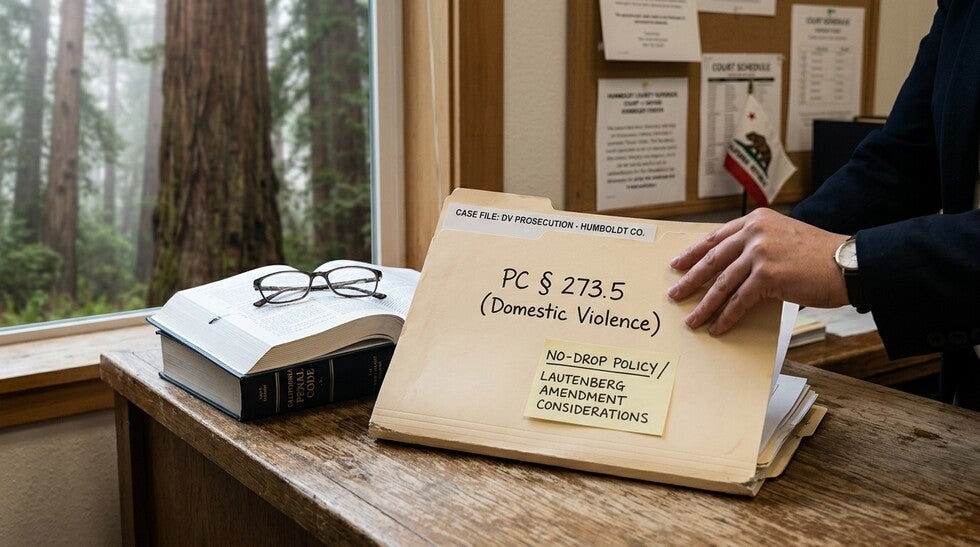
Your partner called 911, and now she's telling everyone she wants the case dropped. You think it's over. It isn't. In Humboldt County, that decision was never really hers to make, and understanding why matters more than almost anything else in this kind of case.
Who actually decides if the case moves forward
In Humboldt County, the District Attorney decides whether a domestic violence case proceeds, not the alleged victim. Prosecutors here regularly move forward even when the alleged victim wants everything to just go away.
Here's how it plays out on the ground: when the Sheriff, Eureka PD, or Arcata PD respond to a DV call, they document everything right there at the scene, injuries, the 911 recording, body camera footage, immediate statements. All of that goes straight to the DA. If the alleged victim later decides not to cooperate, that decision gets weighed against the independent evidence, it's not treated as a veto over the whole case.
This is Humboldt's no-drop policy in practice, and it puts charging authority firmly with the DA at the Humboldt County Superior Court. Both felony and misdemeanor convictions here trigger the permanent Lautenberg federal firearms ban, a genuinely serious consequence in a rural county where guns are just part of daily life: hunting, ranching, protecting property.
Can the DA still prosecute if the alleged victim recants?
Yes, and this catches people off guard constantly. A lot of Humboldt DV cases involve someone who wants it all to disappear, a partner who called 911 in a heated moment and now regrets it, a couple who's reconciled since. But the 911 recording, the body camera footage, the injury photos, and the officer's own observations already went to the DA the night of the arrest. The recantation gets weighed against all of that.
According to the Department of Justice, evidence-based prosecution grew directly out of the recognition that domestic violence cases had dismissal rates far higher than other crimes, because they leaned too heavily on victim testimony alone, and no-drop approaches were built specifically to use 911 recordings, injury photos, and officer observations instead.
I've seen defendants genuinely believe the case would just fade away once the other person stopped cooperating, only to find themselves facing active prosecution weeks later on evidence they never expected to matter. The defense has to start from the day of the arrest, no matter what the alleged victim says or wants afterward.
Why a DV conviction can end your firearms rights for good
PC § 273.5, corporal injury to a spouse or cohabitant, is a wobbler, felony carries two, three, or four years, misdemeanor carries up to one year. But here's the part that catches people by surprise: both the felony and the misdemeanor version trigger the federal Lautenberg Amendment's permanent firearms prohibition.
According to the ATF, a qualifying misdemeanor crime of domestic violence prohibits firearm possession under federal law regardless of any state-level restoration of rights, and unlike most federal firearm prohibitions, there's no exception for law enforcement or military personnel. That last part surprises a lot of people. A conviction also requires a certified 52-week Batterer's Intervention Program, and it carries real immigration consequences for non-citizens.
In a county where hunting in Six Rivers National Forest, rural property protection, and the North Coast's firearms culture make guns a routine part of everyday life, losing that right permanently is a heavy consequence, one that exists completely independent of anything California itself might later restore.
The one outcome that avoids the Lautenberg trigger entirely is DV diversion under PC § 1000.6. Complete the 52-week BIP, and the charge is fully dismissed, no conviction at all, no Lautenberg trigger. We check diversion eligibility at the very first meeting in every case, because it's genuinely the outcome worth prioritizing wherever someone qualifies.
How this affects tribal community members
Humboldt County is home to several federally recognized tribes, the Yurok, Hupa, Wiyot, and Karuk. For tribal community members facing DV charges, there's a second layer beyond the state court case: the reality of tribal community life itself.
The interaction between state jurisdiction and tribal jurisdiction, and the community networks through which a case becomes known, sometimes long before it reaches court, both require real care. We walk through this full context, tribal jurisdiction included, at the first consultation, and we push for DV diversion producing a full dismissal wherever someone qualifies.
How self-defense actually gets proven in a DV case
Timing is everything here. Photographs of your own injuries, taken within hours, are the single most time-sensitive piece of evidence in any two-sided DV case, bruises fade, and once they're gone, that evidence is gone too.
Body camera footage from the Sheriff, Eureka PD, or Arcata PD has a limited retention window, so it has to be preserved fast. From there, we build the rest of the picture: the other person's prior threatening conduct, the real history between you, and witness accounts, starting from the very first day of representation.
What to do after a DV arrest
-
Comply completely with every EPO term, even if the alleged victim reaches out to you first.
-
Photograph your own injuries immediately. This is the single most time-sensitive thing you can do.
-
If you own firearms, contact us right away about Lautenberg compliance and surrender requirements.
-
If you're a tribal community member, reach out about tribal jurisdiction and the community dimension of your case.
-
If you're a Cal Poly Humboldt student or a non-citizen, talk to us about the specific consequences you're facing.
-
Call (888) 928-1609.
The courthouse
Humboldt County Superior Court 825 Fifth Street, Eureka, CA 95501
(Criminal Division: 421 I Street, Eureka, CA 95501)
We serve Eureka, Arcata, Fortuna, Ferndale, Trinidad, Rio Dell, Blue Lake, and the rest of Humboldt County. 📞 (888) 928-1609
Final thoughts
The hardest part of a DV case in Humboldt County isn't usually the arrest itself, it's the false sense of relief that comes when the other person says they've dropped it. They haven't, not really, and the case can move forward on evidence gathered the very first night. If you're facing this, the time to start building a defense is now, not after you find out the case never actually went away. The Bulldog Law evaluates every angle, diversion eligibility, Lautenberg exposure, self-defense evidence, from the very first call.
Frequently asked questions
Can the Humboldt County DA proceed if the alleged victim recants?
Yes. The 911 recording, body camera footage, injury photographs, and officer observations all go to the DA regardless of what the alleged victim says later. When that independent evidence is strong, the DA proceeds with the case at the Eureka courthouse. Anyone expecting the case to disappear because the alleged victim stopped cooperating often finds themselves facing active prosecution weeks afterward, on evidence they didn't see coming.
How does the Lautenberg Amendment affect Humboldt County DV cases?
Under federal law, any qualifying DV conviction, felony or misdemeanor, permanently prohibits firearm possession, regardless of any restoration of rights under California law. In a rural county where firearms are woven into hunting, ranching, and everyday property protection, that permanent loss is a serious consequence. DV diversion under PC § 1000.6, which produces a full dismissal after completing the 52-week BIP, is the only path that avoids triggering Lautenberg entirely.
How does a DV case affect tribal community members?
Tribal community members facing DV charges deal with both the state prosecution at the Eureka courthouse and the specific realities of tribal community life, including how quickly a case can become known throughout close community networks. The interaction between state and tribal jurisdiction requires real care, and we address that full context at the first consultation, pursuing full dismissal through diversion wherever someone qualifies.
What evidence matters most if I acted in self-defense?
Photographs of your own injuries, taken within hours, matter more than almost anything else, bruises fade fast. Body camera footage also needs to be preserved quickly, since retention windows are limited. From there, prior threatening conduct by the other person and the fuller history between you both build out the rest of the defense.
Does a DV conviction affect immigration status?
Yes. A qualifying domestic violence conviction can carry serious immigration consequences for non-citizens, separate from the criminal penalty itself. This is exactly why pursuing full dismissal through DV diversion, wherever eligible, matters so much, it avoids not just the Lautenberg firearms trigger but these immigration consequences as well.
For more on the Humboldt County no-drop policy, Lautenberg federal firearms consequences in a rural county, tribal community considerations, DV diversion full-dismissal eligibility, self-defense evidence development, and DV defense at the Humboldt County Superior Court, visit The Bulldog Law criminal defense blog.