
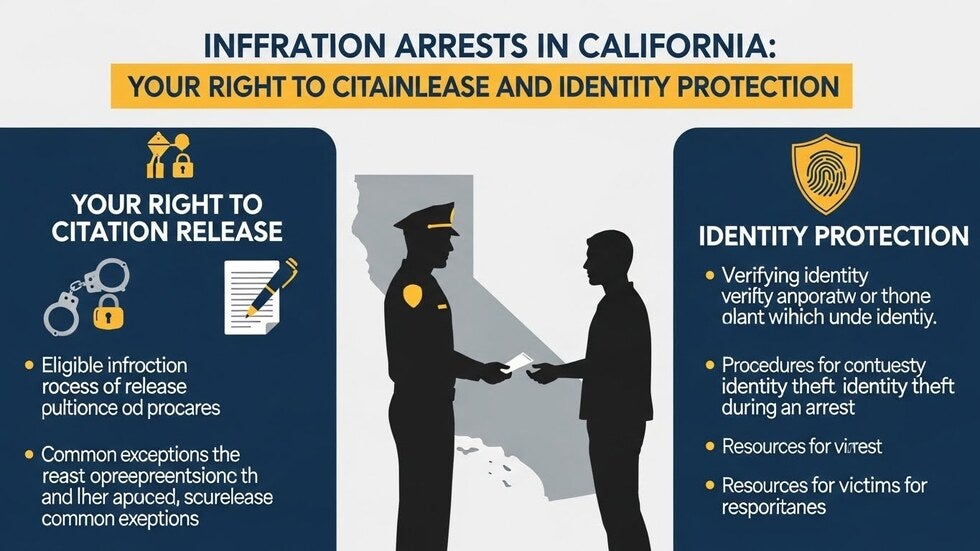
Most people associate arrests with serious crimes, handcuffs, and jail cells. However, California law allows arrests even for infractions, the lowest category of offenses that typically result in fines rather than jail time. If you've been arrested for an infraction, understanding your rights can prevent unnecessary detention and protect your personal information. At Bulldog Law, we ensure that law enforcement respects the legal protections designed to minimize the intrusion that infraction arrests create in your life. These protections exist because infractions are minor violations that should never result in the same treatment as serious criminal offenses.
Understanding Infractions Under California Law
Infractions represent the least serious category of offenses in California's legal system. Unlike misdemeanors and felonies, infractions cannot result in jail sentences. Instead, they carry only monetary fines and potential administrative consequences. Common infractions include most traffic violations, certain municipal code violations, littering, and various other minor regulatory offenses.
Despite their minor nature, infractions still constitute violations of law that courts must address. Law enforcement officers have authority to arrest individuals for infractions under certain circumstances, though this power is limited by important legal protections that favor citation release over physical custody.
The philosophy behind treating infractions differently recognizes that proportionality matters in criminal justice. Using the full force of arrest, detention, and booking procedures for minor violations wastes resources, traumatizes individuals unnecessarily, and undermines public trust in law enforcement. California law therefore establishes a presumption favoring the least intrusive methods of ensuring court appearances for infraction charges.
The Presumption of Citation Release for Infractions
California law creates a strong presumption that people arrested for infractions will be released immediately through a citation rather than being taken into custody. This presumption means that physical arrest and detention should be extraordinarily rare for infraction offenses.
When an officer stops you for an infraction, the standard procedure involves examining your identification, issuing a written notice to appear in court, and requesting your signature acknowledging receipt of the notice. Once you sign, the officer releases you immediately. You never experience booking, fingerprinting, or detention in a jail facility.
This procedure mirrors what most people experience during routine traffic stops. You receive a ticket, sign it, and continue with your day. The signature is not an admission of guilt but simply acknowledgment that you received notice of the charges and the court date when you must appear or otherwise respond.
At Bulldog Law, we emphasize that this process should be standard for all infractions. When officers deviate from citation release procedures, they must have specific legal justification. We hold law enforcement accountable when they unnecessarily escalate infraction stops into custody situations.
Identification Requirements for Citation Release
The primary requirement for citation release on infractions is satisfactory identification. Officers need confidence that they know who you are and can locate you if you fail to appear in court. A valid driver's license typically satisfies this requirement completely, as it contains your photograph, physical description, address, and a unique identification number.
Other forms of identification may also prove satisfactory depending on the circumstances. State issued identification cards, passports, military identification, and other government issued documents generally meet the standard. The key is that the identification must provide reliable information about your identity and how to contact you.
If you cannot produce satisfactory identification, California law allows officers to require a thumbprint on the notice to appear. Typically, officers request your right thumbprint, or your left thumbprint if your right thumb is missing or disfigured. This thumbprint serves solely to verify identity and establish that you are the person who received the citation.
Critical Protections for Your Biometric Information
California law includes important restrictions on how thumbprints collected during infraction arrests can be used. These protections recognize legitimate privacy concerns about biometric data collection and prevent misuse of information gathered during minor law enforcement contacts.
Strict Limitations on Thumbprint Use
Thumbprints taken during infraction citation procedures may only be used for law enforcement purposes relating to the arrestee's identity. This narrow purpose restriction means the thumbprint cannot be used for general criminal investigations, shared with other agencies for unrelated purposes, or compiled into databases for future reference.
The law explicitly prohibits any person or entity from selling, giving away, distributing, including in a database, or creating a database with thumbprints collected during infraction citations. These prohibitions protect against the surveillance state concerns that arise when biometric information is collected broadly and retained indefinitely.
At Bulldog Law, we take violations of these protections seriously. If law enforcement or other agencies misuse thumbprint information collected during infraction citations, we pursue all available remedies to protect our clients' privacy rights and hold responsible parties accountable.
When Officers Can Require Thumbprints
Officers may only require thumbprints when you lack satisfactory identification. If you present a valid driver's license or other acceptable identification, officers cannot demand a thumbprint simply because they prefer to collect this information. The thumbprint requirement exists as an alternative identification method, not as a supplemental data collection tool.
Some officers may be unfamiliar with these limitations or may attempt to collect thumbprints routinely regardless of whether identification has been provided. If an officer demands your thumbprint despite your presentation of satisfactory identification, you can politely decline while noting the officer's name and badge number for potential future legal action.
The Only Circumstances Justifying Custody on Infractions
California law permits taking someone into custody for an infraction only under three specific circumstances. These exceptions are narrow and should be applied rarely.
Refusal to Sign the Notice to Appear
If you refuse to sign the written promise to appear, officers may take you into custody. This exception makes practical sense because the entire citation system depends on defendants' acknowledgment of the charges and their obligation to appear in court. Without a signature, no mechanism exists to ensure you understand these requirements or intend to comply with them.
However, refusal must be genuine and unambiguous. If you have questions about what signing means, if language barriers create confusion, or if you want to consult with an attorney before signing, these situations do not constitute refusal justifying custody. Officers should answer questions and provide clarification rather than immediately resorting to arrest.
Lack of Satisfactory Identification
When you cannot provide any satisfactory identification and cannot or will not provide a thumbprint for the notice to appear, officers may take you into custody. This exception addresses the legitimate concern that releasing someone whose identity cannot be verified creates unacceptable risks that the person will never appear in court.
The standard is lack of any satisfactory identification, not failure to produce a specific type of identification. If you can provide information that allows verification of your identity through other means, custody should not be necessary even if you lack a driver's license or identification card.
Refusal to Provide Thumbprint or Fingerprint
If you lack satisfactory identification and refuse to provide a thumbprint or fingerprint on the notice to appear, officers may take you into custody. This exception combines the previous two concerns: without identification and without willingness to provide a thumbprint for verification purposes, no way exists to document your identity reliably.
Bulldog Law advises clients that if you lack identification, providing a thumbprint generally serves your interests better than being taken into custody. However, we respect that some clients have principled objections to providing biometric information and will defend their rights regardless of the choice they make.
Contesting Infractions Based on Identity Issues
Sometimes people receive citations for infractions they did not commit because someone else used their identity. Perhaps another person provided your name during a traffic stop, or administrative errors resulted in citations being issued to the wrong individual. California law provides specific procedures for contesting charges based on identity disputes.
Submitting Comparison Thumbprints
If you were not the person cited but a thumbprint appears on the notice to appear, you can submit your own thumbprint through your local law enforcement agency for comparison. This process allows you to establish conclusively that you were not the person who received the citation.
You submit a right thumbprint, or left if your right thumb is missing or disfigured, to the court handling your case. The court may refer both your submitted print and the notice to appear to the prosecuting attorney for comparison. Local law enforcement agencies providing this service may charge you actual costs but cannot profit from the service.
Investigation When Comparison Is Inconclusive
When no thumbprint appears on the notice to appear, or when comparing thumbprints produces inconclusive results, the court refers the matter back to the issuing law enforcement agency for further investigation. This referral should occur unless the court determines that further investigation would not serve the interests of justice.
The investigation might include examining officer notes, reviewing any video footage from the stop, interviewing the citing officer, or pursuing other evidence about who actually received the citation. The goal is determining with confidence whether you were the person cited.
Tolling of Speedy Trial Rights During Investigation
When the court initiates investigation or comparison processes, your case is continued and the speedy trial period is tolled for 45 days. This tolling protects the prosecution from losing the ability to pursue charges against you while identity questions are resolved, but it also ensures investigations do not drag on indefinitely.
The 45 day period recognizes that identity investigations require time but should not become drawn out affairs that leave defendants in limbo for months. Law enforcement and prosecutors must prioritize these investigations and respond to courts within the specified timeframe.
Findings of Factual Innocence in Identity Cases
California law provides for findings of factual innocence when evidence establishes that you were not the person cited. These findings carry significant legal and practical consequences that go beyond simple dismissal of charges.
When Courts Must Find Factual Innocence
If the court determines that insufficient evidence exists to establish that you are the person charged, it must make a finding of factual innocence. This finding differs from a not guilty verdict or dismissal. It represents an affirmative judicial determination that you were not involved in the alleged offense.
Similarly, if the prosecuting attorney or issuing agency fails to respond to the court's referral within 45 days, the court must find factual innocence unless doing so would not serve the interests of justice. This requirement prevents agencies from avoiding identity questions by simply ignoring court referrals.
Immediate DMV Notification and License Restoration
When a court makes a finding of factual innocence in an infraction case, it must immediately notify the Department of Motor Vehicles. This notification is critical because many infractions affect driving privileges either directly or through accumulation of points on driving records.
If the DMV determines that the citation in question formed the basis of suspending or revoking your driving privilege, it must immediately set aside that action. This restoration is automatic upon receiving the court's finding of factual innocence. You do not need to file separate applications or pay additional fees to have your license reinstated.
Why Legal Representation Matters Even for Infractions
Many people assume that infractions are too minor to justify hiring an attorney. However, the stakes can be higher than you might think. Accumulating infractions can lead to license suspension, dramatically increased insurance rates, and potential immigration consequences for non citizens. Professional drivers may lose their livelihoods over infractions that affect their commercial driving privileges.
Bulldog Law helps clients understand when fighting infraction charges serves their interests. We evaluate the specific circumstances of your case, assess potential consequences, and develop strategies for achieving the best possible outcomes. Sometimes this means negotiating with prosecutors for reduced charges, other times it involves taking cases to trial to contest citations we believe are unjust.
Protecting Your Rights During Infraction Stops
If an officer stops you for an alleged infraction, remember these key points. Provide identification if you have it. Answer questions about your identity truthfully. If you lack identification and the officer requests a thumbprint, understand that providing it will likely result in immediate release while refusing may result in custody.
Sign the notice to appear after reading it carefully. The signature acknowledges receipt but does not constitute admission of guilt. You retain all rights to contest the charges in court.
If officers threaten custody without legal justification, remain calm and cooperative. Do not physically resist or argue extensively. Note the circumstances and contact Bulldog Law immediately so we can address any rights violations and defend your case effectively.
Your freedom and future matter, regardless of how minor the charges may seem. Contact us today to discuss how we can protect your rights and fight for the best possible resolution of your infraction case.