
By the The Bulldog Law Criminal Defense Team • Reviewed by a licensed California criminal defense attorney
Since January 1, 2023, California police CANNOT stop or ticket you for jaywalking unless your crossing creates an immediate danger of a collision that's the Freedom to Walk Act (AB 2147), and it means the classic ticket for calmly crossing an empty street mid-block is gone. The fine print worth knowing: the underlying rules (like Vehicle Code § 21955's crosswalk requirement between signalized intersections) still exist on the books; when a crossing IS immediately dangerous, an infraction citation no crime, no jail, roughly $200 with assessments remains available; and the reform doubles as a stop-reform: an alleged jaywalk can no longer serve as the pretext for detaining and searching pedestrians absent that danger.
One more thing this page is honest about, because our firm handles both sides of the street: if a car hits you while jaywalking, California's comparative-fault system means you can STILL recover for your injuries. The details below, from The Bulldog Law's defense team.
What the Freedom to Walk Act Actually Changed
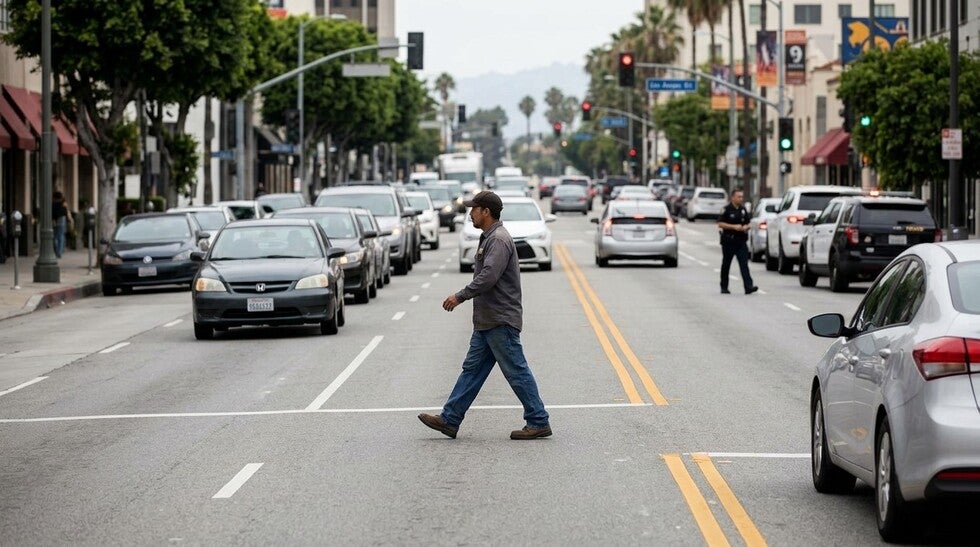
AB 2147 didn't legalize chaos it changed WHEN officers may act: a peace officer may stop or cite a pedestrian for the jaywalking family of infractions ONLY when a reasonably careful person would realize there's an immediate danger of collision with a moving vehicle or device. Translation for daily life: the empty residential street, the 2 a.m. crossing with no cars in sight, the mid-block hop when traffic is stopped not stoppable, not ticketable. Darting through active traffic, stepping into a vehicle's path, crossing against flow that must brake for you still citable, still roughly $200, and still 0 points (it's a pedestrian infraction, not a moving violation on your license).
The Legislature's twin purposes are worth naming because they decide close cases: jaywalking enforcement had been wildly unequal across neighborhoods, and the stops were being used as pretexts so the modern rule is built to make “he was crossing the street” insufficient, by itself, for a detention. If a stop that started with alleged jaywalking turned into a search and charges, that “immediate danger” requirement becomes a suppression argument exactly the kind of technicality criminal defense lives on.
Hit by a Car While Jaywalking? You Can Still Recover
The myth that jaywalking “voids” an injury claim is false: California is a PURE COMPARATIVE FAULT state your recovery is reduced by your percentage of fault, never erased by it. A jury that finds the driver 70% responsible (speeding, phone, failure to yield to a visible pedestrian) and the pedestrian 30% (mid-block crossing) still awards 70% of the full damages and drivers owe ALL pedestrians a duty of care, jaywalkers included: the law expects motorists to watch the road in front of them, not only the crosswalks. Insurers know most people believe the myth, which is why “you were jaywalking” is their opening move on pedestrian claims; the answer is investigation speed analysis, visibility, phone records, camera footage done by a personal injury team that treats fault as a number to be litigated, not a label to be accepted. If you or a family member was struck while crossing anywhere: get medical care, don't give the insurer a recorded statement, and have the fault math done professionally before accepting a cent.
Frequently Asked Questions
Can police stop me for jaywalking in California?
Only when your crossing creates an immediate danger of collision that's the Freedom to Walk Act's rule since 2023. Safe crossings, even technically outside a crosswalk or against a signal, are no longer grounds for a stop or citation, and an officer's hunch or the neighborhood you're walking in doesn't change that. If you were stopped anyway and the encounter escalated into a search or charges, the missing ‘immediate danger' is a genuine legal challenge to everything that followed raise it with counsel rather than arguing it on the sidewalk.
How much is a jaywalking ticket now?
When one can lawfully issue dangerous crossings only the base fine plus court assessments typically lands around $200. It's an infraction: no crime, no jail, no license points (it's not a moving violation), though unpaid tickets grow collections problems like any citation. Contesting is realistic post-AB 2147: the officer must effectively justify that immediate-danger standard, and ‘the street was empty' is now a defense the statute itself endorses. For most people the bigger issue isn't the ticket it's any stop that used jaywalking as a doorway to something else.
Is it illegal to cross mid-block or against a ‘don't walk' signal?
The rules still exist crossing between two signalized intersections outside a crosswalk (VC 21955) and entering against a finished countdown remain on the books but enforcement now requires immediate collision danger, so the practical answer is: cross safely and you're fine; force vehicles to brake or dodge and you're citable. Pedestrians in crosswalks retain the right of way, and drivers owe care to pedestrians everywhere. Our advice as lawyers who see the aftermath: the law freed you to cross the empty street it didn't repeal physics. Look twice; the $200 was never the real risk.
Does jaywalking make a pedestrian automatically at fault in an accident?
No not in California. Pure comparative fault assigns percentages: a jaywalking pedestrian struck by a speeding or distracted driver can still recover the driver's share of full damages, and juries routinely place most fault on motorists who failed to see what was in front of them. Insurance adjusters lead with the jaywalking accusation because the myth saves them money don't accept the framing, don't give recorded statements, and get the crash professionally reconstructed. Pedestrian-versus-car injuries are catastrophic and the fault math is worth real money: have an injury attorney run it before any settlement talk.
California finally matched the law to how humans cross streets safely, judgment intact. Know the immediate-danger line, contest the stops that ignore it, and never let ‘you were jaywalking' shrink an injury claim it doesn't legally shrink. Questions on either side a citation-turned-search or a pedestrian crash The Bulldog Law handles both: criminal defense and injury recovery. Contact the firm online or call (888) 928-1609.