
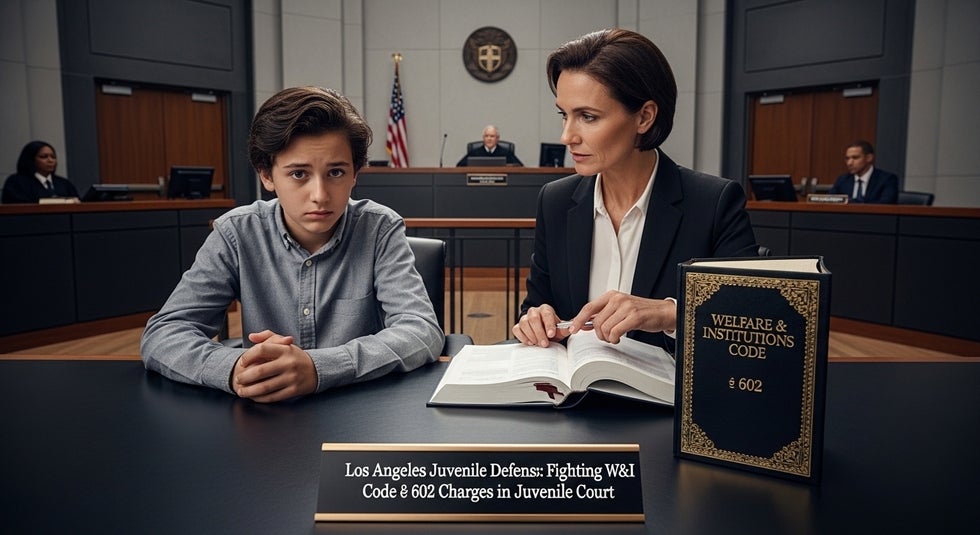
When a minor is accused of a crime in Los Angeles, the stakes are profound for the child, the family, and the future. Welfare and Institutions Code § 602 governs juvenile delinquency proceedings in the Los Angeles County Superior Court Juvenile Division. The LAPD and LASD Juvenile Divisions handle these cases, and prosecutors push hard.
But the juvenile system has unique protections and The Bulldog Law knows exactly how to use them. Start at The Bulldog Los Angles office before this shapes a young person's entire life.
The Bulldog Law defends minors with the same relentless advocacy we bring to adult cases with the added focus on rehabilitation, record sealing, and protecting the child's long term future.
What W&I Code § 602 Means for Los Angeles Juveniles
W&I Code § 602 establishes that any minor who violates any law of California or the United States is subject to the jurisdiction of the juvenile court. Unlike the adult criminal system, the juvenile system is theoretically rehabilitative focused on treatment, supervision, and education rather than punishment.
However, certain serious offenses can result in the minor being tried as an adult through a fitness hearing under W&I Code § 707. If the juvenile court finds the minor is not fit for juvenile court treatment, the case is transferred to adult criminal court where adult sentences apply, including state prison.
How The Bulldog Challenges LAPD and LASD Juvenile Evidence
Juvenile cases in Los Angeles often arise from school incidents, gang allegations, or peer conflicts. The evidence frequently involves school security footage, social media posts, and statements made to school officials or LAPD/LASD school resource officers.
Statements made to school officials can sometimes be used against minors but statements made in custodial interrogation without Miranda warnings and parental notification are suppressible. We review every statement for constitutional validity.
Identification challenges apply equally in juvenile cases. Witness identifications, surveillance footage, and forensic evidence are all contestable.
We fight fitness hearings aggressively. If the prosecution seeks to transfer a juvenile to adult court under W&I § 707, we present comprehensive rehabilitation evidence school records, family support, mental health treatment, and character evidence to demonstrate the minor is amenable to juvenile court treatment.
What to Do in the First 24 Hours After a Juvenile Arrest in Los Angeles
After a juvenile arrest by LAPD or LASD, the minor is typically taken to a Juvenile Hall facility. In Los Angeles County, Eastlake Juvenile Hall and Los Padrinos Juvenile Hall are primary intake facilities. Parents or guardians are notified.
Do not allow the minor to make statements to law enforcement without an attorney present. Juveniles have the right to remain silent and the right to counsel. Exercise both immediately.
The detention hearing the juvenile equivalent of arraignment occurs at the Los Angeles County Superior Court Juvenile Division within 72 hours. The Bulldog Law will be there to fight for release to parental custody and begin building the defense.
Record Sealing and Long Term Protection
Under W&I Code § 781, a minor's juvenile record may be sealed once they turn 18 (or 5 years after the jurisdiction of the juvenile court ends), if certain conditions are met. We pursue record sealing proactively for every juvenile client because the sealing of a juvenile record can protect educational opportunities, employment, and housing for a lifetime.
Frequently Asked Questions
Can a juvenile be tried as an adult in Los Angeles?
Yes. Under W&I Code § 707, the juvenile court may transfer a minor to adult court after a fitness hearing if the court determines the minor is not amenable to juvenile court treatment.
What is the difference between juvenile court and adult criminal court in California?
Juvenile court under W&I § 602 focuses on rehabilitation and uses different terminology (petition instead of complaint, disposition instead of sentence). Adult court can impose state prison sentences.
Can a juvenile record be sealed in California?
Yes. Under W&I Code § 781, juveniles may petition to seal their records after age 18 or 5 years after jurisdiction ends, subject to offense specific limitations.
What rights do juveniles have during police questioning in Los Angeles?
Juveniles have the right to remain silent and the right to an attorney. Statements obtained in custodial interrogation without Miranda warnings and parental notification may be suppressed.
Where are juveniles detained in Los Angeles after arrest?
Los Angeles County operates Eastlake Juvenile Hall and Los Padrinos Juvenile Hall as primary juvenile detention facilities, pending detention hearings at the Juvenile Division of Los Angeles County Superior Court.
Facing charges in Los Angeles? The Bulldog Law fights for you relentlessly, in state and federal court.Visit our The Bulldog Los Angles office