
Updated November 2026 | The Bulldog Law | California Criminal Defense
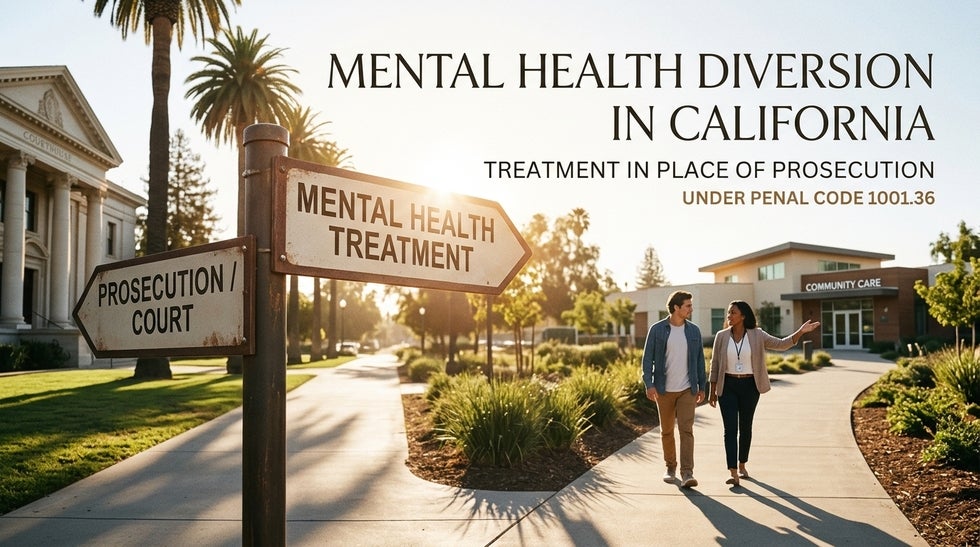
Mental health diversion lets a person charged with a crime in California receive treatment instead of being prosecuted. Under Penal Code 1001.36, a judge can suspend the case for up to two years while the defendant follows a treatment plan. If the plan is completed, the charges are dismissed and the arrest is treated as though it never occurred. It applies to misdemeanors and to most felonies. The person must have a diagnosed mental disorder that played a significant part in the offense, and the judge must be satisfied that treatment in the community will not put the public at unreasonable risk.
For a client whose conduct grew out of untreated illness, this is frequently the best available outcome: no plea, no conviction, and real treatment. Our attorneys start building the request as soon as there is any sign that mental health is part of the story.
Eligibility
Penal Code 1001.36 separates eligibility from suitability. A defendant is eligible when both of the following are true:
- A qualifying diagnosis. The person has been diagnosed with a mental disorder identified in the current Diagnostic and Statistical Manual of Mental Disorders. Bipolar disorder, schizophrenia, schizoaffective disorder, major depression, post-traumatic stress disorder, anxiety disorders, and substance use disorders can all qualify. Antisocial personality disorder and pedophilia are excluded. The diagnosis must come from a qualified mental health expert and be recent, generally within the last five years.
- A connection to the offense. The disorder was a significant factor in the commission of the charged offense. Once a qualifying diagnosis is shown, the court must find this connection unless there is clear and convincing evidence that the disorder was not a motivating, causal, or contributing factor.
Suitability
An eligible defendant is suitable when all of these are met:
- A qualified expert gives the opinion that the symptoms motivating the criminal behavior would respond to mental health treatment.
- The defendant consents to diversion and waives the right to a speedy trial.
- The defendant agrees to comply with treatment as a condition of diversion.
- The defendant will not pose an unreasonable risk of danger to public safety if treated in the community. The statute defines that risk narrowly, as an unreasonable risk of committing one of a short list of the most serious violent felonies.
Even when every criterion is met, the judge retains some discretion, but it must be exercised consistently with the purpose of the law, which is to increase diversion of people with mental disorders.
Charges that cannot be diverted
|
Excluded |
Notes |
|
Murder and voluntary manslaughter |
No diversion regardless of diagnosis |
|
Rape |
Excluded |
|
Lewd or lascivious act on a child under 14 |
Excluded |
|
Assault with intent to commit rape, sodomy, or oral copulation |
Excluded |
|
Rape or sexual penetration in concert |
Excluded |
|
Continuous sexual abuse of a child |
Excluded |
|
Offenses requiring sex offender registration |
Excluded, with an exception for indecent exposure |
|
Offenses involving weapons of mass destruction |
Excluded |
|
Driving under the influence |
Not on the statutory list, but appellate courts have held that Vehicle Code 23640 bars diversion in DUI cases; see our page on [DUI diversion](https://www.thebulldog.law/dui-diversion-in-california-what-the-ruling-means-for-your-defense) |
Everything else is potentially eligible, including assault, robbery, burglary, criminal threats, arson, theft, and drug offenses.
Timing
Diversion is a pretrial remedy. The California Supreme Court held in People v. Braden (2023) that the request must be made before jeopardy attaches at trial or before a guilty or no contest plea is entered, whichever comes first. A request made after the jury is sworn is too late. Because an evaluation and a treatment placement take weeks to arrange, the motion should be in preparation from the early stages of the case.
How the process works
- Evaluation. A psychologist or psychiatrist examines the defendant, reviews records, and writes a report addressing diagnosis, the connection to the offense, and whether treatment would help.
- Treatment plan. The defense identifies a specific program, inpatient or outpatient, that will accept the defendant and can meet his or her needs. Private insurance, county behavioral health, and veterans' programs are all possible sources.
- Motion. The defense files a written request with the report, records, and plan. The court may first ask for a prima facie showing.
- Hearing. The prosecutor may oppose, usually on dangerousness. The judge decides eligibility and suitability.
- Diversion. The case is suspended. The provider sends regular progress reports to the court and both lawyers. The judge may order restitution to a victim and may prohibit firearm possession during the program.
- Completion. After satisfactory performance and with a long-term care plan in place, the court dismisses the charges.
If diversion goes badly
The court holds a hearing to decide whether to modify treatment or reinstate criminal proceedings if the defendant is charged with a new felony or a violent misdemeanor, engages in conduct making him or her unsuitable, or performs unsatisfactorily in the program, or if the provider reports that the person is gravely disabled. Reinstatement returns the case to where it was; nothing said in treatment for the purpose of diversion is a guilty plea.
What dismissal means
On successful completion, the arrest is deemed never to have occurred, and the court orders access to the record restricted. The person can generally say on applications that he or she was not arrested or granted diversion for the offense. Exceptions exist, notably applications to become a peace officer, and the Department of Justice retains the information for limited purposes. See also sealing arrest records.
How it compares with other programs
|
Program |
Charges covered |
Plea required? |
Result |
|
Mental health diversion, Penal Code 1001.36 |
Misdemeanors and most felonies |
No |
Dismissal; arrest deemed not to have occurred |
|
[Judicial diversion](https://www.thebulldog.law/what-is-judicial-diversion-in-california), Penal Code 1001.95 |
Most misdemeanors |
No |
Dismissal |
|
[Drug diversion](https://www.thebulldog.law/pc-1000-drug-diversion-california), Penal Code 1000 |
Specified drug possession offenses |
No |
Dismissal |
|
Mental health defense at trial, [Penal Code 25](https://www.thebulldog.law/california-penal-code-25-mental-health-defense-in-criminal-cases) |
Any |
Not applicable |
Verdict; possible commitment |
General information is on our pretrial diversion page. If a protective order is in place while the case is diverted, see mental health diversion and protective orders.
Frequently asked questions
What is mental health diversion in California?
Mental health diversion is a program under Penal Code 1001.36 that pauses a criminal case so a defendant with a diagnosed mental disorder can receive treatment in place of prosecution. If the person completes the treatment plan, usually over one to two years, the charges are dismissed and the arrest is treated as if it never happened.
Who qualifies for mental health diversion?
A defendant who has been diagnosed with a mental disorder listed in the current diagnostic manual, other than antisocial personality disorder and pedophilia, where the disorder was a significant factor in the charged offense. The court must also find the person suitable: the condition would respond to treatment, the person consents and waives a speedy trial, agrees to comply, and will not pose an unreasonable risk of danger to public safety.
What crimes are not eligible for mental health diversion?
Murder, voluntary manslaughter, rape, lewd acts on a child under 14, assault with intent to commit rape or similar offenses, continuous sexual abuse of a child, most offenses requiring sex offender registration, and offenses involving weapons of mass destruction. California courts have also held that DUI charges are not eligible.
Do felonies qualify for mental health diversion?
Yes. Unlike most diversion programs, Penal Code 1001.36 applies to felonies as well as misdemeanors, including many serious and violent felonies, as long as the charge is not on the excluded list and the judge finds the person does not pose an unreasonable risk to public safety.
How long does mental health diversion last?
Up to two years for a felony and up to one year for a misdemeanor. The provider reports to the court on progress during that time. The judge can end diversion early for successful completion or reinstate the criminal case if the person does not participate or commits new offenses.
Is mental health diversion a conviction?
No. The defendant does not plead guilty to enter the program. On successful completion the charges are dismissed, the arrest is deemed never to have occurred, and the record is sealed for most purposes. The person may state on most applications that he or she was not arrested or diverted for the offense.
When do you have to ask for mental health diversion?
Before trial begins or before a plea is entered. The California Supreme Court held in People v. Braden that a request made after the trial has started comes too late. Because expert evaluation takes time, the request should be prepared early in the case.
Do you need a diagnosis before you are arrested?
No. The diagnosis must be recent, generally within the last five years, and must come from a qualified mental health expert, but the evaluation can be done after the arrest. Treatment records, when they exist, strengthen the request considerably.
Related reading from our attorneys
- Judicial diversion in California
- Pretrial diversion programs
- Mental health defenses under Penal Code 25
A family member charged while in a mental health crisis? Diversion has to be requested before trial
The Bulldog Law's criminal defense attorneys arrange evaluations and treatment placements and litigate diversion motions across California. Call (888) 928-1609 or reach us online.