
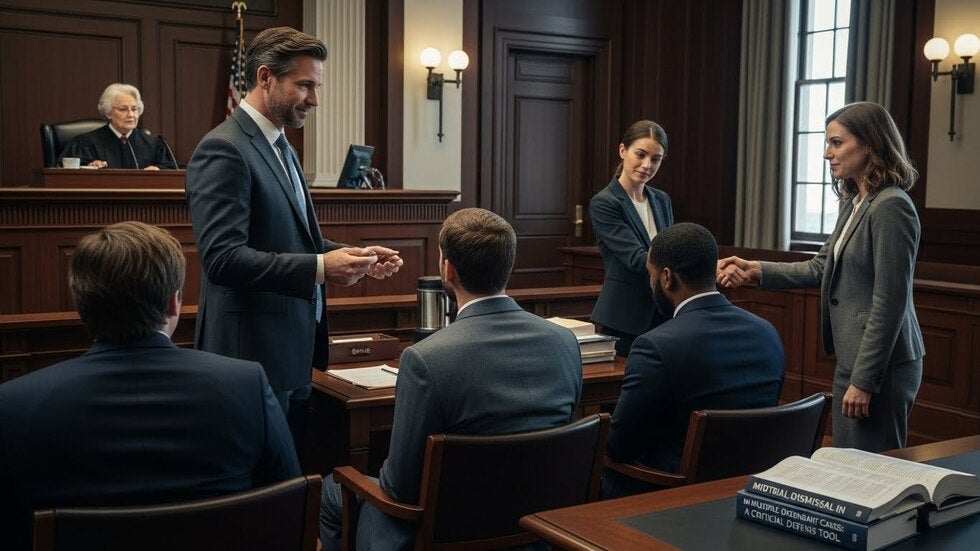
When multiple defendants face charges together in a joint trial, an important but often overlooked legal protection exists. If the prosecution's evidence against one defendant proves insufficient during trial, the court has the power and duty to dismiss that defendant before the case concludes. This midtrial dismissal serves dual purposes: it protects the improperly charged defendant from continuing through an unwarranted trial, and it allows that person to testify as a witness for remaining codefendants. Understanding how this mechanism works can be crucial to your defense strategy.
The Legal Foundation for Midtrial Dismissal
California law recognizes that sometimes prosecutors charge multiple defendants together, but the evidence presented at trial proves adequate against some defendants while falling short against others. Rather than forcing all defendants to endure the entire trial regardless of proof sufficiency, the law requires judges to evaluate the evidence as it comes in and dismiss defendants against whom insufficient evidence has been presented.
This protection stems from fundamental fairness principles. No one should be forced to mount a defense when the prosecution has failed to present a prima facie case establishing each element of the charged offense. The requirement that dismissal occur before the evidence closes reflects the practical reality that a dismissed defendant may have valuable testimony to offer on behalf of codefendants who remain on trial.
The standard applied at this stage mirrors the standard used in other criminal proceedings when evaluating evidence sufficiency. The prosecution must present enough evidence that, if believed by the jury, could support a conviction. If the evidence falls short of this threshold, the defendant is entitled to immediate dismissal rather than having the case go to the jury.
This is not the same as a motion for acquittal at the end of the prosecution's case. While defendants can and should make such motions when appropriate, this statute specifically addresses the unique situation of multiple defendants where dismissing one creates the opportunity for that person to assist in defending the others.
What Constitutes Insufficient Evidence
Understanding when evidence is insufficient requires examining what the prosecution must prove. For each charged crime, the state must establish every element of the offense. If the evidence presented, even when viewed in the light most favorable to the prosecution, cannot support a finding on any essential element, the evidence is insufficient.
Insufficient evidence might mean there is no proof you were present at the scene of the alleged crime. If the prosecution's own witnesses place you somewhere else or cannot identify you as a participant, this gap in the evidence should trigger dismissal. Physical evidence, witness testimony, and circumstantial proof must collectively establish your involvement, and absence of such proof means the case should not proceed.
The evidence might also be insufficient regarding your mental state. Many crimes require specific intent, knowledge, or purpose. If the prosecution presents no evidence showing you had the required mental state, they have failed to establish an essential element. For example, in theft cases, the prosecution must prove you intended to permanently deprive the owner of property. Without evidence of this intent, the case against you is incomplete.
Insufficient evidence can also mean that while some conduct occurred, the evidence does not show it constituted a crime. Perhaps the evidence shows you were present but does nothing to establish you participated in or aided the offense. Mere presence at a crime scene, without more, typically cannot support a conviction.
The timing element of offenses can create evidentiary insufficiency. If you are charged with conspiracy but the evidence shows you had no contact with codefendants until after the alleged conspiracy ended, the prosecution has not proven you were part of the agreement. Similarly, if charged as an accomplice but the evidence shows you arrived after the crime was completed, the accomplice liability theory fails.
The Timing and Process of Seeking Dismissal
This protection applies specifically before the evidence closes, meaning before both sides have rested their cases. The strategic timing is important because once a defendant is dismissed, that person becomes available as a witness for codefendants. If dismissal waited until after all evidence was presented, this testimonial benefit would be lost.
Defense attorneys should actively monitor the prosecution's case as it unfolds, evaluating whether sufficient evidence has been presented against each defendant. When it becomes clear that the prosecution has failed to establish a prima facie case against a particular defendant, defense counsel should bring this to the court's attention through an appropriate motion.
The motion should specifically identify which elements of the charged offense lack evidentiary support. Generic arguments that the evidence is weak or unconvincing are insufficient. Instead, the motion must demonstrate that even viewing the evidence favorably to the prosecution, no reasonable jury could find the defendant guilty because essential elements remain unproven.
Courts must take these motions seriously because the statute uses mandatory language. When the court determines that insufficient evidence exists to put a defendant on defense, it must order that defendant discharged. This is not discretionary. The judge does not weigh whether dismissal would be convenient or whether keeping all defendants together serves judicial economy. If the evidence is insufficient, dismissal is required.
Understanding how criminal trials proceed helps defendants and their attorneys recognize the appropriate moments to raise these critical motions and protect their rights.
The Benefit of Becoming a Witness for Codefendants
The statute explicitly acknowledges that dismissed defendants may become witnesses for those who remain on trial. This recognition reflects an important strategic reality in multiple defendant cases. Someone originally charged as a codefendant often has firsthand knowledge of events and may provide testimony that helps establish the innocence of others.
Before dismissal, a defendant facing charges cannot typically be compelled to testify and will almost certainly invoke Fifth Amendment protections against self incrimination. Once dismissed, however, that person no longer faces jeopardy from the current charges and the Fifth Amendment concerns largely disappear. The dismissed defendant can now testify about what actually happened without fear of self incrimination.
This testimony can be particularly powerful because the witness was close to the events and may have been present during the alleged offense. Unlike outside witnesses who may have partial or second hand knowledge, a former codefendant often observed the complete picture and can provide crucial context that supports the remaining defendants' innocence.
The dismissed defendant might testify that the remaining defendants were not present, did not participate, or did not have knowledge of criminal activity. This testimony directly contradicts the prosecution's theory and comes from someone who cannot be accused of bias in the same way a friend or family member might be.
Additionally, a dismissed codefendant's testimony carries inherent credibility because that person was initially charged and therefore presumably investigated by the same authorities. The fact that the charges could not be sustained adds weight to testimony contradicting the prosecution's version of events.
Strategic Considerations for All Defendants
When multiple defendants face charges together, everyone's legal team should be monitoring whether sufficient evidence exists against each person. This is not just about protecting your own interests but recognizing how the strength or weakness of cases against codefendants affects overall defense strategy.
If you are the defendant against whom evidence appears weakest, seeking midtrial dismissal serves your interests by ending your ordeal promptly. It also positions you to help codefendants by testifying about what you know. This cooperation might prove valuable if you face future charges or related legal issues.
If you are a defendant whose case is stronger but a codefendant's case is weak, you benefit from that codefendant being dismissed and becoming available as a defense witness. Your attorney should coordinate with codefendants' counsel to ensure motions for dismissal are filed when appropriate, even though your attorney does not directly represent the other defendants.
This coordination requires careful navigation of ethical rules about representing multiple clients and conflicts of interest. Typically, each defendant has separate counsel, but those attorneys often communicate and cooperate on matters of shared interest. Ensuring that meritorious dismissal motions are filed falls within this sphere of cooperation.
The possibility of midtrial dismissal also affects plea negotiation strategies. If you know the evidence against a codefendant is weak, you might be more inclined to proceed to trial knowing that codefendant may be dismissed and available to testify. Conversely, prosecutors aware their evidence is weak against one defendant might offer favorable plea agreements to prevent that person from being dismissed and testifying for others.
The Court's Duty and Standard of Review
Judges have an independent obligation to evaluate evidence sufficiency throughout trial. Even without a defense motion, courts should recognize when evidence fails to support charges against particular defendants and order appropriate dismissals. However, relying on the court to act independently is risky. Defense attorneys should affirmatively bring evidentiary insufficiency to the court's attention.
The standard for evaluating sufficiency at this stage requires viewing evidence in the light most favorable to the prosecution. This means the court accepts the prosecution's version of disputed facts and draws reasonable inferences supporting the charges. Despite this favorable standard, when evidence simply does not address essential elements, dismissal is warranted.
This is not a credibility determination. The court does not decide whether to believe prosecution witnesses. Instead, the question is whether, assuming the jury believes the witnesses, sufficient evidence exists to support all elements of the offense. If witnesses' testimony leaves gaps regarding essential facts, the evidence is insufficient regardless of witness credibility.
Appellate courts review these dismissal decisions carefully. If a trial court refuses to dismiss a defendant despite insufficient evidence, and that defendant is later convicted, the issue can be raised on appeal. Conversely, if the court dismisses a defendant and the remaining codefendants are acquitted, the dismissal decision likely becomes moot.
Building effective defense strategies includes understanding procedural protections like midtrial dismissal and ensuring they are invoked when appropriate.
Distinguishing This From Other Dismissal Mechanisms
California criminal procedure provides several mechanisms for challenging evidence sufficiency, and understanding how midtrial dismissal of codefendants differs from these other procedures is important.
A motion to set aside the information or dismiss charges can be filed before trial based on preliminary hearing testimony. This challenges whether sufficient evidence existed to hold the defendant to answer. While similar in concept, this occurs before trial begins and does not involve the statute's provision about making dismissed defendants available as witnesses.
A motion for judgment of acquittal under Section 1118.1 occurs after the prosecution rests its case. This motion asks the court to acquit because insufficient evidence was presented to support conviction. While timing is similar to the midtrial dismissal under discussion, Section 1118.1 applies whether there is one defendant or many and does not specifically address making acquitted defendants available as witnesses for codefendants.
The midtrial dismissal of codefendants specifically contemplates the multiple defendant scenario and explicitly provides that dismissal should occur so the dismissed defendant can testify for others. This unique purpose distinguishes it from other dismissal procedures, though the standards for evaluating evidence sufficiency remain similar across these various mechanisms.
Practical Challenges and Considerations
While the law clearly provides for midtrial dismissal of defendants against whom evidence is insufficient, practical challenges can arise in asserting this right. Judges may be reluctant to dismiss defendants midtrial, preferring to let the jury decide all defendants' fates. This reluctance might stem from concerns about judicial efficiency, worry about appearing to favor defendants, or simple unfamiliarity with this statutory provision.
Defense attorneys must be prepared to cite the statute specifically and argue forcefully that dismissal is mandatory, not discretionary, when evidence is insufficient. The statutory language states the court "must" order discharge, leaving no room for judicial discretion once the factual determination of insufficiency is made.
Prosecutors will typically argue that evidence should be construed broadly, that circumstantial evidence fills any gaps, and that credibility determinations belong to the jury. Defense counsel must distinguish between evidence that allows different reasonable interpretations and evidence that simply does not address essential elements at all.
The dismissed defendant's willingness and ability to testify for codefendants can affect strategic calculations. If the dismissed defendant intends to invoke Fifth Amendment privileges regarding other potential charges or has reasons not to testify, the benefit of midtrial dismissal may be reduced. Defense teams should discuss these issues among themselves to coordinate strategy effectively.
Protecting Your Rights Throughout Trial
If you are charged alongside codefendants, your defense attorney should continually assess whether sufficient evidence has been presented against each defendant. This ongoing evaluation allows your legal team to recognize opportunities for dismissal motions that benefit everyone's defense.
You should understand that protecting one codefendant's rights can indirectly benefit your own defense. If a codefendant with knowledge supporting your innocence gets dismissed and becomes available to testify, your chances of acquittal improve. This interconnection of interests in multiple defendant cases requires sophisticated legal strategy and coordination.
Be forthcoming with your attorney about your knowledge of events and what testimony you could provide if charges against you were dismissed. This information helps your lawyer evaluate the strength of dismissal motions and allows coordination with codefendants' attorneys about overall defense strategy.
Never assume the court will automatically recognize insufficient evidence and dismiss defendants without prompting. Active advocacy through well crafted motions is essential to invoking this protection. Your attorney's vigilance and willingness to argue for midtrial dismissal can make the difference between conviction and acquittal.
The Intersection With Constitutional Protections
The statutory right to midtrial dismissal when evidence is insufficient reinforces constitutional protections against being convicted without adequate proof. The due process clause requires the government to prove every element of a charged offense beyond a reasonable doubt. When evidence fails to establish essential elements, continuing the prosecution violates due process.
The right to confront witnesses also connects to this protection. If you are dismissed and testify for codefendants, they gain the ability to present testimony from someone with direct knowledge of events. The prosecution must then cross examine this witness, testing the testimony's reliability. This adversarial process serves the truth seeking function of trials.
Equal protection principles support treating defendants differently based on the evidence against each. When proof supports charges against some defendants but not others, dismissing those against whom evidence is weak ensures each person is judged based on evidence specific to their conduct and culpability.
Understanding how statutory procedures reinforce constitutional rights helps you appreciate the multiple layers of protection available when facing criminal charges. Protecting your constitutional rights requires invoking both constitutional principles and specific statutory procedures designed to implement those principles.
Conclusion: A Vital But Underutilized Protection
The right to midtrial dismissal when evidence proves insufficient represents an important protection for defendants charged alongside others. This mechanism prevents defendants from enduring unnecessary trials when the prosecution has failed to present adequate evidence and creates opportunities for dismissed defendants to assist in defending codefendants through their testimony.
However, this protection only helps those who actively assert it through well timed, well argued motions. Judges will not automatically dismiss defendants without prompting from defense counsel. The burden falls on defense attorneys to monitor evidence as it is presented, recognize when it falls short of establishing essential elements, and bring these deficiencies to the court's attention.
If you face charges alongside codefendants, discuss with your attorney whether this protection might apply in your case. Understanding the strength of evidence against each defendant allows for strategic decisions about trial tactics, plea negotiations, and coordination among defense teams. The possibility that one or more defendants might be dismissed midtrial and become defense witnesses should factor into everyone's strategic planning from the earliest stages of the case. For strategic guidance in multi-defendant criminal cases, contact Bulldog Law at (888) 928-1609 or visit thebulldog.law to speak with experienced defense counsel.