
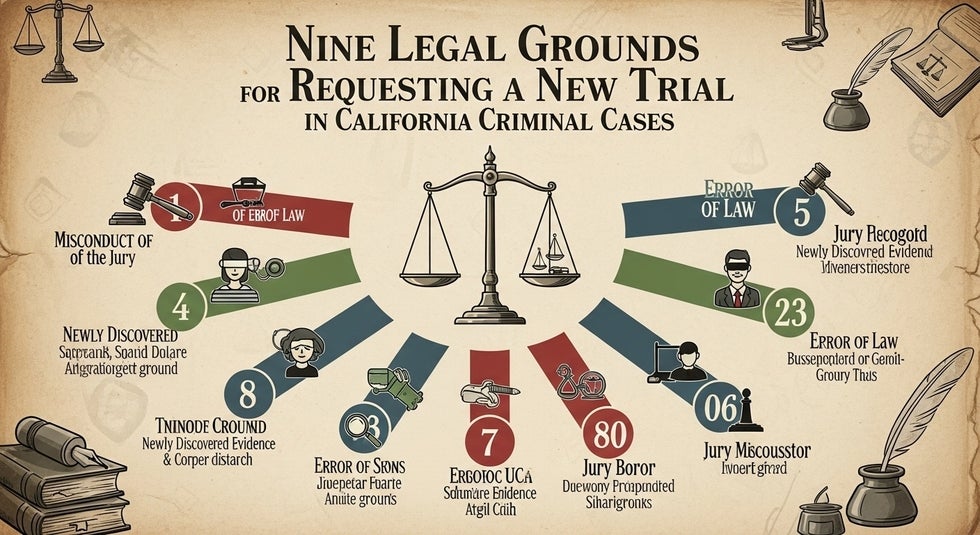
Receiving an unfavorable verdict can feel devastating, but California law recognizes that trials don't always proceed fairly or result in just outcomes. When serious errors occur during your criminal trial, you may have the right to request a new trial before the same judge who presided over your case.
Understanding these nine specific grounds for seeking a new trial can make the difference between accepting an unjust conviction and securing another opportunity to present your defense.
Understanding Your Right to Request a New Trial
California Penal Code Section 1181 establishes the exclusive circumstances under which a defendant can apply for a new trial after a verdict or finding against them. Unlike an appeal, which goes to a higher court, a motion for new trial is filed with the trial court judge who heard your case. This judge has the authority to set aside the verdict and grant you another chance at justice when specific legal standards are met.
The motion for new trial serves as a critical safeguard against miscarriages of justice, providing a mechanism to correct errors before they become permanent through final judgment. Recognizing when these grounds apply to your situation requires careful analysis of everything that occurred during your trial.
Trial Conducted Without Your Presence
The first ground for seeking a new trial addresses situations where the trial proceeded in your absence when the law required your presence. While California law permits certain proceedings to continue without defendants in limited circumstances, your constitutional right to be present at critical stages of your trial remains fundamental.
If the court conducted substantive portions of your trial without you being physically present, and no valid waiver of your appearance rights existed, this constitutes grounds for a new trial. This protection ensures defendants can confront witnesses, consult with counsel, and participate meaningfully in their defense throughout the proceedings.
Jury Received Evidence Outside the Courtroom
The second ground concerns jury misconduct involving evidence received outside the formal court proceedings. If jurors received any evidence beyond what was presented in court, except for authorized views of premises or personal property, you may have grounds for a new trial.
This might include situations where jurors conducted their own internet research about the case, discussed the matter with non jurors, visited the crime scene without authorization, or received information from outside sources. The integrity of the trial process depends on limiting jury consideration to properly admitted evidence subject to cross examination and legal scrutiny.
Even well intentioned jurors sometimes make mistakes that compromise the fairness of deliberations. When jurors expose themselves to outside information, they deny the defense the opportunity to challenge that evidence, creating grounds for setting aside the verdict.
Jury Separation or Misconduct During Deliberations
The third ground addresses improper jury separation or misconduct that prevented fair consideration of your case. After the jury retires to deliberate, they must remain together under court supervision unless the judge grants permission for separation. Unauthorized separation creates opportunities for outside influence and compromises the deliberative process.
Beyond improper separation, this ground covers various forms of jury misconduct that interfered with fair deliberation. Examples include jurors discussing the case with outsiders, considering facts not in evidence, allowing bias or prejudice to influence discussions, or failing to follow the court's instructions about deliberation procedures.
Proving jury misconduct often requires testimony from jurors themselves about what occurred during deliberations, though limitations exist on what jurors can disclose. Working with skilled criminal defense attorneys becomes essential for investigating potential misconduct and presenting compelling evidence to support your motion.
Verdict Decided by Chance Rather Than Deliberation
The fourth ground protects against verdicts reached through chance rather than thoughtful consideration. If the jury decided your verdict by flipping a coin, drawing straws, or any other method besides genuine discussion and fair expression of each juror's opinion, you have clear grounds for a new trial.
This requirement ensures verdicts result from actual deliberation where jurors consider evidence, discuss the case, and reach conclusions based on their individual assessment of the facts. When jurors shortcut this process through games of chance, they violate fundamental principles of jury trial rights.
While such conduct might seem unlikely, it does occur when juries become deadlocked and seek quick resolutions. Any verdict tainted by chance rather than reasoned deliberation cannot stand.
Legal Errors by the Court or Prosecutorial Misconduct
The fifth ground encompasses two distinct categories of trial errors: judicial mistakes and prosecutor misconduct. Courts must properly instruct juries on applicable law and make correct rulings on legal questions throughout trial. When judges misdirect juries on the law or err in deciding legal issues, these mistakes can fundamentally affect the outcome.
Common examples include giving incorrect jury instructions, improperly admitting or excluding evidence, making erroneous rulings on objections, or failing to provide necessary legal guidance to the jury. Even seemingly minor legal errors can warrant a new trial if they prejudiced your defense.
Prosecutorial misconduct represents the other component of this ground. When prosecutors engage in prejudicial misconduct during trial, they compromise the fairness of proceedings. This might include making improper arguments to the jury, presenting evidence in violation of court orders, making prejudicial comments about the defendant, or deliberately eliciting inadmissible testimony.
The key consideration is whether the misconduct was prejudicial, meaning it likely affected the verdict. Not every prosecutor misstep justifies a new trial, but serious misconduct that undermines confidence in the verdict's reliability provides strong grounds for relief.
Verdict Contrary to Law or Evidence
The sixth ground allows courts to grant new trials when verdicts contradict the law or the evidence presented. This standard recognizes that juries sometimes reach conclusions unsupported by the trial record or contrary to legal requirements for conviction.
When the evidence clearly shows you are not guilty of the crime charged, but the jury convicted you anyway, this ground applies. However, the law provides an alternative remedy when evidence shows guilt of a lesser offense.
Rather than automatically granting a new trial, judges can modify the verdict to reflect the lesser degree of crime or lesser included offense supported by the evidence.
This power to modify verdicts serves judicial efficiency while ensuring outcomes match the evidence. For example, if convicted of first degree murder but evidence supports only manslaughter, the court can reduce the conviction without requiring a completely new trial. Understanding these sentencing alternatives and modification options helps defendants and attorneys strategize appropriately.
Excessive Punishment Recommendations
The seventh ground addresses situations where the verdict includes punishment recommendations that exceed what the evidence supports. In cases where juries or courts recommend specific punishments as part of their verdicts, judges can modify these recommendations to impose lesser punishment without ordering an entirely new trial.
This provision allows courts to correct disproportionate punishment recommendations while preserving the underlying conviction when appropriate. The power extends to any appellate court reviewing the case, ensuring multiple levels of review can address excessive punishment issues.
Newly Discovered Evidence
The eighth ground permits new trials based on newly discovered evidence material to your defense that you could not have discovered and produced at trial despite reasonable diligence. This represents one of the most challenging grounds to establish successfully but provides crucial protection when genuinely new evidence emerges.
To succeed on this ground, you must demonstrate several elements. First, the evidence must be truly new, meaning it was not available or discoverable before or during trial. Second, the evidence must be material, meaning it could reasonably change the outcome if presented to a jury. Third, you must show reasonable diligence in attempting to discover this evidence earlier.
The procedural requirements for newly discovered evidence motions are specific. You must produce affidavits from witnesses who can provide this new evidence, describing what their testimony would be. If you need additional time to obtain these affidavits, courts may postpone hearings to allow proper preparation.
Examples of newly discovered evidence might include witnesses who come forward after trial, scientific evidence that was not previously available, or evidence the prosecution improperly withheld. The timing of discovery matters significantly, and courts scrutinize whether the evidence could have been found earlier with appropriate investigation.
Lost or Destroyed Court Reporter Notes
The ninth ground addresses situations where the official trial record becomes unavailable through no fault of the defendant. When you have not waived your right to a phonographic report, and the court reporter's notes are lost, destroyed, or cannot be transcribed due to the reporter's death or disability, courts can set aside judgments and order new trials.
This provision recognizes that meaningful appellate review requires accurate trial transcripts. Without these records, reviewing courts cannot properly assess claimed errors or evaluate the proceedings. Rather than allowing potentially flawed convictions to stand without adequate review, the law provides for new trials when records are unavailable.
Taking Action to Protect Your Rights
Understanding these nine grounds for new trials represents just the beginning. Successfully arguing for a new trial requires thorough investigation of what occurred during your trial, careful legal analysis of applicable standards, and persuasive presentation of evidence and arguments to the court.
The timing for filing new trial motions is strictly limited, making prompt action essential. Working with experienced defense counsel who understand these procedures and can identify viable grounds in your case provides your best opportunity for success.
When trial errors undermine the fairness or accuracy of your conviction, the motion for new trial offers a vital remedy before the judgment becomes final. Recognizing these grounds and acting quickly to assert your rights can open the door to a second chance at justice.