
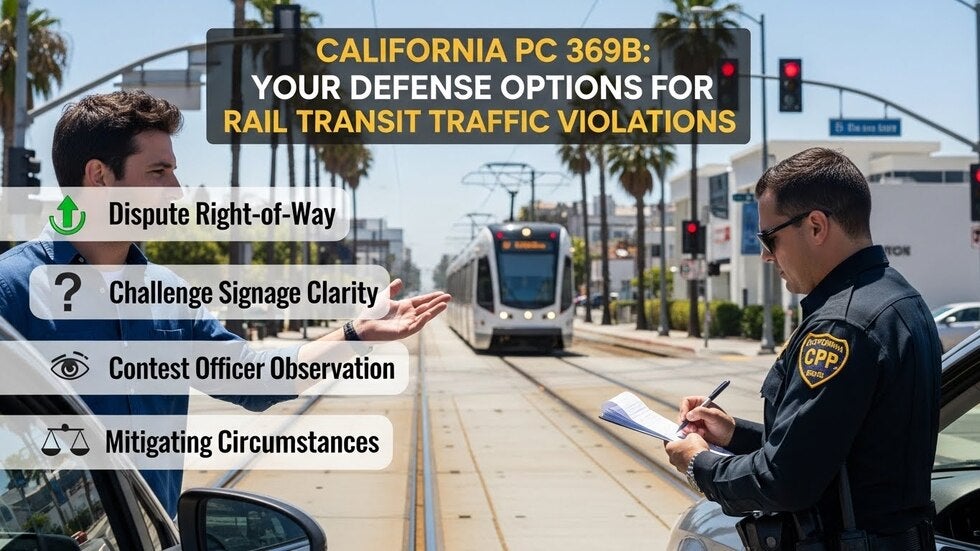
Railroad crossings and light rail systems create unique traffic situations that many drivers navigate daily without incident. However, one moment of confusion or misjudgment at a rail crossing can result in a traffic citation under California Penal Code Section 369b.
If you've received a ticket involving rail transit safety violations, understanding your options and potential defenses can significantly impact the outcome.
What PC 369b Actually Covers
Penal Code Section 369b establishes special procedures for handling certain rail transit related traffic violations in California's more populous counties. This statute only applies in counties with populations exceeding 500,000 residents, which includes most major metropolitan areas throughout the state.
The law gives courts authority to order individuals convicted of specific rail transit violations to attend specialized traffic schools. These programs must include curriculum covering rail transit safety, often featuring films or presentations developed by local transportation commissions or authorities.
The statute also authorizes additional fines beyond standard traffic penalties.
Understanding that PC 369b creates options rather than mandatory sentences becomes important. For first offenses, courts exercise discretion about whether to order traffic school, impose additional fines, or require both. This discretion creates opportunities for your attorney to advocate for outcomes that minimize impact on your finances and driving record.
Violations Covered Under This Statute
PC 369b doesn't create new traffic offenses. Instead, it provides enhanced penalties and educational requirements for existing violations involving rail transit safety. The statute specifically references several code sections.
Section 369g addresses various railroad crossing violations. Section 369i covers additional rail transit safety requirements. The law also encompasses Vehicle Code violations including subdivision (c) of Section 21752, Sections 22450, 22451, and 22452, and subdivision (c) of Section 22526 when these violations occur at railroad grade crossings.
These referenced statutes cover situations like failing to stop at railroad crossings when required, proceeding across tracks when warning signals are active, and driving around crossing gates. Each underlying violation carries its own elements that prosecutors must prove, creating defense opportunities before PC 369b enhancements even become relevant.
First Offense Treatment and Your Options
When facing a first rail transit violation under PC 369b, the court possesses significant discretion in determining consequences. Understanding the available options helps you and your attorney develop effective strategy.
The court may order you to attend traffic school that offers rail safety presentations, Internet based rail safety testing, or rail transit safety films prepared by county transportation authorities. Attending such programs typically requires several hours and may involve fees beyond any fines imposed.
Alternatively, the court can impose an additional fine of one hundred dollars beyond standard traffic penalties. This financial consequence comes on top of base fines, court fees, and other assessments that accompany traffic convictions.
The court also has authority to order both traffic school and the additional fine. However, for first offenses, the statute grants discretion rather than mandating these consequences. Your defense attorney can argue for the least burdensome outcome based on your circumstances, driving record, and the specific facts of your case.
Second and Subsequent Violations
If you've previously been convicted of rail transit violations covered by PC 369b, the consequences escalate significantly. The law removes judicial discretion for repeat offenders and mandates certain penalties.
Courts must order second time violators to attend traffic school offering rail safety education. Unlike first offenses where this remains optional, repeat violations trigger mandatory educational requirements. You'll need to complete the program to resolve your case.
Additional fines also increase for subsequent violations. Courts can impose up to two hundred dollars in additional penalties beyond standard traffic fines. While the statute provides a range up to this maximum, many courts impose the full amount for repeat offenders.
These enhanced consequences for subsequent violations make fighting your first rail transit ticket especially important. Accepting a conviction on an initial offense means facing mandatory requirements and higher fines if any future incident occurs. For information about protecting your driving record, understanding long term consequences of traffic convictions proves valuable.
Defense Strategies for Rail Transit Violations
Successfully defending against charges that trigger PC 369b requires challenging the underlying traffic violation itself. If you're not convicted of the base offense, the enhanced penalties and traffic school requirements never apply.
Challenging the Traffic Stop and Citation
Every traffic stop must be supported by reasonable suspicion that a violation occurred. Your attorney examines whether the citing officer had proper legal justification for the stop. Perhaps visibility conditions obscured traffic signals or crossing markers. Maybe the officer's position prevented clear observation of what actually happened.
Traffic signal timing and crossing gate operation also warrant investigation. Malfunctioning equipment can create situations where drivers appear to violate laws through no fault of their own. If signals activated improperly or gates descended without adequate warning, these mechanical failures support your defense.
Examining the Elements of Specific Violations
Each code section referenced in PC 369b contains specific elements prosecutors must prove beyond reasonable doubt. Your defense attorney analyzes whether the state can actually establish every required element.
For railroad crossing violations, prosecutors must often prove you failed to stop when legally required. Questions about where stop requirements applied, whether adequate signage existed, and what warning signals were actually operating become critical. Ambiguous signage or unclear crossing markings can create reasonable doubt about whether violations occurred.
Timing issues frequently arise in these cases. Did warning signals activate before you entered the intersection, or did they begin while you were already committed to crossing? This distinction matters tremendously because drivers cannot always safely stop once they've entered certain points.
Your attorney investigates the precise sequence of events to determine if your actions were actually lawful.
Demonstrating Necessity or Emergency Circumstances
Sometimes drivers must make split second decisions at rail crossings due to emergency circumstances. Perhaps stopping would have caused a rear end collision. Or maybe you needed to clear tracks quickly to avoid an approaching train after gates malfunctioned.
While necessity doesn't excuse every violation, it can provide complete defenses when emergency circumstances left no reasonable alternative. Your attorney gathers evidence about road conditions, traffic patterns, and the specific emergency you faced to support necessity arguments.
Challenging Officer Observations and Testimony
Traffic citations rely heavily on officer observations and conclusions. Your defense attorney scrutinizes what the citing officer actually witnessed versus what they assumed or inferred.
Officers sometimes observe situations from positions that don't provide complete views of intersections or crossing areas. Perhaps buildings, vegetation, or other vehicles blocked the officer's sightline. These visibility limitations can create uncertainty about exactly what occurred.
The officer's training and experience with rail transit violations also becomes relevant. Does the citing officer regularly patrol areas with rail crossings? Are they familiar with the specific intersection where your citation occurred? Lack of familiarity can lead to mistaken conclusions about whether violations actually happened.
Negotiating Traffic School as an Alternative
Even when the evidence doesn't support complete dismissal, your attorney may negotiate for traffic school as an alternative to conviction. This option under PC 369b serves dual purposes: education and record protection.
Completing traffic school often prevents the violation from appearing on your driving record. This protection matters significantly for employment, insurance rates, and avoiding points that could lead to license suspension. While you'll still pay fines and school fees, protecting your record provides substantial long term value.
Your attorney negotiates with prosecutors about the type of traffic school required. Online programs offer flexibility and convenience compared to in person classes.
The rail safety component required under PC 369b can typically be satisfied through Internet based testing, making completion more manageable around work and family obligations.
For individuals with commercial driver's licenses, traffic school options require careful consideration. CDL holders face restrictions on using traffic school to mask certain violations. Your attorney ensures any negotiated resolution complies with commercial licensing requirements and doesn't jeopardize your professional driving privileges.
Financial Considerations and Fine Reduction
The additional fines authorized under PC 369b can substantially increase the total cost of rail transit violations. Beyond these statutory enhancements, base fines, state assessments, and local penalties add up quickly.
Your defense attorney may negotiate for reduced fines based on financial hardship, clean driving history, or circumstances surrounding the violation. Courts sometimes exercise leniency when violations resulted from confusion rather than reckless disregard for safety.
Payment plans provide relief when immediate fine payment creates hardship. Most courts allow extended payment schedules, preventing the violation from triggering additional penalties for non payment. Your attorney can arrange these plans as part of case resolution.
Community service sometimes substitutes for fines in appropriate cases. If financial circumstances make paying hundreds of dollars in fines and fees impossible, performing community service hours may offer an alternative. This option depends on court policies and your attorney's negotiation with prosecutors.
Impact on Insurance and Driving Records
Rail transit violations affect auto insurance rates and driving records differently than standard traffic tickets. Insurance companies view crossing violations as indicators of risky driving behavior, potentially triggering premium increases.
The number of points assessed against your license varies depending on the specific violation. California's point system penalizes drivers who accumulate excessive violations within specific timeframes. Your attorney works to minimize point assessments through negotiated resolutions that protect your record. Understanding how traffic violations impact insurance helps you appreciate the full stakes involved.
Some insurance companies offer accident forgiveness or violation dismissal programs that may apply to first offenses. Reviewing your policy before resolving charges helps you understand how different outcomes might affect premiums. Your attorney can structure resolutions to minimize insurance consequences when possible.
County Population Requirements and Applicability
PC 369b only applies in counties exceeding 500,000 residents. This geographic limitation means the enhanced penalties and traffic school requirements don't apply everywhere in California.
If you received a citation in a smaller county, different procedures govern your case. Your attorney determines whether PC 369b actually applies based on where the violation occurred. Charges filed under this statute in counties below the population threshold may be subject to dismissal of the enhanced penalties.
County population figures change over time. Your attorney verifies current census data to confirm PC 369b applies in your jurisdiction. This seemingly technical detail can make substantial differences in available defenses and potential outcomes.
Transportation Commission Programs and Requirements
The traffic schools authorized under PC 369b must offer programs developed or approved by county transportation commissions or authorities. These agencies create curriculum specifically addressing local rail safety concerns.
Program content varies by county based on local transit systems and identified safety priorities. Some jurisdictions emphasize light rail safety in urban cores. Others focus on traditional railroad crossings in suburban or rural areas. Understanding what specific education requirements apply in your county helps you prepare for potential traffic school attendance.
Completion requirements include passing tests demonstrating comprehension of rail safety principles. These examinations aren't designed to be difficult, but they do require attention during the educational programming. Your attorney can explain what to expect from the specific program your court requires.
Working With Experienced Traffic Defense Counsel
Rail transit violations under PC 369b involve both traffic law and criminal procedure. Effective representation requires understanding how these systems intersect and what strategies protect your interests.
Your attorney reviews all evidence related to your citation, including officer reports, intersection diagrams, and signal operation records. This investigation often reveals defenses that aren't apparent from reading the citation alone.
Court appearances for traffic matters follow specific procedures that benefit from experienced legal guidance. Your attorney can often appear on your behalf, saving you time and ensuring technical requirements get handled properly.
Most importantly, your lawyer advocates for outcomes that minimize long term consequences. Whether through dismissal, reduced charges, or strategic use of traffic school options, experienced counsel makes significant differences in final results.
Taking Action on Your Citation
Rail transit violations carry consequences extending beyond immediate fines. Your driving record, insurance rates, and even employment can be affected by how these charges get resolved.
Acting quickly protects your options. Traffic citations impose deadlines for responding and appearing in court. Missing these deadlines can result in additional charges, license suspension, and arrest warrants. Your attorney ensures all procedural requirements get met while building your defense.
Don't simply pay the fine and accept conviction without exploring your options. What seems like the easiest solution often creates the most significant long term problems. Consulting with a qualified traffic defense attorney before making decisions gives you the information needed to choose wisely.
We offer a free consultation, Call (888) 928-1609 or contact us online to find out if we can help you get a fresh start.