
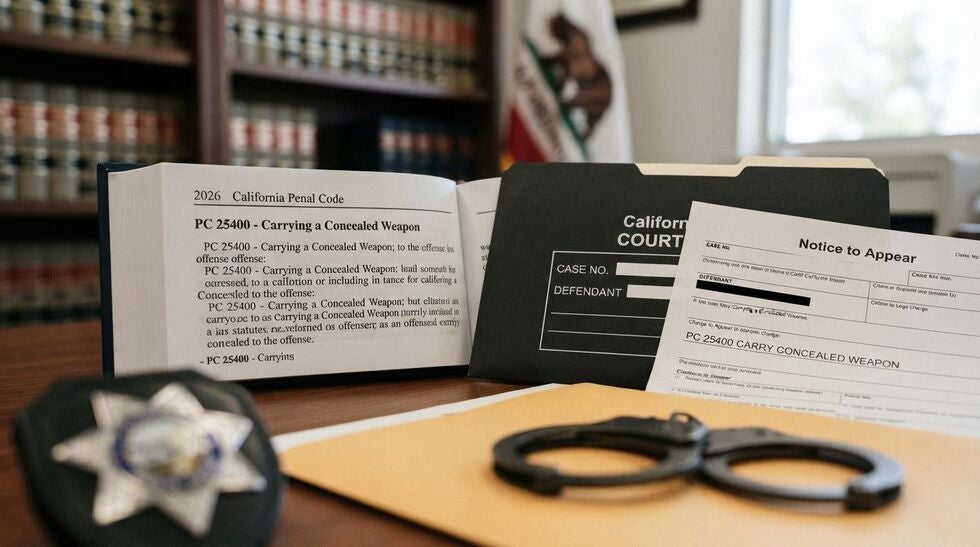
California Penal Code 25400 PC makes it a crime to carry a concealed firearm on your person or inside a vehicle without a valid CCW permit. A first offense is usually a misdemeanor punishable by up to 1 year in county jail and a $1,000 fine, but the charge becomes a felony carrying up to 3 years if you have a prior conviction, the gun was stolen, you are legally prohibited from possessing firearms, or prosecutors allege gang involvement.
Concealed carry cases in California often begin with a traffic stop and end with a criminal record, even for responsible gun owners who legally purchased their firearm. If you have been arrested under PC 25400 anywhere in California, contact the criminal defense attorneys at The Bulldog Law for a free, confidential consultation.
What Is Penal Code 25400 PC?
PC 25400 prohibits three things, each involving a pistol, revolver, or other firearm capable of being concealed on the person (generally, a firearm with a barrel under 16 inches):
-
Carrying a concealed firearm inside a vehicle under your control or direction;
-
Carrying a concealed firearm on your person; or
-
Causing a firearm to be carried concealed inside a vehicle in which you are an occupant.
A few points routinely surprise people. The gun does not need to be loaded and it does not even need to work; an inoperable firearm still supports a charge. "Concealed" does not mean invisible: a handgun tucked in a waistband under a shirt, inside a purse or backpack, or partially covered in a center console is concealed even if part of it can be seen. By statute, a firearm carried openly in a belt holster is not concealed, though openly carrying a handgun in public generally violates a different law, PC 26350.
If you want a deeper look at what qualifies as a concealed weapon specifically inside a vehicle, The Bulldog Law blog has a detailed explanation of what constitutes a concealed weapon in your vehicle that walks through how courts draw the line.
What Must the Prosecutor Prove?
A conviction under PC 25400 requires proof beyond a reasonable doubt of three elements:
-
You carried a firearm capable of being concealed on the person, or caused it to be carried in your vehicle;
-
You knew the firearm was there; and
-
The firearm was substantially concealed.
The knowledge element is often the battleground. A gun left in a borrowed car, placed in your bag by someone else, or forgotten by a passenger is not your crime if you genuinely did not know it was present.
When Carrying a Concealed Gun Is Legal in California
PC 25400 contains major carve-outs that resolve many cases before trial:
Valid CCW permit: A license to carry issued under PC 26150/26155 is a complete defense, subject to the "sensitive places" limits discussed below.
Home and business (PC 25605): You may carry a concealed firearm at your residence, on private property you own or lawfully possess, and at your own place of business without any permit.
Locked-container transport (PC 25610): A legal gun owner may transport a handgun in a vehicle if it is unloaded and locked in the trunk or in a fully enclosed locked container. Critically, a glove compartment, even a locked one, does not count as a locked container under PC 16850.
Exempt persons (PC 25450 et seq.): Active and honorably retired peace officers, certain members of the military, licensed firearms dealers, and hunters transporting unloaded firearms for lawful activity, among others, each subject to specific conditions.
CCW Permits After Bruen and SB 2: The 2026 Landscape
The U.S. Supreme Court's decision in New York State Rifle & Pistol Association v. Bruen (2022) forced California to abandon its "good cause" requirement and become a shall-issue state: sheriffs must now grant CCW permits to qualified applicants. California responded with Senate Bill 2 (effective January 1, 2024), which rebuilt the licensing system, applicants must be at least 21, complete expanded training, and pass a broadened suitability and background review.
SB 2's most consequential feature is its long list of "sensitive places" under PC 26230, where carrying is prohibited even with a valid permit, including bars and restaurants that serve alcohol, parks and playgrounds, stadiums, casinos, hospitals, public transit, government buildings, and many parking areas connected to them. Several of these categories have been challenged in ongoing federal litigation (May v. Bonta), with courts blocking some restrictions and upholding others as the appeals continue. The practical effect: permit holders can now be charged under PC 25400 or related statutes for carrying in places they reasonably assumed were lawful. Where you were carrying can matter as much as whether you had a license.
The Bulldog Law's firearm offenses defense page covers the full range of California weapons charges and explains how the post-Bruen landscape affects your defense options.
Penalties for Carrying a Concealed Firearm (2026)
|
Circumstances |
Charge Level |
Punishment |
|
No aggravating factors (most first offenses) |
Misdemeanor |
Up to 1 year county jail and/or $1,000 fine; summary probation common |
|
Firearm loaded (or ammo readily accessible) and you are not the registered owner; or a prior misdemeanor conviction for a crime against a person or property or a narcotics offense |
Wobbler |
Misdemeanor: up to 1 year; Felony: 16 months, 2, or 3 years |
|
Prior felony or firearm conviction; stolen firearm you knew or should have known was stolen; active participation in a criminal street gang; or you are prohibited from possessing firearms (e.g., PC 29800 felon in possession) |
Straight felony |
16 months, 2, or 3 years and up to $10,000 |
Certain prior convictions also trigger mandatory minimum county jail terms, at least three months for a prior felony or firearm offense, and three to six months for priors such as assault with a deadly weapon or brandishing, although courts retain discretion to suspend the minimum where justice requires. Police will also confiscate the weapon, and a felony conviction strips gun rights for life. A misdemeanor PC 25400 conviction, by contrast, generally does not affect your right to own firearms.
Legal Defenses to PC 25400 Charges
Unlawful search and seizure. Most concealed-carry cases start with a vehicle stop or pat-down. If police lacked reasonable suspicion for the stop or probable cause for the search, a motion to suppress under PC 1538.5 can exclude the firearm, usually ending the case. This is the single most successful defense in CCW prosecutions.
You didn't know the gun was there. Knowledge is an element. Borrowed vehicles, shared bags, and passengers' belongings create genuine doubt.
The firearm was not concealed. A gun carried openly in a belt holster falls outside PC 25400 by statute.
Lawful transport or location. An unloaded firearm locked in the trunk or a proper locked container, or a firearm carried at your home or business, is not a crime.
Valid CCW permit. A license is a complete defense to PC 25400, provided the carrying did not occur in an SB 2 sensitive place.
Momentary or transitory possession. Briefly handling a firearm solely to dispose of it or move it to safety can negate criminal carrying in limited circumstances.
Second Amendment challenges. Post-Bruen litigation continues to reshape California gun law, and constitutional challenges, particularly to sensitive-place allegations, are live issues that a defense attorney can raise in appropriate cases.
Additional Consequences of a Conviction
Immigration: Firearm offenses are a specific ground of deportability for non-citizens under federal law, often more dangerous than the jail exposure itself. If you are not a U.S. citizen, understanding the deportation consequences of a criminal conviction before making any decisions in your case is critical.
Federal exposure: Prohibited persons (including felons) face separate federal charges under 18 U.S.C. § 922(g), which carries far harsher penalties. If you are wondering how a firearm offense can cross into federal territory, the Bulldog Law blog explains what makes a crime federal and when that line gets crossed.
Professional licensing and employment consequences from any weapons conviction.
CCW eligibility: A conviction can disqualify you from ever obtaining a carry permit.
Record relief: Misdemeanor and probation-based convictions are often expungeable under PC 1203.4 after successful completion of probation. The Bulldog Law's expungement and post-conviction relief page explains who qualifies and how the process works.
Related California Weapons Offenses
-
PC 25850 – Carrying a loaded firearm in public
-
PC 26350 – Openly carrying an unloaded handgun in public
-
PC 29800 – Felon (or certain misdemeanant/addict) in possession of a firearm
-
PC 26230 – Carrying in "sensitive places" (SB 2)
-
PC 626.9 – Gun-Free School Zone Act
-
PC 21310 – Carrying a concealed dirk or dagger
-
PC 417 – Brandishing a weapon
Frequently Asked Questions
Is carrying a concealed weapon a felony in California?
Usually not for a first offense, it is a misdemeanor punishable by up to one year in jail. It becomes a felony if you have a prior felony or firearm conviction, the gun was stolen, you are a prohibited person, prosecutors allege active gang participation, or (as a wobbler) the gun was loaded and unregistered to you.
Can I keep a gun in my car in California?
Yes, if you transport it correctly: unloaded and locked in the trunk or in a fully enclosed locked container. A glove compartment does not qualify even if it locks. A loaded or unsecured handgun in the passenger area is a crime without a CCW permit.
Does a CCW permit protect me everywhere?
No. Under SB 2, a long list of "sensitive places", bars, parks, stadiums, hospitals, public transit, government buildings, and more, remain off-limits even to permit holders. Parts of the list are being litigated in federal court, so where you can lawfully carry continues to shift.
What if the gun wasn't mine or I didn't know it was there?
Knowledge is a required element of PC 25400. If someone else left the firearm in your car or bag and you did not know it was present, you are not guilty, and the defense can develop evidence to prove it.
Will a PC 25400 conviction take away my gun rights?
A felony conviction results in a lifetime firearms ban. A standard misdemeanor PC 25400 conviction generally does not strip your gun rights, though it can affect CCW permit eligibility.
What should I do after a concealed weapon arrest?
Do not explain, consent, or volunteer anything, statements like "I forgot it was in there" still admit knowledge and possession. Invoke your right to remain silent and contact a defense attorney immediately so the legality of the stop and search can be examined.
Charged Under PC 25400? Contact The Bulldog Law Today
Concealed-carry prosecutions punish ordinary gun owners for paperwork, storage, and location mistakes, and the rules have changed more in the past four years than in the previous forty. These cases are highly winnable: suppression motions, the knowledge element, transport exemptions, and fast-moving Second Amendment law all give the defense real leverage.
The criminal defense team at The Bulldog Law defends clients across California against PC 25400 and all firearms charges. We scrutinize every stop and search, assert every statutory exemption, and fight for dismissals, reductions, and outcomes that protect your record and your rights.
Call The Bulldog Law now for a free, confidential case evaluation. Available 24/7.