
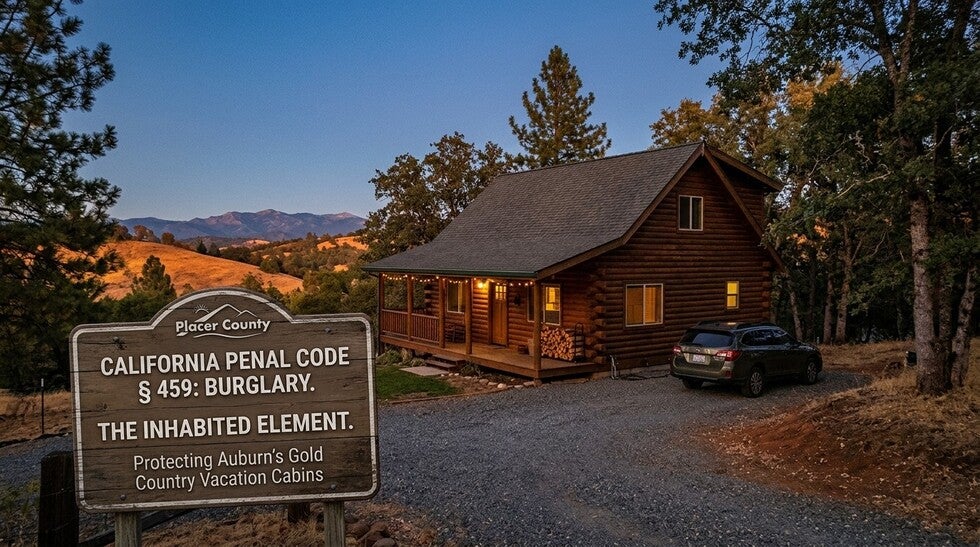
What “Inhabited” Actually Means Under California Law
California courts have found that a structure is inhabited when it is currently being used as a dwelling even if temporarily unoccupied at the moment of entry. A vacation cabin whose owner is at their primary residence in the Bay Area but who visited two weeks ago and plans to return next month is typically inhabited under this standard. A structure that's been converted to purely commercial use or that's been abandoned without intent to return is not.
The specific facts matter enormously: frequency of use, presence of personal property, the owner's documented return schedule, utility service, and the character of the structure's use. These facts are developed through independent investigation from the first day of representation, because the prosecution's inhabited characterization is sometimes based on incomplete information about the property's actual occupancy pattern.
Auburn and Colfax Gold Country and Mountain Seasonal Properties
Auburn's Gold Country vacation cabin occupied element: Auburn's position as the heart of California's Gold Country attracts Bay Area and Sacramento families who own vacation properties along Highway 49, in the Auburn State Recreation Area corridor, and in the surrounding foothill communities. These properties range from actively used weekend retreats visited nearly every weekend to genuinely seasonal cabins used only during summer or wine harvest season.
We analyze the specific occupancy pattern of every Auburn Gold Country vacation property frequency of visit, presence of personal belongings, utility records, owner's return schedule to challenge first degree treatment wherever the inhabited element is factually contestable at the Auburn Courthouse on Maple Street.
Colfax' Sierra Nevada mountain community generates vacation and seasonal cabin burglary cases from its position on I-80 in the Sierra Nevada foothills. Mountain cabins in the Colfax area are sometimes occupied only during skiing, summer recreation, or specific seasons.
A structure that's been locked and unoccupied since the end of ski season may still be inhabited under California law but the specific facts of its occupancy pattern are what determine that conclusion. We develop those facts in every Colfax seasonal cabin burglary case at the Auburn Courthouse.
Loomis Equestrian Barn and Agricultural Authorization
Loomis' equestrian community generates burglary cases from its boarding facilities, training barns, and agricultural structures where prior employment or boarding arrangements create authorization contexts that challenge the unlawful entry element of burglary. A former barn employee who re-enters the facility based on prior access authorization, a boarding client who enters a structure to retrieve their horse or equipment based on a standing permission arrangement, or a ranch worker who enters an outbuilding based on the employment relationship all present authorization defenses that challenge burglary's foundational element.
Agricultural storage buildings, equipment sheds, and ranch outbuildings throughout Loomis generate second degree commercial burglary cases where the authorization defense is regularly available. We document every boarding agreement, employment record, access arrangement, and permission communication that supports the authorization defense in every Loomis equestrian and agricultural burglary case at the Auburn Courthouse.
Thunder Valley Shoplifting vs. Commercial Burglary
Thunder Valley Casino Resort's retail operations in Lincoln generate burglary charges from shoplifting situations where the Prop 47 shoplifting provision PC § 459.5 actually applies. PC § 459.5 covers entry into an open business during business hours with intent to steal merchandise valued at $950 or less. That's a misdemeanor, not a commercial burglary felony wobbler. When Thunder Valley retail shoplifting situations are charged as commercial burglary, we challenge the charge at 10820 Justice Center Drive and pursue misdemeanor shoplifting treatment wherever the facts support it.
H-2A Agricultural Workers and the Aggravated Felony Dimension
First degree residential burglary constitutes an aggravated felony under federal immigration law, permanently barring cancellation of removal, asylum, and adjustment of status for H-2A agricultural workers. Second degree commercial burglary does not carry the same immigration consequence. The first versus second degree determination is therefore not just a sentencing issue for non-citizen defendants in Placer County's foothill farming community it determines whether a conviction permanently ends their ability to work legally in California.
We challenge the inhabited element as the absolute top priority in every H-2A defendant first degree burglary case at either Placer County courthouse.
Where Burglary Cases Are Heard in Placer County
Placer County Superior Court
Auburn Main Courthouse: 101 Maple Street, Auburn, CA 95603
South Placer Courthouse: 10820 Justice Center Drive, Roseville, CA 95678
Auburn, Colfax, and North Placer cases at 101 Maple Street. Lincoln, Loomis, Rocklin, and South Placer cases at 10820 Justice Center Drive.
After a Burglary Arrest in Placer County
- Do not discuss the structure you entered, your authorization, or your purpose without an attorney.
- Preserve every boarding agreement, employment record, access authorization, or property ownership document.
- If this involves an Auburn or Colfax vacation cabin, identify every piece of evidence about the property's occupancy pattern and the owner's use schedule.
- If you are H-2A or any non-citizen, the first vs. second degree determination requires immediate analysis. Call (888) 928-1609.
Auburn: Auburn office | Colfax: Colfax office | Loomis: Loomis office | Lincoln: Lincoln office | Rocklin: Rocklin office | (888) 928-1609
Burglary Defense Questions in Placer County
Is an Auburn Gold Country vacation cabin an inhabited dwelling for burglary purposes?
It depends on the specific property and its occupancy pattern. A vacation cabin visited regularly by its Bay Area owner, furnished and maintained as a dwelling, with personal belongings present and utilities active, is typically inhabited even when temporarily vacant.
A cabin that's been locked and unused for months, with utilities shut off, may not be. We analyze the specific frequency of use, personal property presence, utility records, and owner's return schedule of every Auburn Gold Country vacation property to challenge first degree treatment and pursue second degree wobbler treatment wherever the inhabited element is factually contestable at the Auburn Courthouse on Maple Street.
How does prior boarding authorization defend against a Loomis barn burglary charge?
If a former boarding client, barn employee, or equestrian facility user entered the structure based on a genuine good-faith belief in their continuing authorization through a prior access arrangement, a key that was never recovered, or a standing permission from the property owner the unlawful entry element of burglary is challenged.
The prosecution must prove unlawful entry beyond a reasonable doubt. We document every boarding agreement, employment record, key access arrangement, and communication establishing prior authorization in every Loomis equestrian burglary case at the Auburn Courthouse.
How does the shoplifting provision apply to Thunder Valley retail cases in Lincoln?
PC § 459.5 shoplifting applies when the defendant entered an open business during business hours intending to steal merchandise valued at $950 or less. When a Thunder Valley retail shoplifting situation is charged as commercial burglary instead of shoplifting, we bring the PC § 459.5 argument at the South Placer Courthouse in Roseville.
The distinction is significant: shoplifting is a Prop 47 misdemeanor; commercial burglary is a felony wobbler. We pursue misdemeanor treatment wherever the shoplifting provision applies in every Placer County retail case.
For more on Auburn Gold Country vacation cabin inhabited element analysis, Colfax Sierra mountain seasonal property defense, Loomis equestrian authorization defense, Thunder Valley shoplifting vs commercial burglary, H-2A aggravated felony priority, and burglary defense at Placer County Superior Court, visit The Bulldog Law blog.