
Updated November 2026 | The Bulldog Law | California Criminal Defense
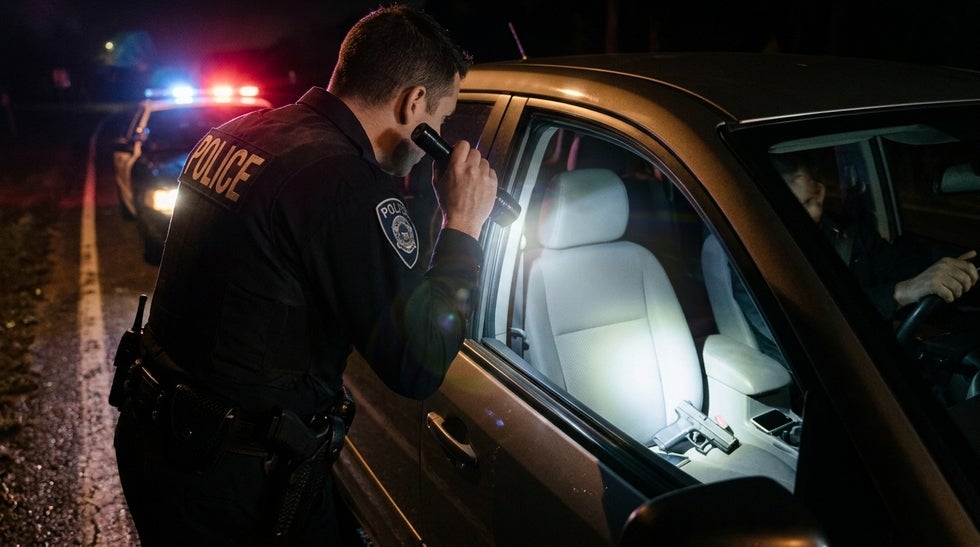
The plain view doctrine lets officers grab evidence without a warrant when they are in the right place, see something clearly illegal, and have a lawful right to touch it. This shortcut can mean the difference between a conviction and a dismissal.
Legal Foundations of the Plain View Doctrine in California
California courts rely on a three-element test from Horton v. California (1990) to decide when a seizure is lawful under the Fourth Amendment.
The officer must be lawfully present, the item must be immediately apparent as incriminating, and the officer must have a lawful right to reach it.
Accidental discovery is not required; an officer may anticipate finding contraband as long as the search stays within the limits that made the presence lawful. This flexibility keeps the doctrine practical while protecting constitutional rights.
Requirement of Lawful Presence
Lawful presence means the officer did not violate the Fourth Amendment to get to the spot. Valid stops, warrants, consent, emergencies, or standing on a public sidewalk all satisfy this element.
If the officer's arrival is unlawful, every observation made afterward is tainted and the seized item becomes inadmissible. Penal Code 1538.5 requires a motion to suppress in such cases.
Immediate Apparent Illegality Standard
The officer must have probable cause to believe the item is contraband or evidence without further searching. The item must be obvious from the view point.
When an officer needs to open, touch, or run a number to confirm, the requirement fails. Health and Safety Code 11362.1 clarifies that lawful cannabis possession is not contraband.
Lawful Right of Access and Reach
Seeing an item is not enough; the officer must have a lawful right to reach it. A front-window view of drugs does not grant entry into a home without a warrant or consent.
Even if the officer hopes to find contraband, the search must stay within the limits that made the presence lawful. Proposition 64 limits searches for cannabis under the new legal system.
Statutory Elements and California Codes Governing Plain View Seizures
California statutes shape how plain view seizures are challenged and defended. Understanding each code helps attorneys build strong motions to suppress or secure evidence.
Key statutes include Penal Code 1538.5, Penal Code 1546, Health and Safety Code 11362.1, and the effects of Proposition 64 on cannabis possession.
|
Statute |
Key Provision |
Penalty or Effect |
|---|---|---|
|
Penal Code 1538.5 |
Motion to suppress plain view seizures |
Evidence excluded if exception fails |
|
Penal Code 1546 |
Electronic Communications Privacy Act limits |
Sealed files unless court orders |
|
Health and Safety Code 11362.1 |
Legal adult cannabis possession |
No warrant for possession alone |
|
Proposition 64 |
Regulates cannabis sales and possession |
Limits search based on quantity |
Penal Code 1538.5: Motion to Suppress Plain View Seizures
Under Penal Code 1538.5, a defendant may file a motion to suppress if the seizure violated the Fourth Amendment. The prosecution must prove the plain view exception applies.
Failure to meet any element, lawful presence, immediate apparent illegality, or lawful right of access, renders the evidence inadmissible. Penal Code 1538.5 is the cornerstone of suppression arguments. Readers comparing related California statutes also review our guide on checking for an active California arrest or bench warrant.
Penal Code 1546 & Digital Evidence Limits
Penal Code 1546, part of the Electronic Communications Privacy Act, requires warrants to search electronic devices. Courts demand specificity about what may be examined.
Information unrelated to the warrant's objective must remain sealed and cannot be reviewed without a further court order. Penal Code 1546 protects digital privacy in plain view contexts.
Health and Safety Code 11362.1 & Proposition 64: Cannabis Reform
Health and Safety Code 11362.1 declares adult possession of cannabis legal, removing it from contraband status. Police cannot arrest or detain solely for possession.
Proposition 64 further limits searches for cannabis, requiring evidence of unlawful quantity or sales before a vehicle or home search is justified. Health and Safety Code 11362.1 is the legal foundation for these limits.
Key Supreme Court Cases Shaping the Doctrine
Supreme Court rulings refine the boundaries of plain view, especially regarding movement and touch. These decisions help attorneys predict how courts will view evidence seized under the doctrine. They also clarify that plain view does not automatically allow entry into private property or manipulation of items.
Arizona v. Hicks: Moving Items Creates a New Search
In Arizona v. Hicks (1987), officers moved a turntable to read a serial number. The Supreme Court held that even a small movement constituted a new search, violating the Fourth Amendment.
Moving, opening, or manipulating items in plain view is prohibited unless the officer has probable cause before the movement. Arizona v. Hicks is the benchmark for this restriction.
Minnesota v. Dickerson: The Plain Feel Exception
In Minnesota v. Dickerson (1993), a pat-down for weapons revealed cocaine by touch. The Court ruled that a plain feel exception applies only to weapons, not to other contraband.
Thus, a pat-down cannot be used to explore pockets for drugs. The plain feel doctrine is limited to items whose illicit nature is obvious by touch. Minnesota v. Dickerson remains a key precedent.
Application to Cannabis, Odor, and Other Senses in California
In my professional experience defending California drug cases, police officers often claim they smelled marijuana during a routine traffic stop. This sensory observation used to be enough to justify a full vehicle search. Today, the legal field has shifted significantly due to state cannabis laws.
The In plain sight doctrine now faces strict limits when applied to legal cannabis products. Officers cannot rely on odor alone to establish probable cause for a search. They must find additional facts that point to illegal activity or a specific violation.
Odor of Cannabis and Vehicle Searches Post-Proposition 64
Before Proposition 64, the smell of burning marijuana gave officers immediate probable cause to search any vehicle. This rule changed when California legalized adult possession of cannabis.
The law now protects lawful users from suspicion based solely on scent. Readers comparing related California statutes also review our guide on drug possession under Health and Safety Code 11350.
Health and Safety Code 11362.1 makes lawful adult possession not contraband. This means officers need more than just smell to search. They must see an open container or signs of impairment to proceed legally.
People v. Lee and People v. Hall: Limits on Odor-Based Searches
In People v. Lee (2019), the court ruled that odor alone does not justify a vehicle search. The officer needed additional facts to establish probable cause. This decision clarified that lawful cannabis use is protected under state law.
People v. Hall (2020) reinforced these limits by rejecting odor-based searches without more. Officers must observe an open container or evidence of sales. These cases protect drivers from arbitrary stops based on plain smell and cannabis in california.
If you face charges related to moving traffic violations and California DUI charges, understanding these search limits is essential. Your attorney can review the stop details to find legal errors.
Digital Devices, Phones, and Computers Under Plain View
Digital searches strain the traditional plain view doctrine because files are not physically visible. Prosecutors often argue that anything seen during a device search is in plain view. Courts have pushed back by demanding stricter limits on what officers can access.
The electronic device seizure process requires specific warrants that define the scope of the search. Officers cannot browse through unrelated files just because they are on the same device. This protects your privacy from broad, exploratory digital searches.
Warrant Specificity for Electronic Searches
Courts insist that warrants for phones and computers be specific about what they are looking for. A general warrant to search for financial records does not allow officers to browse photos. The search warrant limitation must match the crime being investigated.
Without a limited scope order, officers may violate the Fourth Amendment. They must stay within the boundaries set by the judge. This prevents them from digging through personal data that has nothing to do with the case.
Penal Code 1546: Sealing Unrelated Digital Evidence
California's Electronic Communications Privacy Act, found in Penal Code 1546, requires sealing unrelated information. If an officer finds a file not covered by the warrant, they must stop. They cannot read or copy it without a new court order.
This rule protects digital evidence from improper expansion of the search. It ensures that only relevant data is reviewed. Officers must follow strict procedural checklist steps to avoid suppressing the entire seizure.
Hicks Analogy: Opening Files vs. Moving Physical Items
Opening a file to understand its content is like moving a turntable in Arizona v. Hicks. If the officer needs to open it to know what it is, it is not in plain view. The initial observation must be immediate and obvious without further manipulation.
This analogy applies to digital evidence plain view doctrine challenges. If the file name is ambiguous, the officer cannot open it. They must have probable cause before accessing the contents to avoid a new, warrantless search.
If your case involves violating a protective order under Penal Code 273.6, digital records may be key evidence. Ensuring the search was proper is critical to your defense strategy.
Defending Against Improper Plain View Seizures
I've seen this pattern many times when reviewing police reports, where officers claim they saw contraband in plain view. However, the details often reveal that the officer was not lawfully present or had to move items. These errors can get your evidence thrown out of court.
A Suppression motion under Penal Code 1538.5 is the primary tool to challenge these seizures. The prosecution must prove the exception applies beyond a reasonable doubt.
If they fail, the item and any related evidence are excluded. Readers comparing related California statutes also review our guide on evading a police officer under Vehicle Code 2800.
Analyzing the Officer's Vantage Point and Consent
We start by checking if the officer was lawfully where they were. Was the traffic stop based on reasonable suspicion? Did the person who gave consent actually have authority? Any flaw here taints everything the officer saw afterward.
If the officer entered your home without a warrant or valid emergency, the view is illegal. Body-worn camera footage often reveals if the officer exceeded their authority. We scrutinize every step of their approach to find these critical errors.
Evaluating Whether the Item Was Immediately Apparent
Next, we ask if the item was obviously illegal at the moment of seeing it. A closed bag or a prescription bottle is not self-evidently contraband. The officer must have probable cause without picking it up or inspecting it further.
If the officer needed to open a container or read a label, the plain view claim fails. This is a common mistake in case law analysis of suppression hearings. We highlight any delay or manipulation in the officer's actions to prove this point.
Identifying Unauthorized Moving, Opening, or Manipulation
Finally, we look for any physical manipulation of the items. Moving a bag, turning over a phone, or opening a drawer creates a new search. This violates the rule established in Arizona v. Hicks and similar cases.
If the court grants the motion, the fruit of the poisonous tree doctrine applies. This means any evidence found because of the illegal seizure is also excluded. In possession cases, this usually ends the prosecution entirely.
Understanding challenging a plain view seizure tactics is important for your defense. We use judicial review standard principles to hold the prosecution accountable. Your attorney will build a strong record to support your motion to suppress.
How The Bulldog Law Protects Your Rights When Plain View Claims Are Challenged
Our California criminal defense team reviews every police observation, video, and report to spot unlawful seizures before any plea is discussed. We safeguard your Fourth Amendment rights from the first phone call.
From filing suppression motions to negotiating reduced penalties, we fight aggressively for you. Call (888) 928-1609 now for a confidential case review and experienced advocacy.
Full statutory definitions and statewide court rules are maintained by Legal Information Institute and Health and Safety Code 11362.1 for criminal proceedings across all 58 California counties.
Frequently Asked Questions
What is the plain view doctrine and its three key elements?
The plain view doctrine lets officers seize evidence without a warrant when they are lawfully present, the incriminating nature is immediately apparent, and they have a right to reach the item. Fourth Amendment protects this exception.
These three elements, lawful presence, immediate apparentness, and lawful access, must all be satisfied; otherwise, the seizure is suppressible under Penal Code 1538.5.
Does the plain view doctrine apply if the officer had to move or open an item?
No. Moving, opening, or manipulating an object creates a separate search. In Arizona v. Hicks (1987), the Supreme Court ruled that such actions require independent probable cause.
Therefore, if an officer must shift a stereo, a bag, or any container to see its contents, the plain view exception does not apply and the evidence may be excluded.
Can the odor of marijuana alone justify a vehicle search in California?
Generally, the smell of marijuana does not provide probable cause for a vehicle search. California courts recognize lawful adult possession, so odor alone is insufficient under Vehicle Code 22500.
Officers need additional factors, open containers, large quantities, or signs of distribution, to meet the threshold for a valid search under the automobile exception.
Are digital files on a smartphone subject to plain view seizure without a specific warrant?
Digital data on a phone is not visible to the naked eye, so plain view does not apply. The Supreme Court in Riley v. California requires a specific warrant for smartphone content.
Even if an officer lawfully arrests a suspect, they must obtain a warrant before examining texts, photos, or apps, unless an exigent circumstance exists.
How does a motion to suppress under Penal Code 1538.5 work?
A motion under Penal Code 1538.5 asks the court to exclude evidence obtained in violation of the Fourth Amendment. The defense must show the seizure failed one of the plain view elements.
If the judge finds unlawful entry, lack of probable cause, or improper manipulation, the evidence is suppressed and cannot be used at trial, protecting the defendant's rights.
What California cases define the limits of plain view and plain feel?
Horton v. California (1990) clarified that inadvertent discovery is not required; officers may seize items they expect to find, provided the plain view criteria are met.
Minnesota v. Dickerson (1993) extended the doctrine to touch, allowing seizure of contraband felt during a lawful pat-down, but prohibiting further manipulation to identify the object.
Can a citizen invoke the plain view doctrine to seize evidence?
No. The plain view doctrine is a limitation on government officers, not private individuals. Citizens have no constitutional right to conduct searches or seizures, and doing so may expose them to civil liability.
If a private person discovers illegal items, they should contact law enforcement rather than attempt a citizen's arrest or self-help seizure.