
How 18 U.S.C. § 2113 Works in the Southern District, Why the FBI Closes These Cases Fast, and Where the Defense Starts
The teller pressed the silent alarm within seconds. By the time the suspect reached the parking lot, the FBI's Bank Robbery Task Force had already been dispatched. Within 48 hours, surveillance photos were on the news. Within a week, an arrest was made. This is how bank robbery cases work in San Diego fast, coordinated, and overwhelmingly federal from the first moment.
Bank robbery is one of the few crimes that is almost universally prosecuted at the federal level rather than the state level. Because virtually every U.S. bank is FDIC-insured, any robbery of a bank, credit union, or savings institution triggers federal jurisdiction under 18 U.S.C. § 2113. The FBI's San Diego Field Office handles these investigations with a dedicated Bank Robbery Task Force that includes SDPD detectives and Sheriff's deputies. Cases are prosecuted by the U.S. Attorney's Office for the Southern District of California, and sentences are mandatory served in federal prison without parole.
The Bulldog Law has defended federal bank robbery cases in the Southern District and covered these prosecutions on our criminal defense blog. This article explains exactly what § 2113 requires, how fast the FBI closes these cases, and where experienced defense counsel finds the leverage to fight.
What 18 U.S.C. § 2113 Actually Covers
Section 2113 is broader than most people realize. It is not limited to the classic armed robbery scenario. The statute covers a range of conduct at financial institutions each carrying different mandatory sentences.
§ 2113(a): Taking by Force, Intimidation, or Extortion
The base offense covers taking money or property from a bank by force and violence, by intimidation, or by extortion. Intimidation the most commonly charged theory in San Diego bank robbery cases means conduct that would make a reasonable person fear bodily harm. A note demand without any weapon can constitute bank robbery by intimidation. The base sentence is up to 20 years in federal prison.
§ 2113(b): Theft From a Bank
This subsection covers entering a bank or savings institution with intent to commit a felony, or taking property exceeding $1,000 without force. It carries up to 10 years. This provision is less commonly charged in San Diego than the intimidation prong but appears in cases involving employee theft, fraudulent withdrawals, and ATM-based schemes.
§ 2113(d): Aggravated Bank Robbery Assault or Jeopardizing Life
When the robbery is committed by assault, or when a dangerous weapon or device is used to put lives in jeopardy, the charge becomes aggravated bank robbery under subsection (d). This is a straight felony carrying up to 25 years. A toy gun, a replica firearm, or even a hand in a pocket suggesting a weapon can trigger the “jeopardizing life” enhancement regardless of whether any actual weapon was present.
§ 2113(e): Murder or Kidnapping During Bank Robbery
The most serious version of the statute applies when a killing or kidnapping occurs in connection with the bank robbery. This provision carries a mandatory minimum of 10 years and a maximum of life imprisonment or the death penalty if a death results.
THE NOTE JOB PROBLEM: San Diego bank robberies committed with a demand note no weapon, no physical force, just a piece of paper are still prosecuted as federal bank robbery by intimidation under § 2113(a), carrying up to 20 years. Prosecutors in the Southern District treat note robberies as seriously as armed robberies in terms of charging, even if sentences ultimately differ.
How the FBI's San Diego Bank Robbery Task Force Investigates These Cases
The FBI's San Diego Bank Robbery Task Force is one of the most efficient investigative units in the Southern District. Their speed and resources create a compressed timeline that makes early defense engagement critical.
Surveillance Footage Analysis
Every federally insured bank in San Diego County maintains multiple surveillance cameras covering every angle of the teller line, the entrance, and the parking lot. Within hours of a robbery, FBI agents collect and analyze this footage. High-resolution stills are extracted and distributed to law enforcement and, in many San Diego cases, released to the public through media and social channels.
We obtain the complete unedited footage through discovery, challenge the quality and reliability of any identification made from it, and analyze whether the footage depicts our client or someone who merely resembles them.
Dye Pack and GPS Tracker Evidence
Many San Diego banks provide tellers with dye packs and GPS tracking devices embedded in bait money. When activated, dye packs release an ink explosion that stains the suspect and the stolen cash. GPS trackers allow law enforcement to follow the stolen money in real time. We challenge the chain of custody of any recovered dye-stained currency, the reliability of GPS tracker data, and whether the evidence actually connects to our specific client.
Witness and Teller Identification
Bank tellers and witnesses are interviewed by FBI agents within hours of the robbery. These identifications made under high-stress conditions, often in a brief encounter are vulnerable to the same reliability challenges as any eyewitness identification. We obtain the FBI's identification procedures, challenge any suggestive lineup or photo array administration, and retain eyewitness memory experts for cases where identification is the central issue.
Cell Phone and Digital Evidence
The FBI uses cell tower data, phone location records, and digital communications to place suspects near bank robbery scenes at the time of the offense. In San Diego, where banks are clustered in commercial corridors throughout the county, cell location evidence is often imprecise covering an area with dozens of businesses. We challenge the technical accuracy of cell location analysis and the government's characterization of general proximity as evidence of presence at the specific bank.
The “Serial Bandit” Investigation Pattern
Many San Diego bank robbery prosecutions involve alleged serial offenders — individuals suspected of multiple robberies at different banks over a period of weeks or months. The FBI compiles these cases into a single investigation and often charges multiple counts in a single indictment. We challenge both the identification evidence and the alleged similarity between incidents, preventing the government from using one weak identification to bolster others through propensity evidence.
Where Federal Bank Robbery Cases Are Prosecuted in San Diego
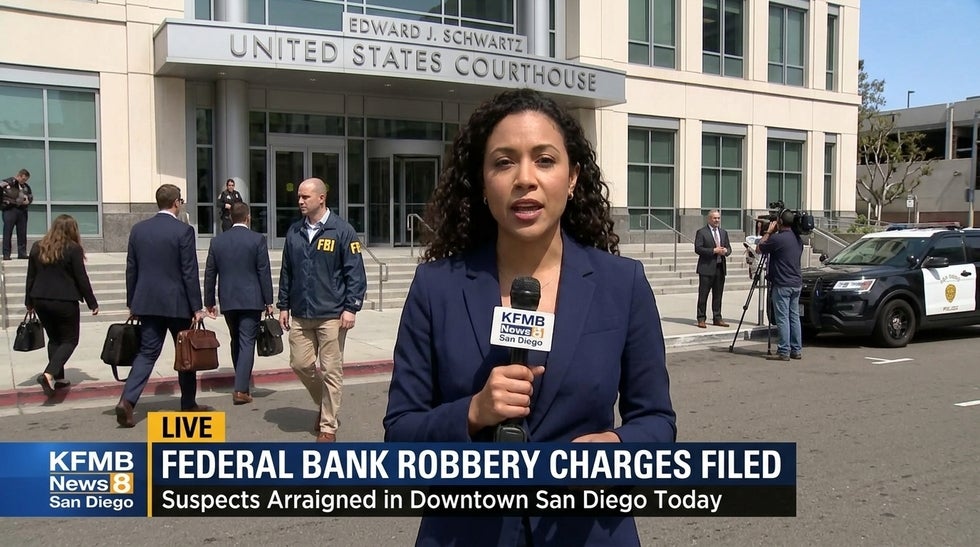
Federal bank robbery charges under 18 U.S.C. § 2113 are prosecuted exclusively in the United States District Court for the Southern District of California:
U.S. District Court Southern District of California
333 West Broadway, San Diego, CA 92101
U.S. Attorney's Office: 880 Front Street, San Diego, CA 92101
The Southern District's Violent Crimes section handles bank robbery prosecutions. These cases are assigned to experienced AUSAs who work closely with the FBI Bank Robbery Task Force and are familiar with the San Diego banking geography and the patterns of repeat offenders in the county.
Defense Strategies for Federal Bank Robbery in the Southern District
The Bulldog Law's federal criminal defense practice approaches every § 2113 case by attacking the identification evidence, challenging the government's physical evidence, and contesting any enhancement allegations that drive sentences above the base term:
Challenging Identification Evidence
Identification is the central battleground in the majority of San Diego federal bank robbery cases. The circumstances of a bank robbery high stress, brief duration, disguises, and limited interaction between the suspect and witnesses create significant conditions for misidentification. We challenge the FBI's photo array and lineup procedures, retain eyewitness memory experts to testify on the science of stress-induced misidentification, and present alibi evidence developed through independent investigation.
Challenging the Intimidation Element
For the base offense under § 2113(a), the prosecution must prove the taking was accomplished through conduct that would make a reasonable person fear bodily harm. Ambiguous conduct, a note that was genuinely ambiguous, or a teller who did not actually feel intimidated all create genuine issues about whether this element is satisfied. We examine the teller's statements, the specific language of any demand note, and the objective circumstances at the scene to challenge whether the intimidation standard was met.
Contesting the Dangerous Weapon Enhancement
The aggravated bank robbery enhancement under § 2113(d) requires that the defendant assaulted someone or used a dangerous weapon to put lives in jeopardy. Whether a replica firearm, a finger in a pocket, or an implied threat satisfies the “dangerous weapon” standard is a genuinely contested legal question. Courts have reached different conclusions on what qualifies. We research the specific facts and applicable Ninth Circuit precedent to challenge enhancement allegations that are legally or factually unsupported.
Negotiating Charge and Sentencing Reduction
In cases where identification evidence is strong and the facts are difficult to contest, we focus on charge reduction negotiations and sentencing mitigation. Reducing an aggravated § 2113(d) charge to a base § 2113(a) charge can eliminate years from the sentence. Presenting a comprehensive mitigation package including mental health history, substance abuse treatment needs, family circumstances, and employment history supports arguments for a downward variance below the Guideline range under 18 U.S.C. § 3553(a).
Arrested for Federal Bank Robbery in San Diego? Your First Steps
- Invoke your right to remain silent immediately and completely. Do not make any statement to FBI agents, SDPD detectives, or any law enforcement personnel at the scene of arrest or during processing. Bank robbery investigations move extremely fast and agents are trained to use the arrest moment to extract admissions.
- Do not consent to any search of your vehicle, home, or phone. FBI agents routinely request consent to search immediately after a bank robbery arrest. A warrantless search conducted without your consent preserves your suppression arguments for every piece of evidence found.
- If dye-stained clothing or currency was found on you or at your location, do not attempt to explain or minimize it. The presence of dye pack evidence is a significant factual challenge but your explanation without counsel present is almost always more damaging than the physical evidence itself.
- Federal bank robbery booking occurs at the San Diego Metropolitan Correctional Center (MCC), 808 Union Street, San Diego, or at a federal holding facility pending initial appearance at the courthouse, 333 West Broadway. You will appear before a U.S. Magistrate Judge within 24 to 48 hours. The Bulldog Law fights for release at the initial appearance detention hearing.
- If you are charged with multiple counts multiple bank robberies do not attempt to assess the strength of each case on your own. The government's ability to use identification evidence from one incident to support another is a complex legal question that requires immediate defense analysis.
- Call The Bulldog Law at (888) 928-1609. The charging decision in federal bank robbery cases happens within 72 hours of arrest. Getting counsel involved before that decision is made is the single most important step.
Contact The Bulldog Law From Your San Diego County Community
The Bulldog Law represents clients facing federal bank robbery charges throughout San Diego County and the Southern District. Reach us directly from your community:
Carlsbad: North Coastal clients in Carlsbad, Oceanside, and Vista can contact The Bulldog Law through our Carlsbad office page. Federal cases from North County are prosecuted at 333 West Broadway, San Diego.
La Mesa: East County clients in La Mesa, El Cajon, and Santee can reach us through our La Mesa office page.
Poway: North inland clients in Poway, Rancho Bernardo, and surrounding areas can contact us through our Poway office page.
We also serve clients in Encinitas, Solana Beach, Del Mar, Coronado, Chula Vista, National City, Lemon Grove, and all surrounding San Diego County communities.
View our complete San Diego County or contact our main San Diego office:
San Diego Office
501 West Broadway, Suite 800 San Diego, CA 92101 Phone: (888) 928-1609
Frequently Asked Questions: 18 U.S.C. § 2113 Bank Robbery in San Diego
Why is bank robbery a federal crime rather than a state crime in San Diego?
Federal jurisdiction over bank robbery arises from the federal insurance that covers virtually every U.S. bank and credit union. When the FDIC insures a financial institution which is nearly universal any robbery of that institution constitutes a federal offense under 18 U.S.C. § 2113, regardless of how minor the amount taken or whether any weapon was used. California state bank robbery charges under PC § 211 can technically be filed as well, but prosecutors almost always defer to federal prosecution given the stronger resources and mandatory sentencing framework available in the Southern District.
Can a note demand without any weapon be charged as federal bank robbery?
Yes. Robbery by intimidation under § 2113(a) does not require a weapon. Presenting a demand note to a teller without any physical force, without showing a weapon, and without making any verbal threat constitutes robbery by intimidation if the conduct would make a reasonable person fear bodily harm. Note demand robberies are among the most commonly prosecuted bank robbery categories in San Diego, carrying up to 20 years in federal prison despite the absence of any weapon.
What is the difference between § 2113(a) and § 2113(d) in terms of sentence?
Section 2113(a) covers the base offense of bank robbery by force, intimidation, or extortion and carries a maximum of 20 years. Section 2113(d) is the aggravated version that applies when a dangerous weapon or device is used to assault someone or jeopardize lives it carries a maximum of 25 years. The critical issue is whether the object used even if it was a toy gun, a fake weapon, or a hand gesture implying a weapon satisfies the “dangerous weapon” standard. Reducing a § 2113(d) charge to § 2113(a) can meaningfully reduce the Guideline range and the ultimate sentence.
How quickly does the FBI typically solve bank robbery cases in San Diego?
The FBI's San Diego Bank Robbery Task Force has one of the highest clearance rates of any violent crime category. The combination of high-resolution bank surveillance footage, GPS-tracked bait money, dye pack evidence, and the geographic concentration of San Diego's banking corridors means most bank robbery cases result in an arrest within days to weeks. This speed underscores why retaining defense counsel immediately after an arrest before the initial appearance, before arraignment, and before the government finalizes its charging theory is so critical.
Does the amount stolen affect the federal sentence for bank robbery?
Under the Federal Sentencing Guidelines, loss amount is a factor in calculating the Guideline range for bank robbery but it is not the primary driver the way it is in fraud cases. The more significant sentencing factors in § 2113 cases are whether a dangerous weapon was used, whether anyone was physically injured, whether the defendant was a leader or organizer of multiple robberies, and the defendant's criminal history category. A defendant who robbed a bank for $500 with a note faces a substantially similar Guideline range to someone who took $5,000 with the same conduct.
What happens if I was involved but did not personally enter the bank?
Bank robbery conspiracy and aiding and abetting under 18 U.S.C. § 2 are frequently charged alongside § 2113 in cases involving a getaway driver, a lookout, or someone who helped plan the robbery without entering the bank.
Federal aiding and abetting liability makes each participant equally responsible for the principal offense. We analyze the specific conduct alleged and challenge the sufficiency of the evidence connecting our client to the robbery, the knowledge of the plan, and the intent to facilitate the specific offense charged.