
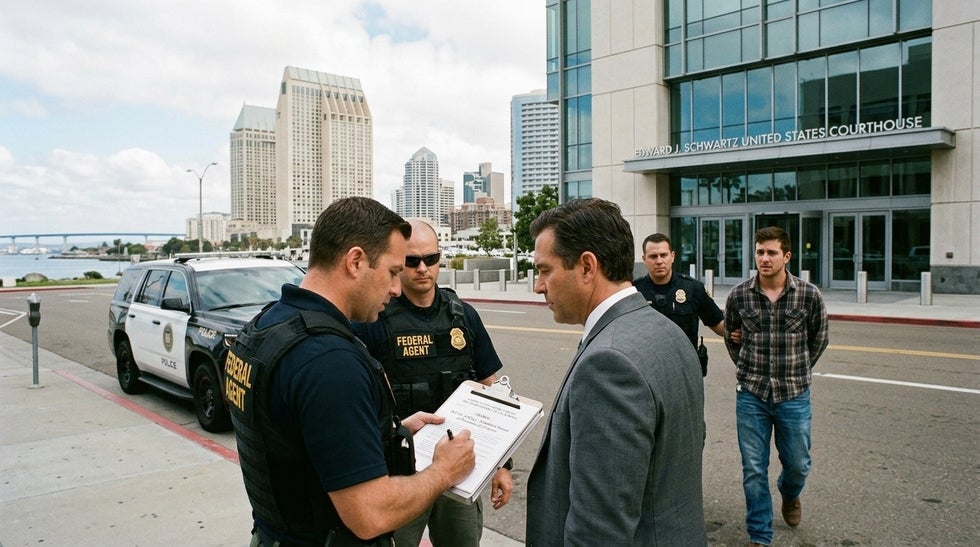
A Complete Defense Guide to Federal Felon-in-Possession Charges, Who Is Prohibited, and How the Southern District Prosecutes These Cases
You have a prior felony conviction. You were stopped at a traffic checkpoint on Interstate 5 south of San Diego. The officer discovered a firearm in your vehicle. Within 48 hours, the U.S. Attorney's Office filed federal charges under 18 U.S.C. § 922(g). You are now facing a federal felony with no mandatory minimum but a Guideline range that can reach a decade or more depending on your record prosecuted in the Southern District of California, one of the most active federal firearm prosecution districts in the country.
Federal felon-in-possession charges under 18 U.S.C. § 922(g) are among the most frequently filed charges in the Southern District of California. San Diego's border proximity, its large military population, its active gang enforcement environment, and its high volume of cross-border firearms trafficking all generate § 922(g) prosecutions at a rate that exceeds most other federal districts. These cases move fast, the evidence is typically physical and straightforward, and the sentencing consequences are serious particularly for defendants with prior violent or drug-related convictions.
The Bulldog Law handles federal firearm defense throughout the Southern District and covers § 922(g) developments on criminal defense blog. This guide explains exactly who is prohibited, how the Southern District builds these cases, and what defense attorneys challenge to protect their clients' futures.
Who Is Prohibited From Possessing Firearms Under 18 U.S.C. § 922(g)
Section 922(g) establishes nine categories of prohibited persons who may not ship, transport, possess, or receive any firearm or ammunition that has traveled in interstate or foreign commerce. Because virtually every commercially manufactured firearm has traveled in interstate commerce, the jurisdictional element is almost always met.
The Nine Prohibited Persons Categories
- 922(g)(1): Any person convicted of a crime punishable by imprisonment for more than one year the ‘felon in possession' provision. The most commonly charged category in San Diego.
- 922(g)(2): Fugitives from justice.
- 922(g)(3): Unlawful users of or addicts to controlled substances. In San Diego, this provision is frequently charged alongside drug trafficking cases.
- 922(g)(4): Persons adjudicated as mentally defective or committed to a mental institution.
- 922(g)(5): Illegal aliens particularly relevant in San Diego given the volume of border-related prosecutions. An undocumented person found with a firearm faces both § 922(g)(5) and immigration charges.
- 922(g)(6): Persons dishonorably discharged from the Armed Forces. Significant in San Diego's large military community.
- 922(g)(7): Persons who have renounced U.S. citizenship.
- 922(g)(8): Persons subject to a domestic violence restraining order. Common add-on charge in San Diego domestic violence cases.
- 922(g)(9): Persons convicted of a misdemeanor crime of domestic violence the Lautenberg Amendment. Particularly significant for military personnel whose careers can be destroyed by a misdemeanor DV conviction.
THE ARMED CAREER CRIMINAL ACT: When a § 922(g)(1) defendant has three or more prior convictions for violent felonies or serious drug offenses, the Armed Career Criminal Act (ACCA, 18 U.S.C. § 924(e)) applies imposing a mandatory minimum sentence of 15 years. ACCA dramatically elevates the stakes in any § 922(g) case where the defendant has a significant prior record. Challenging ACCA predicate convictions is one of the highest-value defense strategies in Southern District firearm cases.
The Knowledge Requirement After Rehaif
The Supreme Court's 2019 decision in Rehaif v. United States held that the government must prove the defendant knew they belonged to the relevant prohibited category at the time they possessed the firearm. For felons, this means the government must prove the defendant knew they had been convicted of a crime punishable by more than one year. For § 922(g)(5) cases, it means the government must prove the defendant knew they were in the country illegally. Rehaif created genuine defense opportunities that the Bulldog Law evaluates in every § 922(g) case.
How § 922(g) Cases Are Generated in San Diego's Southern District
Border Firearms Trafficking Interdiction
San Diego's border location makes it a primary corridor for firearms trafficking in both directions American firearms moving south into Mexico and Mexican cartel weapons moving north. CBP inspections at San Ysidro and Otay Mesa, combined with ATF and HSI border enforcement operations, generate a significant volume of § 922(g) charges against prohibited persons found with firearms at or near the border. These cases frequently involve straw purchase conspiracies and are charged alongside federal conspiracy counts.
Traffic Stops and Gang Enforcement
SDPD and the Sheriff's Department conduct active gang enforcement operations throughout San Diego County, and traffic stops that yield firearms on individuals with prior felony convictions are immediately referred to federal prosecution through the ATF's Project Safe Neighborhoods initiative. The Southern District's partnership with SDPD on gang-related firearms cases means that what might be a state firearm charge in another city is routinely filed federally in San Diego, where the penalties and prosecutorial resources are significantly greater.
Domestic Violence Restraining Order Cases
Section 922(g)(8) prohibits firearm possession by anyone subject to a qualifying domestic violence restraining order. In San Diego, SDPD and the Sheriff's Family Protection Unit actively enforce firearm surrender requirements following domestic violence restraining orders, and referrals to the ATF for federal prosecution occur when prohibited persons are found with firearms during welfare checks, follow-up domestic calls, or traffic stops. These cases are often charged alongside state domestic violence charges in a dual prosecution strategy.
Military Dishonorably Discharged Personnel
San Diego's large military community generates a unique category of § 922(g)(6) cases involving service members who received dishonorable discharges following court-martial proceedings and later possessed firearms. The interaction between military law, the definition of dishonorable discharge, and the § 922(g)(6) prohibition is technically complex. We evaluate whether the prior discharge qualifies as a dishonorable discharge within the meaning of the statute and whether any restoration of rights occurred after the discharge.
Where Federal Firearms Cases Are Prosecuted in San Diego
Federal firearms charges under 18 U.S.C. § 922(g) are prosecuted in the United States District Court for the Southern District of California:
U.S. District Court Southern District of California
333 West Broadway, San Diego, CA 92101
U.S. Attorney's Office: 880 Front Street, San Diego, CA 92101
Federal firearms cases in the Southern District are handled by the Violent Crimes section of the U.S. Attorney's Office in coordination with the ATF San Diego Field Division, FBI, and SDPD's Gang Suppression Unit. The Southern District has an active Project Safe Neighborhoods program that fast-tracks § 922(g) prosecutions involving gang members and repeat offenders.
Defense Strategies for § 922(g) Charges in the Southern District
The Bulldog Law's federal firearms defense practice builds every § 922(g) defense around challenging the predicate prohibition, attacking the possession evidence, and where a conviction cannot be avoided minimizing sentencing exposure through every available legal mechanism:
Challenging the Prior Conviction The Predicate Attack
For § 922(g)(1) charges, the prior conviction is the foundation of the entire case. We challenge whether the prior conviction qualifies as a crime punishable by more than one year using the categorical approach analyzing the elements of the prior offense rather than the specific facts of the prior case. Many state convictions that appear to be disqualifying felonies do not meet the federal definition. We also examine whether civil rights were restored following the prior conviction, which in some cases eliminates the § 922(g)(1) prohibition entirely.
The Rehaif Knowledge Defense
Following Rehaif v. United States (2019), the government must prove the defendant knew they were a prohibited person. In cases where the defendant had multiple prior convictions of varying severity and may not have known which crossed the one-year threshold, where the defendant's immigration status was genuinely ambiguous, or where the defendant had reason to believe their rights had been restored, the knowledge element is genuinely contestable. We present evidence of the defendant's actual understanding of their prohibited status at the time of the alleged possession.
Constructive Possession Challenges
When the firearm was found in a shared vehicle, a home occupied by multiple people, or a location where third parties had access, constructive possession requires proof that the defendant had both knowledge of the firearm's presence and dominion and control over it. We challenge constructive possession through evidence of third-party access, the defendant's lack of knowledge of the firearm's presence, and the absence of fingerprints, DNA, or other physical evidence connecting the defendant specifically to the weapon.
Fourth Amendment Suppression
The stop, detention, or search that produced the firearm must be constitutionally valid. Traffic stops without reasonable articulable suspicion, searches conducted without consent or a valid exception to the warrant requirement, and checkpoint stops that exceeded their constitutional scope are all vulnerable to suppression challenge. A successful suppression motion eliminates the firearm from evidence and without the firearm, there is no § 922(g) case.
Challenging the ACCA Enhancement
When the government seeks an Armed Career Criminal Act enhancement, each of the three predicate prior convictions must independently qualify as a violent felony or serious drug offense under the ACCA's definitions. The Supreme Court's decisions in Johnson v. United States (2015) and subsequent cases have eliminated the ACCA's residual clause and narrowed the definition of violent felony significantly. We challenge every ACCA predicate individually a single successful challenge prevents the 15-year mandatory minimum from applying.
Arrested on Federal Firearms Charges in San Diego? Act Now
- Invoke your right to remain silent immediately. Do not explain where the firearm came from, who it belongs to, or why you had it. Federal firearms agents and AUSAs build these cases quickly from physical evidence your statements add intent evidence that makes conviction easier.
- Do not consent to any further search of your vehicle, home, or phone. A § 922(g) arrest frequently triggers requests for consent to search for additional firearms, ammunition, or evidence of drug use. Decline all searches clearly. Require a warrant for everything beyond what is already seized.
- If the firearm was not yours if it belonged to another occupant of the vehicle or was left by someone else do not attempt to explain this to officers at the scene. Preserve this defense for your attorney, who can investigate and present it properly.
- Federal firearms booking occurs at the San Diego Metropolitan Correctional Center (MCC), 808 Union Street, San Diego, or at a federal holding facility pending initial appearance at 333 West Broadway. You will appear before a U.S. Magistrate Judge within 24 to 48 hours. The Bulldog Law fights for release at the initial detention hearing.
- Identify all documentation of your prior convictions and any rights restorations, pardons, or expungements that occurred after those convictions. The prior conviction record shapes the entire prosecution and sentencing analysis and must be reviewed by defense counsel before any plea is entered.
- Call The Bulldog Law at (888) 928-1609. Federal firearms cases are charged and resolved quickly in the Southern District. Getting experienced federal defense counsel before the initial appearance is the most important step you can take for your case.
Contact The Bulldog Law From Your San Diego County Community
The Bulldog Law represents clients facing federal firearms charges throughout San Diego County and the Southern District of California. Reach us from your community:
National City: South Bay clients in National City, Chula Vista, and Imperial Beach an area with active federal firearms enforcement near the border can reach The Bulldog Law through our National City office page. Federal cases from this area are prosecuted at 333 West Broadway.
Oceanside: North County clients in Oceanside, Carlsbad, and the Camp Pendleton corridor where military-related firearms cases are particularly common can contact us through our Oceanside office page.
El Cajon: East County clients in El Cajon, La Mesa, and Santee can reach us through our El Cajon office page. We defend federal firearms defendants from across East County in the Southern District courthouse.
We also serve clients in Poway, Vista, San Marcos, Escondido, Lemon Grove, Coronado, Solana Beach, Del Mar, Encinitas, and all surrounding San Diego County communities.
Visit our office San Diego County service area:
San Diego Office
501 West Broadway, Suite 800 San Diego, CA 92101 Phone: (888) 928-1609
Frequently Asked Questions: 18 U.S.C. § 922(g) in San Diego
What is the Rehaif decision and how does it affect my § 922(g) case?
In Rehaif v. United States (2019), the Supreme Court held that the government must prove the defendant knew they belonged to the prohibited category under § 922(g) at the time of possession. For felon-in-possession cases, this means the government must prove the defendant knew their prior conviction was punishable by more than one year. While most defendants with prior felony convictions do have this knowledge, Rehaif has created genuine defense opportunities in cases involving convictions the defendant believed were misdemeanors, convictions in other states with different classification systems, or situations where the defendant genuinely believed their rights had been restored.
Does the Armed Career Criminal Act apply to my case?
The ACCA applies when a § 922(g)(1) defendant has three or more prior convictions for violent felonies or serious drug offenses as defined by the statute, imposing a mandatory minimum of 15 years. Following the Supreme Court's Johnson v. United States decision (2015), the ACCA's residual clause which covered offenses that ‘otherwise involve conduct that presents a serious potential risk of physical injury' was struck down as unconstitutionally vague. This eliminated many prior convictions from ACCA predicate status. We analyze every potential ACCA predicate individually under current law to identify challenges that prevent the 15-year mandatory minimum from applying.
Can I be charged federally for a firearm found in my home in San Diego?
Yes. The § 922(g) prohibition applies to possession anywhere in a home, a vehicle, on a person, or in any other location. There is no exception for firearms possessed in a private residence. Federal jurisdiction is established by the firearm's prior travel in interstate commerce, which applies to virtually every commercially manufactured weapon. When a prohibited person's home is searched pursuant to a warrant in a domestic violence case, a drug investigation, or a probation search and a firearm is found, federal charges under § 922(g) follow alongside any state charges.
What is the difference between a state firearm charge and a federal § 922(g) charge in San Diego?
California state firearm charges for prohibited persons including PC § 29800 (felon in possession) are prosecuted in San Diego Superior Court by the DA's Office and carry state prison sentences. Federal § 922(g) charges are prosecuted in the Southern District federal court by the U.S. Attorney's Office. Federal sentences are served in federal prison without parole. The Federal Sentencing Guidelines determine the sentence range based on criminal history and the specific offense characteristics. In San Diego, the ATF's Project Safe Neighborhoods program results in federal prosecution of § 922(g) cases that involve gang members, repeat offenders, or firearms found in connection with drug trafficking with state prosecution reserved for less serious cases.
Can my gun rights ever be restored after a § 922(g) conviction?
Federal firearms rights can potentially be restored through a presidential pardon, through state-level restoration of civil rights if the underlying conviction was a state offense, or through the expungement of the prior conviction in jurisdictions where expungement eliminates the disability. California's PC § 1203.4 expungement does not restore federal firearms rights only a full pardon or other complete relief from the underlying conviction eliminates the federal prohibition. We advise clients on all available post-conviction relief options that may restore firearms rights after a § 922(g) conviction.
How does § 922(g)(9) the misdemeanor domestic violence prohibition affect military members in San Diego?
The Lautenberg Amendment under § 922(g)(9) prohibits anyone convicted of a misdemeanor crime of domestic violence from possessing firearms. For active duty military in San Diego, this is devastating military personnel are required to carry firearms as part of their duties, meaning a misdemeanor DV conviction automatically disqualifies them from service. This consequence is permanent and applies retroactively to convictions entered before the Lautenberg Amendment's enactment. The Bulldog Law handles Lautenberg cases with full awareness of both the federal firearms consequences and the parallel military career consequences, and pursues every available avenue for vacating or modifying the underlying conviction to restore firearms eligibility.