
Understanding 8 U.S.C. § 1326 Illegal Reentry in the World's Busiest Border Court, How Sentences Are Calculated, and What Defense Options Exist
No federal district in the United States prosecutes more immigration cases than the Southern District of California. The San Diego-Tijuana border corridor — the most heavily crossed international border in the world generates a volume of federal immigration prosecutions that dwarfs every other district. The U.S. Attorney's Office for the Southern District processes thousands of immigration cases annually, the majority of which are illegal reentry charges under 8 U.S.C. § 1326.
What distinguishes San Diego immigration cases from other districts is not just volume it is complexity. Southern District immigration defendants include first-time border crossers, individuals with prior removal orders and criminal histories, asylum seekers whose claims were improperly adjudicated, and long-term California residents with deep community ties who were removed years ago and reentered to be with their families. Each of these situations requires a fundamentally different defense approach.
The Bulldog Law has handled federal immigration defense throughout the Southern District and covered these cases extensively on defense blog. This article explains how § 1326 works in San Diego, what the sentencing enhancements mean in practice, and the specific defense strategies that produce results in the Southern District.
THE VOLUME REALITY: The Southern District's immigration docket is so large that cases often move from arrest to plea offer within days. Defendants without experienced federal immigration defense counsel are frequently pushed through the process before any meaningful defense analysis has occurred. Retaining counsel immediately is critical.
How 8 U.S.C. § 1326 Works: Illegal Reentry After Removal
Section 1326 makes it a federal crime for any alien who has been denied admission, excluded, deported, or removed from the United States to enter, attempt to enter, or be found in the United States without express consent from the Attorney General or Secretary of Homeland Security. The statute has two tiers of penalties depending on the defendant's criminal history.
§ 1326(a): Base Illegal Reentry
The base offense applies to any previously removed alien found in the United States without authorization. It carries a maximum of 2 years in federal prison. In the Southern District, first-time § 1326 defendants without significant criminal histories often resolve their cases quickly under fast-track plea programs that produce sentences well below the 2-year maximum.
§ 1326(b): Enhanced Illegal Reentry
The penalties increase dramatically when the prior removal was based on or following a criminal conviction:
- 1326(b)(1): Prior removal following an aggravated felony conviction maximum 20 years in federal prison.
- 1326(b)(2): Prior removal following a conviction for a felony maximum 10 years.
- 1326(b)(3): Three or more prior removals maximum 10 years.
WHAT IS AN AGGRAVATED FELONY: The definition of ‘aggravated felony' under immigration law is broader than its name suggests. It includes not just violent crimes but also drug trafficking offenses, theft offenses with sentences over 1 year, fraud offenses involving losses over $10,000, and many other categories. A conviction that is a misdemeanor under state law can qualify as an aggravated felony under federal immigration law, dramatically increasing the § 1326(b) exposure.
The Federal Sentencing Guidelines for § 1326
Beyond the statutory maximums, the Federal Sentencing Guidelines calculate a specific recommended sentence range based on the defendant's criminal history and the nature of the prior removal. The base offense level for § 1326 is 8, with increases for prior aggravated felony convictions, drug trafficking convictions, and other criminal history factors. In the Southern District, the fast-track departure program under U.S.S.G. § 5K3.1 provides 4-level reductions for defendants who accept responsibility early and waive certain rights a program unique to high-volume border districts.
What Makes San Diego Immigration Prosecutions Different
The Fast-Track Program
The Southern District operates one of the country's most active fast-track early disposition programs for § 1326 cases. Fast-track allows defendants who plead guilty early and waive appeal rights to receive a 4-level downward departure under the Sentencing Guidelines typically reducing a sentence by months. For defendants without aggravated felony histories, fast-track produces sentences that range from time-served to several months. We evaluate fast-track eligibility carefully in every case, weighing the departure benefit against the value of viable defense arguments that fast-track waives.
Operation Streamline and Mass Prosecution
At various points in San Diego's border enforcement history, Operation Streamline has been used to prosecute groups of border crossers simultaneously in mass proceedings. These proceedings raise due process concerns about the adequacy of individual legal representation and the voluntariness of group plea proceedings. We challenge fast-tracked dispositions that were secured without adequate individual review of each defendant's specific circumstances, prior removal history, and potential defenses.
Collateral Attack on Prior Removal Orders
Under 8 U.S.C. § 1326(d), a defendant charged with illegal reentry can challenge the validity of the underlying removal order as a defense to the criminal charge. To succeed, the defendant must show: (1) they exhausted administrative remedies; (2) the deportation proceedings deprived them of judicial review; and (3) the removal order was fundamentally unfair. This collateral attack is particularly powerful in cases where the prior removal was based on a criminal conviction that has since been vacated, or where the immigration court failed to advise the defendant of their right to apply for relief from removal.
Asylum and Protection-Based Defenses
Many San Diego § 1326 defendants reentered the United States to flee persecution, gang violence, or government harm in their home countries. The fact that a prior removal order exists does not extinguish a valid claim for asylum, withholding of removal, or protection under the Convention Against Torture. We identify asylum and protection-based arguments in every § 1326 case and, where viable, incorporate them into both the criminal defense strategy and parallel immigration proceedings.
Where Federal Immigration Cases Are Prosecuted in San Diego
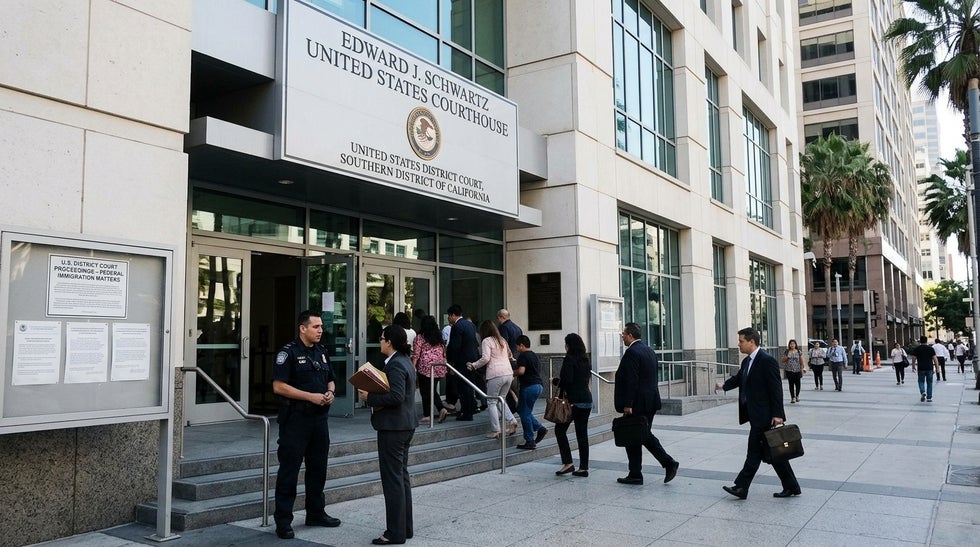
Federal immigration charges under 8 U.S.C. § 1326 are prosecuted in the United States District Court for the Southern District of California the highest-volume immigration prosecution court in the country:
U.S. District Court — Southern District of California
333 West Broadway, San Diego, CA 92101
U.S. Attorney's Office: 880 Front Street, San Diego, CA 92101
Immigration Court (EOIR): 2415 Mendocino Blvd, San Diego, CA 92103
The Southern District's immigration section handles § 1326 prosecutions alongside the border enforcement teams from CBP and ICE. The volume of cases means that individual defendants risk being processed through a system optimized for efficiency rather than individual justice. We ensure every client receives individualized analysis regardless of the court's pace.
Defense Strategies for § 1326 Immigration Charges in San Diego
The Bulldog Law's federal immigration defense practice evaluates every § 1326 case for the full range of defense and mitigation options available in the Southern District:
Collateral Attack on the Prior Removal Order
When the prior removal order was fundamentally unfair issued without proper notice, without advice of the right to apply for relief, or based on a conviction that has since been vacated we file a § 1326(d) collateral attack. A successful collateral attack eliminates the predicate for the criminal charge. This is the most powerful defense available in § 1326 cases and is available in a significant number of Southern District cases where prior removal proceedings were conducted rapidly and without adequate procedural protections.
Challenging the Aggravated Felony Enhancement
The difference between a § 1326(a) prosecution with a 2-year maximum and a § 1326(b)(1) prosecution with a 20-year maximum often turns on whether the prior conviction qualifies as an aggravated felony under immigration law. Many convictions that are labeled felonies under state law do not meet the immigration law definition of aggravated felony. We analyze every prior conviction using the categorical approach and modified categorical approach to challenge the government's enhancement allegation.
Fast-Track vs. Full Defense Evaluation
The fast-track 4-level departure is genuinely valuable for defendants without viable defense arguments. But for defendants with collateral attack claims, enhancement challenges, or asylum-based arguments, accepting fast-track means waiving these rights permanently. We conduct a thorough cost-benefit analysis of fast-track for every client before any plea is entered ensuring the departure benefit is not purchased at the cost of a winnable defense argument.
Sentencing Mitigation
For clients where a plea is the appropriate resolution, we prepare comprehensive sentencing mitigation packages that present the full picture of their lives to the federal judge their family ties in the United States, their history in the community, the circumstances that led to reentry, their employment record, and any humanitarian factors that support a below-Guideline sentence. Southern District judges retain discretion to vary downward from the Guidelines under 18 U.S.C. § 3553(a), and effective mitigation advocacy produces meaningfully shorter sentences.
Arrested on Immigration Charges in San Diego? Your Rights and Next Steps
- You have the right to remain silent. Do not answer questions about your immigration history, your prior removals, your criminal record, or how you entered the country without an attorney present. Statements made to CBP or ICE officers are used directly in the federal criminal prosecution.
- You have the right to an attorney. In a federal criminal immigration case as opposed to a civil immigration proceeding you have a constitutional right to counsel. If you cannot afford an attorney, one will be appointed. Retaining private federal defense counsel from The Bulldog Law gives you access to individualized defense analysis that appointed counsel under the Southern District's volume often cannot provide.
- Do not sign any documents presented by immigration officers without understanding what you are signing. Voluntary departure agreements and stipulated removal orders waive important rights and create the prior removal record that forms the basis of future § 1326 prosecutions.
- Federal immigration arrests in San Diego typically result in detention at the Otay Mesa Detention Center (7488 Calzada de la Fuente, San Diego) or another DHS detention facility pending initial appearance at the federal courthouse. Your initial appearance before a U.S. Magistrate Judge will occur within 24 to 48 hours.
- If you have a prior U.S. conviction, provide your attorney with as much detail as possible about that conviction immediately. The nature and date of the prior conviction determines whether the aggravated felony enhancement applies and shapes the entire sentencing analysis.
- Call The Bulldog Law at (888) 928-1609. Immigration cases in the Southern District move extremely fast. Getting experienced federal immigration defense counsel engaged before the initial appearance is the most important step you can take.
Contact The Bulldog Law From Your San Diego County Community
The Bulldog Law represents clients facing federal immigration charges throughout San Diego County and the Southern District. Reach us from your community:
Chula Vista: Chula Vista is home to one of the largest immigrant communities in San Diego County. Clients from Chula Vista, Bonita, and the South Bay can reach The Bulldog Law through our Chula Vista office page. Federal immigration cases from this area are prosecuted at 333 West Broadway.
National City: National City's large Spanish-speaking community and proximity to the border generates significant federal immigration case volume. Clients from National City, Lemon Grove, and the South Bay can contact us through our National City office page.
Escondido: North County's Escondido and San Marcos have significant immigrant populations whose members face both federal immigration prosecution and parallel civil immigration proceedings. Clients from this area can reach us through our Escondido office page.
We also serve clients in Oceanside, Vista, Santee, El Cajon, La Mesa, Imperial Beach, Coronado, and all surrounding San Diego County communities.
View our complete San Diego County service area or contact our San Diego office directly:
San Diego Office
501 West Broadway, Suite 800 San Diego, CA 92101 Phone: (888) 928-1609
Frequently Asked Questions: 8 U.S.C. § 1326 in San Diego
What is the difference between civil deportation and criminal illegal reentry?
Civil deportation (now called “removal”) is an administrative proceeding conducted by the Department of Homeland Security and the immigration courts under the Executive Office for Immigration Review (EOIR). It results in a removal order but not a criminal conviction. Criminal illegal reentry under § 1326 is a federal criminal prosecution in U.S. District Court that results in a federal conviction and prison sentence. A person can be deported civilly multiple times without facing criminal charges. Criminal prosecution typically occurs when a previously removed person is found in the United States again converting the immigration violation into a federal crime.
How does the fast-track program work in San Diego and should I accept it?
The Southern District's fast-track program provides a 4-level downward departure from the Sentencing Guidelines in exchange for an early guilty plea and waiver of certain rights including the right to appeal the sentence and, in some cases, the right to file a collateral attack on the prior removal order. For defendants without viable defense arguments or strong collateral attack claims, fast-track often produces the best available sentence. For defendants with strong collateral attack arguments, enhancement challenges, or asylum claims, accepting fast-track can waive the most powerful tools available. The decision requires careful, individualized analysis that The Bulldog Law conducts for every client.
Can I challenge the prior removal order that is the basis for my § 1326 charge?
Yes under 8 U.S.C. § 1326(d), you can challenge the validity of the underlying removal order as a defense to the criminal charge if three conditions are met: you exhausted available administrative remedies, the deportation proceedings effectively eliminated judicial review, and the entry of the order was fundamentally unfair. Common grounds for collateral attack include failure to advise of the right to apply for relief from removal, removal based on a conviction that has since been vacated, and removal proceedings conducted without proper notice. A successful collateral attack eliminates the predicate for the criminal charge entirely.
What is an ‘aggravated felony' under immigration law and why does it matter?
An aggravated felony under 8 U.S.C. § 1101(a)(43) is a specific list of offenses defined by federal immigration law that is much broader than the term's name suggests. It includes drug trafficking, theft with a sentence over 1 year, fraud with losses over $10,000, sexual abuse of a minor, and many other categories. Critically, a state misdemeanor can qualify as an immigration aggravated felony if the sentence imposed exceeded 1 year. An aggravated felony prior removal triggers the § 1326(b)(1) enhancement, raising the maximum sentence from 2 years to 20 years. We challenge aggravated felony designations in every case using the categorical and modified categorical approach to compare the prior conviction to the immigration law definition.
What happens if I have asylum or protection claims in addition to a criminal charge?
Asylum and protection claims do not automatically stop a criminal § 1326 prosecution but they are critically important both as defense arguments and as parallel immigration proceedings. If you have a genuine fear of persecution, torture, or serious harm if returned to your home country, we identify asylum, withholding of removal, and Convention Against Torture claims and incorporate them into both the criminal defense strategy and a parallel EOIR proceeding. A pending asylum claim can affect detention status, influence the prosecutor's charging decisions, and form the basis of a motion to dismiss the criminal charge where the prior removal was fundamentally unfair because the immigration court failed to consider protection claims.
How long does a federal immigration case take in the Southern District?
The Southern District's § 1326 docket moves faster than almost any other federal criminal case category. Simple cases first-time illegal reentry without criminal history can resolve in weeks through the fast-track program. Complex cases involving collateral attack claims, enhancement challenges, or trial can take 6 to 18 months. The initial appearance before a U.S. Magistrate Judge occurs within 24 to 48 hours of arrest.
The Bulldog Law works at the Southern District's pace without sacrificing the quality of defense analysis every client deserves.