
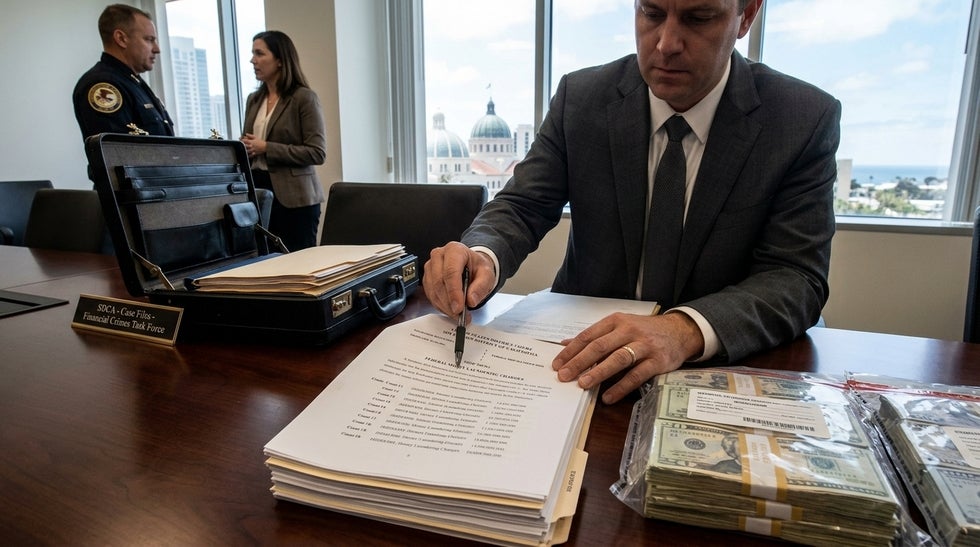
How 18 U.S.C. § 1956 Works in the Southern District, Why the Border Makes This Charge Uniquely Common, and What Defense Looks Like
Your business processed cash transactions that federal agents now claim were structured to hide their origin. Or a wire transfer you sent money you believed was legitimate is being traced by FinCEN to a drug trafficking operation. Or you were paid in cash for services rendered, and HSI is arguing that you knew the money came from a criminal enterprise. In San Diego, money laundering charges emerge from contexts most people never anticipate.
San Diego's position on the US-Mexico border makes it one of the most active money laundering prosecution districts in the country. The flow of drug proceeds, cartel money, and illicit cash northbound through the Southern District generates a disproportionate volume of 18 U.S.C. § 1956 cases. But money laundering is not limited to cartel cases it is charged in real estate transactions, business dealings, cryptocurrency transfers, and any situation where the government believes proceeds from specified unlawful activity were processed through financial transactions.
The Bulldog Law covers federal money laundering defense strategy in the Southern District on defense blog. This article explains what § 1956 actually requires, how border-adjacent investigations differ, and where the defense attacks these cases most effectively.
What 18 U.S.C. § 1956 Actually Requires
Money laundering under § 1956 is more technically complex than most federal charges. Understanding exactly what the government must prove is essential — because the complexity creates genuine defense opportunities at every element.
The Three Core Theories of § 1956
Section 1956 covers three distinct forms of money laundering, each with different elements:
- 1956(a)(1): Conducting or attempting to conduct a financial transaction with proceeds of specified unlawful activity, knowing the property represents such proceeds, with intent to promote the unlawful activity, evade taxes, or conceal the nature, source, or ownership of the proceeds. This is the most commonly charged form in San Diego.
- 1956(a)(2): Transporting, transmitting, or transferring funds from the United States to a foreign country or into the United States with intent to promote specified unlawful activity or to conceal its proceeds. This provision is frequently charged in San Diego cases involving cross-border cash movement between California and Mexico.
- 1956(a)(3): Sting operations where a government agent conducts a financial transaction with funds represented to be proceeds of specified unlawful activity. This version applies to undercover federal operations and requires careful analysis of the government's conduct.
SPECIFIED UNLAWFUL ACTIVITY: Money laundering requires that the underlying funds come from a ‘specified unlawful activity' (SUA) a list of over 200 federal and state crimes defined in 18 U.S.C. § 1956(c)(7). In San Diego, the most common SUAs are drug trafficking, fraud, and organized crime. The government must prove both that the proceeds came from an SUA and that the defendant knew they did.
18 U.S.C. § 1957: Engaging in Monetary Transactions in Criminally Derived Property
Section 1957 is a lower-threshold money laundering statute that covers engaging in monetary transactions over $10,000 involving criminally derived property without requiring proof of intent to conceal or promote. It carries up to 10 years and is frequently charged alongside § 1956 in cases where the government can prove the transaction amount but struggles to establish specific criminal intent.
The 20-Year Maximum and Sentence Stacking
A § 1956 conviction carries up to 20 years per count. In complex cases, the government charges separate counts for each transaction creating enormous cumulative exposure. The Federal Sentencing Guidelines calculate money laundering sentences based primarily on the value of the laundered funds, with enhancements for sophistication of the scheme, use of financial institutions, and role in the offense. We challenge both the transaction count and the laundered amount at every stage of the case.
How Money Laundering Investigations Work in San Diego's Border Context
Cross-Border Cash Movement
The most common money laundering pattern prosecuted in San Diego's Southern District involves drug proceeds generated by cartel distribution networks in California being transported southbound across the border or laundered through legitimate-appearing businesses before transfer. HSI, DEA, and FinCEN work in close coordination to trace these financial flows. Anyone who touches money in this chain even if they were paid a small percentage for processing transactions quez can be charged with money laundering under § 1956(a)(2).
Bulk Cash Smuggling
Bulk cash smuggling is a related offense under 31 U.S.C. § 5332 that is frequently charged alongside money laundering in San Diego border cases. Crossing the border with more than $10,000 in undeclared cash triggers federal currency reporting requirements. When the cash is connected to drug proceeds, money laundering charges follow. We challenge the nexus between the cash and any alleged criminal activity, the sufficiency of evidence establishing knowledge of the cash's criminal origin, and the voluntariness of any statements made at the border.
Cryptocurrency and Digital Asset Laundering
San Diego federal prosecutors have increasingly charged money laundering in cases involving cryptocurrency using Bitcoin, Ethereum, and mixing services to obscure the trail of drug proceeds or fraud proceeds. The Southern District has prosecuted several high-profile cryptocurrency money laundering cases involving digital asset exchanges and peer-to-peer transfer networks. We retain blockchain forensics experts to challenge the government's tracing analysis and the attribution of specific wallet addresses to our clients.
Real Estate and Business Money Laundering
Legitimate-appearing San Diego businesses restaurants, car washes, construction companies, and retail stores are sometimes used to commingle criminal proceeds with lawful revenue. Federal investigators from FinCEN and the IRS Criminal Investigation unit analyze business banking records, cash deposit patterns, and revenue inconsistencies to identify laundering schemes. We retain forensic accountants to challenge the government's financial analysis and present legitimate business explanations for the patterns prosecutors have characterized as money laundering.
Where Federal Money Laundering Cases Are Prosecuted in San Diego
Money laundering charges under 18 U.S.C. § 1956 are prosecuted in the United States District Court for the Southern District of California:
U.S. District Court Southern District of California
333 West Broadway, San Diego, CA 92101
U.S. Attorney's Office: 880 Front Street, San Diego, CA 92101
Money laundering cases in the Southern District are handled by the Financial Crimes and Narcotics sections of the U.S. Attorney's Office, often in coordination with DEA, HSI, FinCEN, and IRS Criminal Investigation. These cases are frequently multi-defendant and involve voluminous financial discovery that requires immediate and sustained defense attention.
Defense Strategies for § 1956 Money Laundering Charges in San Diego
The Bulldog Law's federal criminal defense practice builds money laundering defenses around attacking the knowledge element, challenging the SUA nexus, and contesting the financial analysis that drives the loss calculation:
Challenging Knowledge of Criminal Origin
The most powerful defense in most San Diego money laundering cases is attacking the government's proof that the defendant knew the funds were proceeds of specified unlawful activity. A business owner who accepted cash payments from a customer later discovered to be a drug dealer, an employee who processed transactions on behalf of an employer without knowledge of the employer's criminal activity, or a family member who received money transfers without knowing their source none of these people possessed the required knowledge. We build the lack of knowledge defense through evidence of the defendant's genuine understanding of the funds' origin.
Attacking the Specified Unlawful Activity Link
The government must prove both that the funds came from a specific SUA and that our client knew they did. When the underlying criminal activity is alleged but not proven particularly in cases where the principal offender was not convicted the SUA element is genuinely contestable. We challenge the evidentiary basis for the government's SUA designation and require the prosecution to prove the criminal origin of the funds beyond a reasonable doubt, not merely by circumstantial inference.
Challenging the Financial Analysis
Government forensic accountants analyze banking records, cash flows, and transaction patterns to build the laundering narrative. This analysis frequently overstates the amount laundered, mischaracterizes legitimate transactions as criminal, and ignores alternative explanations for financial patterns. We retain independent forensic accountants to challenge the government's methodology, present alternative financial narratives, and reduce the laundered amount which directly reduces the Guideline range.
Structuring vs. Money Laundering Distinction
Federal prosecutors sometimes charge money laundering when the more accurate charge is currency structuring under 31 U.S.C. § 5324 breaking transactions into amounts under $10,000 to avoid Currency Transaction Reports. Structuring carries a maximum of 5 years compared to 20 years for § 1956. We challenge the government's characterization of conduct as money laundering when the evidence more accurately supports a structuring charge, and we argue for the lesser charge in plea negotiations.
Under Federal Money Laundering Investigation in San Diego? Act Now
- Do not speak to HSI agents, DEA investigators, IRS Criminal Investigation, or FinCEN personnel without retaining federal defense counsel first. Money laundering investigations frequently begin with a “voluntary” interview request or a grand jury subpoena neither of which is truly voluntary once the government has identified you as a target.
- Do not destroy, alter, or delete any financial records, bank statements, business records, or electronic communications. Evidence destruction is obstruction of justice a separate federal felony that adds years to sentencing exposure and signals guilt to the court.
- If you have received a grand jury subpoena for financial records, contact The Bulldog Law immediately. Subpoena compliance requires careful analysis of what is actually required to be produced and what may be protected by attorney-client privilege or the Fifth Amendment.
- If your bank accounts have been frozen or assets seized under federal civil forfeiture, you have the right to contest that forfeiture through the courts. Contact The Bulldog Law to evaluate the forfeiture action and file the appropriate legal challenge within the required deadlines.
- Gather all documentation of legitimate business activity contracts, invoices, tax returns, business licenses, and records of lawful income sources. The documentation of legitimate business purpose is the foundation of the defense against money laundering allegations.
- Call The Bulldog Law at (888) 928-1609. Federal money laundering charges are almost always accompanied by civil forfeiture of assets seized during the investigation. We fight both the criminal charges and the forfeiture simultaneously.
Contact The Bulldog Law From Your San Diego County Community
The Bulldog Law represents clients facing federal money laundering charges throughout San Diego County and the Southern District. Reach us from your community:
Vista: North County clients in Vista, San Marcos, and Escondido can contact The Bulldog Law through our Vista office page. Federal cases from North County are prosecuted at 333 West Broadway, San Diego.
Lemon Grove: East and South Bay clients in Lemon Grove, Spring Valley, and surrounding areas can reach us through our Lemon Grove office page.
Coronado: Coronado, Point Loma, and naval station area clients can contact us through our Coronado office page.
We also serve clients in Chula Vista, National City, El Cajon, La Mesa, Santee, Oceanside, Carlsbad, Encinitas, Del Mar, and all surrounding San Diego County communities.
View our full San Diego County service area or contact our San Diego office directly:
San Diego Office
501 West Broadway, Suite 800 San Diego, CA 92101 Phone: (888) 928-1609
Frequently Asked Questions: 18 U.S.C. § 1956 Money Laundering in San Diego
What makes San Diego such an active money laundering prosecution district?
San Diego's position directly on the US-Mexico border creates the highest concentration of cross-border drug proceeds movement in the United States. The cartels that control drug trafficking through the San Ysidro and Otay Mesa ports of entry generate billions of dollars in annual proceeds that must be laundered back through the financial system. The Southern District's proximity to this activity makes it one of the busiest money laundering prosecution districts in the country, with HSI, DEA, FinCEN, and IRS Criminal Investigation all maintaining active money laundering enforcement programs.
Can I be charged with money laundering if I did not know where the money came from?
No and this is the most important element in most San Diego money laundering defenses. Section 1956 requires that you knew the property represented proceeds of specified unlawful activity. If you genuinely did not know the criminal origin of the funds if you were deceived, if the money appeared to come from a legitimate source, or if you had no reason to suspect criminal activity the knowledge element fails. The defense is fact-intensive and requires thorough investigation of what the defendant actually knew and when they knew it.
What is the difference between money laundering and structuring?
Structuring under 31 U.S.C. § 5324 involves breaking financial transactions into amounts under $10,000 specifically to avoid Currency Transaction Reporting requirements. It does not require that the underlying funds be criminal proceeds only that the defendant intentionally structured transactions to evade reporting. It carries a maximum of 5 years. Money laundering under § 1956 requires that the funds be proceeds of specified unlawful activity and that the defendant knew this. It carries up to 20 years. The distinction matters enormously for defense strategy and plea negotiations.
What is civil asset forfeiture and how does it connect to money laundering?
Federal civil asset forfeiture allows the government to seize assets connected to money laundering without first obtaining a criminal conviction. In San Diego, the government regularly seizes bank accounts, vehicles, real property, and cash under civil forfeiture authority alongside criminal money laundering charges. The forfeiture proceedings are civil meaning the burden of proof is lower than in the criminal case and the government need only show a preponderance of evidence connecting the assets to criminal activity. We challenge forfeiture actions through administrative claims and federal court petitions, fighting to recover seized assets simultaneously with defending the criminal charges.
How does cryptocurrency factor into money laundering charges in San Diego?
The Southern District has aggressively prosecuted cryptocurrency-related money laundering cases, particularly those involving mixing services, peer-to-peer exchanges, and privacy coins used to obscure the movement of drug proceeds. The government uses blockchain analysis firms like Chainalysis to trace cryptocurrency transactions and establish connections between wallets, exchanges, and real-world identities. We retain independent blockchain forensics experts to challenge the government's tracing methodology, identify alternative ownership explanations, and contest the reliability of the statistical analysis the government presents as definitive proof of cryptocurrency identity attribution.
What happens to my business if I am charged with money laundering in San Diego?
A money laundering investigation can destroy a legitimate business even before charges are filed. Asset freezes, bank account seizures, and civil forfeiture actions can cut off operating capital and vendor relationships immediately upon execution of a search or seizure warrant. If the business itself is alleged to have been used as a laundering vehicle, the government may seek its forfeiture as a proceed of the offense.
The Bulldog Law addresses the business impact of a money laundering investigation from the first consultation seeking emergency relief from asset freezes, protecting legitimate business operations, and distinguishing criminal proceeds from lawful business assets throughout the litigation.