
How IRS Criminal Investigation Builds 26 U.S.C. § 7201 Cases in the Southern District, What Willfulness Really Means, and Where the Defense Wins
The IRS audited your business and found discrepancies. Or you filed returns that understated income from a cash-intensive business. Or you moved money offshore and never disclosed it. Or you simply did not file for several years during a financial crisis. What began as a civil tax matter has been referred to IRS Criminal Investigation and a special agent has requested an interview. This is how federal tax evasion prosecutions begin in San Diego.
Tax evasion under 26 U.S.C. § 7201 is the most serious of the federal tax crimes, carrying up to 5 years in federal prison per count. What distinguishes it from mere civil tax liability which is handled administratively and carries only financial penalties is the element of willfulness. The government must prove not just that taxes were owed and unpaid, but that the defendant affirmatively acted to evade assessment or payment with the specific intent to do so.
The Bulldog Law handles federal tax crime defense in the Southern District and covers IRS enforcement trends on our criminal defense blog. This article explains exactly what § 7201 requires, how IRS Criminal Investigation operates in San Diego, and the defense strategies that produce results in these cases.
What 26 U.S.C. § 7201 Actually Requires
Tax evasion under § 7201 has three elements that the government must prove beyond a reasonable doubt: (1) the existence of a tax deficiency taxes legally owed but unpaid; (2) an affirmative act constituting evasion or attempted evasion of the tax; and (3) willfulness a voluntary, intentional violation of a known legal duty.
The Affirmative Act Requirement
This element separates tax evasion from simple failure to file. The government must prove an affirmative act something the defendant did to evade assessment or payment, beyond merely failing to report income. Common affirmative acts in San Diego tax evasion prosecutions include: keeping double sets of books, making false entries in business records, destroying records, structuring transactions to hide income, paying employees in cash off the books, filing false returns, and concealing assets in nominee accounts or offshore structures.
THE CRITICAL DISTINCTION: Simply failing to file a return or pay taxes owed is not tax evasion under § 7201 it may be a failure to file under § 7203 or failure to pay under § 7203, which carry far lesser penalties. Tax evasion requires an affirmative deceptive act. Identifying whether the conduct alleged constitutes affirmative evasion or merely failure to comply is the first analysis in every tax crime defense.
Willfulness The Heart of Every Tax Crime Defense
Willfulness in federal tax cases means a voluntary, intentional violation of a known legal duty. It requires the defendant to have known what the law required and to have deliberately chosen not to comply. Mistake, negligence, careless disregard of tax obligations, reliance on a tax advisor, and good faith disagreement with the IRS about what is owed are all defenses to willfulness. The Supreme Court's decision in Cheek v. United States (1991) established that a genuine even if unreasonable belief that the conduct was lawful negates willfulness.
The Full Range of Federal Tax Crimes
Section 7201 tax evasion carries the highest penalties of the tax crime statutes. The related offenses prosecutors charge alongside or instead of § 7201 include:
- 26 U.S.C. § 7203: Willful failure to file a return, pay taxes, or keep required records. Misdemeanor carrying up to 1 year per count. Frequently charged in cases where evasion cannot be proven but non-compliance is clear.
- 26 U.S.C. § 7206(1): Filing a false tax return. Felony carrying up to 3 years per count. Does not require proof of a tax deficiency the false statement in the return is sufficient.
- 26 U.S.C. § 7206(2): Aiding or assisting in the preparation of a false return. Felony carrying up to 3 years. Applies to tax preparers and accountants who knowingly prepare false returns.
- 31 U.S.C. § 5314: Failure to file an FBAR (Report of Foreign Bank and Financial Accounts). Civil and criminal penalties for willful failure to disclose foreign accounts. Frequently charged alongside § 7201 in offshore tax cases.
How IRS Criminal Investigation Builds Tax Cases in San Diego
The CI Special Agent Investigation
IRS Criminal Investigation (CI) special agents are the only federal law enforcement agents with jurisdiction over federal tax crimes. CI investigations in San Diego are methodical and typically run 12 to 36 months before any referral to the U.S. Attorney's Office. Agents use financial analysis, bank record subpoenas, third-party interviews, and undercover operations to reconstruct income, document affirmative acts of concealment, and establish the tax deficiency with precision. By the time a CI agent contacts a subject for an interview, the investigation is typically well advanced.
The Net Worth and Expenditure Methods
When a taxpayer's books are unreliable or incomplete, IRS CI uses indirect methods to reconstruct income. The net worth method compares the taxpayer's increase in assets over a period to their reported income if assets grew more than reported income can explain, the government argues unreported income made up the difference. The expenditure method compares total spending to reported income. We challenge both methods through evidence of non-taxable income sources, gifts, loans, and prior accumulations that legitimately explain the discrepancy.
San Diego's Cash-Intensive Business Landscape
San Diego's large restaurant, construction, landscaping, and retail sectors generate significant tax evasion investigations arising from cash-intensive businesses that underreport income. CI agents analyze Point of Sale records, bank deposits, supplier invoices, and employee W-2 filings to identify systematic cash skimming. We challenge the accuracy of the government's reconstruction methodology, present evidence of legitimate cash uses, and demonstrate that discrepancies resulted from accounting errors rather than intentional concealment.
Cross-Border and Offshore Accounts
San Diego's proximity to Mexico and its large cross-border business community generate FBAR and offshore account cases that CI investigates with support from FinCEN and the Department of Justice Tax Division. Taxpayers with undisclosed Mexican bank accounts, real estate held through Mexican entities, or business income received in Mexican pesos face both criminal tax prosecution and civil FBAR penalties. We evaluate voluntary disclosure options, FBAR penalty mitigation, and the specific criminal exposure in each offshore case from the first consultation.
Where Federal Tax Cases Are Prosecuted in San Diego
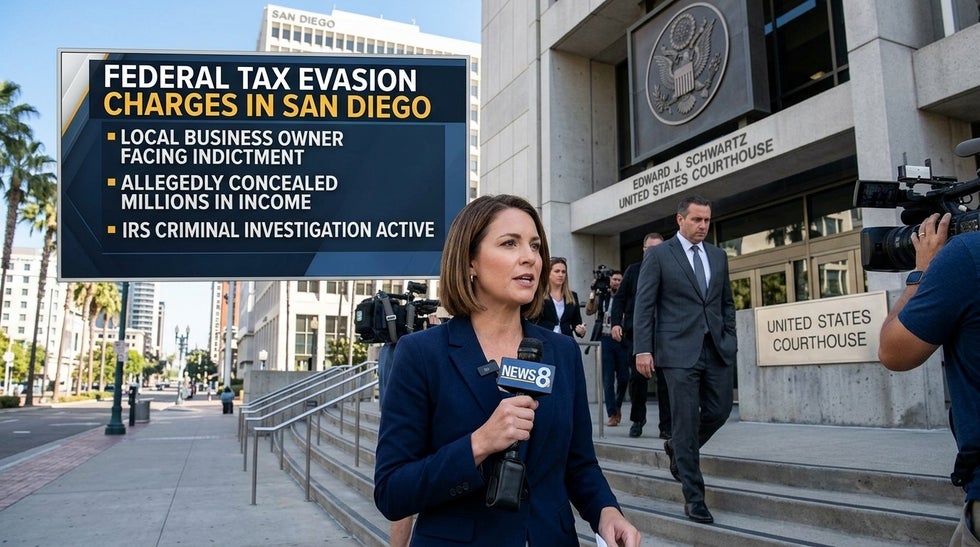
Federal tax evasion charges under 26 U.S.C. § 7201 are prosecuted in the United States District Court for the Southern District of California:
U.S. District Court — Southern District of California
333 West Broadway, San Diego, CA 92101
U.S. Attorney's Office: 880 Front Street, San Diego, CA 92101
IRS Criminal Investigation San Diego Field Office: 880 Front Street, San Diego, CA 92101
Tax cases in the Southern District are handled by the Tax Division of the U.S. Attorney's Office in coordination with IRS Criminal Investigation. These cases involve voluminous financial discovery and frequently proceed to trial when the defense contest is built around willfulness the element the government finds hardest to prove beyond a reasonable doubt.
Defense Strategies for Federal Tax Evasion in San Diego
The Bulldog Law's federal white collar defense practice builds tax crime defenses around attacking willfulness, challenging the government's financial reconstruction, and presenting the full context of a client's tax compliance history:
The Cheek Good Faith Defense
Under Cheek v. United States, a genuine belief that the conduct was lawful even an unreasonable one negates the willfulness element of a tax crime. Reliance on a tax advisor's advice, a genuine misunderstanding of complex tax law, or a good faith dispute with the IRS about what income is taxable all support this defense. We build good faith defenses through evidence of the defendant's actual understanding of their tax obligations, their history of seeking professional advice, and the complexity of the tax issues at stake.
Challenging the Tax Deficiency
The government must prove a specific tax deficiency the amount of taxes legally owed but unpaid. We retain independent forensic accountants and tax experts to challenge the IRS's deficiency calculation, present evidence of legitimate deductions and offsets the government ignored, and contest the reliability of the indirect income reconstruction methods used. Reducing the tax deficiency reduces both the criminal exposure and the civil tax liability that runs alongside every tax evasion prosecution.
Challenging the Affirmative Act
Not every tax non-compliance constitutes affirmative evasion. We challenge the government's characterization of conduct as affirmative acts of evasion presenting evidence that business records were incomplete due to poor accounting practices rather than deliberate falsification, that cash transactions reflected business realities rather than concealment, and that the defendant's conduct falls short of the affirmative, deceptive act that § 7201 requires.
Voluntary Disclosure and Civil Resolution
When a client has unfiled returns or unreported income and criminal charges have not yet been filed, the IRS Voluntary Disclosure Program offers a pathway to civil resolution that significantly reduces criminal prosecution risk. We evaluate voluntary disclosure eligibility in every pre-indictment tax case and, when appropriate, guide clients through the disclosure process to resolve their tax liability civilly before the matter is referred to CI for criminal prosecution.
IRS Special Agent at Your Door in San Diego? Act Before You Speak
- Do not speak to an IRS Criminal Investigation special agent without retaining federal defense counsel first. When a CI special agent contacts you for an interview, the investigation is already advanced. Unlike civil IRS audits, CI interviews are conducted by law enforcement agents whose purpose is to gather evidence for criminal prosecution. Invoke your right to remain silent and contact The Bulldog Law immediately.
- Do not attempt to reconstruct, amend, or correct tax returns on your own after learning of a CI investigation. Amendments made after a criminal investigation has opened can be characterized as additional evidence of the original fraud or as obstruction. All corrective action must be taken with defense counsel's guidance.
- Preserve all financial records, business records, bank statements, and tax-related documents. Do not destroy anything. CI investigations involve grand jury subpoenas for years of financial records. Evidence destruction is obstruction of justice and a separate federal felony.
- If you have unfiled tax returns or unreported income that is not yet under CI investigation, the voluntary disclosure window may still be open. Contact The Bulldog Law immediately to evaluate whether voluntary disclosure is available and appropriate before the matter escalates to criminal referral.
- Gather all communications with your tax preparer, accountant, or attorney about the tax years at issue. These communications particularly advice you received about reporting positions are central to the good faith defense and must be preserved and analyzed before any government interview occurs.
- Call The Bulldog Law at (888) 928-1609. Pre-indictment representation in tax cases is the highest-value intervention available. Getting federal defense counsel involved before the CI referral to the U.S. Attorney's Office is made gives us the opportunity to influence the charging decision.
Contact The Bulldog Law From Your San Diego County Community
The Bulldog Law represents individuals and business owners facing federal tax evasion charges throughout San Diego County and the Southern District. Reach us from your community:
Del Mar: North Coastal San Diego's concentration of high-net-worth individuals, investment professionals, and business owners makes Del Mar, Solana Beach, and Rancho Santa Fe a significant source of federal tax investigations. Clients from this area can reach The Bulldog Law through our Del Mar office page.
Carlsbad: North County's active business community in Carlsbad, Encinitas, and San Marcos generates cash business and contractor tax cases. Clients from this area can contact us through our Carlsbad office page.
Chula Vista: South Bay business owners and cross-border entrepreneurs in Chula Vista and National City facing tax investigations related to income from Mexican operations or cross-border business activity can reach us through our Chula Vista office page.
We also serve clients in Poway, Escondido, La Mesa, El Cajon, Santee, Lemon Grove, Coronado, Imperial Beach, and all surrounding San Diego County communities.
San Diego Office
501 West Broadway, Suite 800 San Diego, CA 92101 Phone: (888) 928-1609
Frequently Asked Questions: Federal Tax Evasion in San Diego
What is the difference between tax evasion and failing to file or pay taxes?
Tax evasion under § 7201 requires an affirmative deceptive act something the defendant did to hide income, falsify records, or conceal assets. Simply failing to file a return or failing to pay taxes owed is charged under 26 U.S.C. § 7203 as willful failure to file or pay a misdemeanor carrying up to 1 year rather than the 5-year felony maximum of § 7201. This distinction matters enormously. If the government's evidence shows non-compliance but cannot establish an affirmative act of concealment, the § 7201 felony charge fails and at most a § 7203 misdemeanor can be sustained.
What does ‘willfulness' mean in a federal tax case and how is it defended?
Willfulness in federal tax law means a voluntary, intentional violation of a known legal duty as established by the Supreme Court in Cheek v. United States (1991). The government must prove the defendant knew what the tax law required and deliberately chose to violate it. Good faith even an unreasonable good faith belief that the conduct was lawful is a complete defense. Common good faith defenses include reliance on a tax advisor's advice, genuine misunderstanding of complex tax rules, a good faith dispute with the IRS about taxability, and the complexity of the tax issues involved.
Can I still file amended returns or make a voluntary disclosure after an IRS audit in San Diego?
It depends on whether a CI investigation has already been opened. If the matter is still in civil audit status, amended returns and voluntary disclosure remain available. Once CI opens a criminal investigation, the standard voluntary disclosure program is generally closed. We evaluate the current status of any IRS matter — civil audit, CI investigation, or pre-indictment and identify every available pathway to civil resolution before the matter escalates further. Acting quickly is critical because the voluntary disclosure window closes the moment CI opens an investigation.
How does the IRS prove unreported income in San Diego cash business cases?
IRS CI uses several indirect methods to reconstruct unreported income when books and records are unreliable. The net worth method tracks the growth in a defendant's assets over a tax year and compares it to reported income unexplained increases suggest unreported income. The bank deposit method analyzes total deposits to all accounts and subtracts known non-income sources. The expenditure method compares total spending to reported income. We challenge all of these methods by presenting evidence of non-taxable income sources gifts, loans, inheritance, prior cash accumulations that legitimately explain the discrepancy without implicating unreported taxable income.
What is an FBAR, and what are the consequences of not filing one in San Diego?
An FBAR (FinCEN Form 114) is required for any U.S. person who has a financial interest in or signature authority over foreign financial accounts exceeding $10,000 in aggregate value at any point during the calendar year. Willful failure to file an FBAR carries civil penalties of the greater of $100,000 or 50% of the account value per violation, plus potential criminal charges under 31 U.S.C. § 5322 carrying up to 10 years. San Diego's cross-border business community makes FBAR compliance a significant issue.
The IRS Offshore Voluntary Disclosure Program and the Streamlined Filing Compliance Procedures offer pathways to resolve FBAR violations with reduced penalties before criminal charges are filed.
What happens if I owe back taxes but cannot pay will the IRS criminally prosecute me?
Criminal prosecution under § 7201 is not triggered by inability to pay. The IRS distinguishes between taxpayers who cannot pay and taxpayers who willfully evade. A taxpayer who files accurate returns showing what they owe but lacks the funds to pay is a civil collection matter not a criminal case. Criminal prosecution requires willful non-payment accompanied by affirmative concealment or deceptive acts.
If you have unfiled returns or unreported income that you cannot now pay, the path forward is voluntary disclosure and a civil installment agreement not silence.
The Bulldog Law guides clients through this process to resolve tax obligations civilly and avoid criminal referral.