
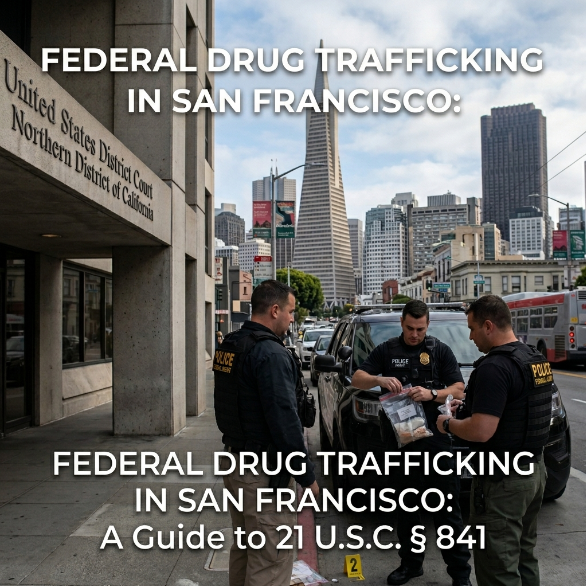
21 U.S.C. § 841 in the Northern District Fentanyl Enforcement Priority, Mandatory Minimums, and Defense Strategies at 450 Golden Gate
San Francisco's ongoing fentanyl crisis has made federal drug trafficking prosecution in the Northern District of California's San Francisco Division one of the most active enforcement environments in the country. The Tenderloin one of the most densely populated open drug markets in the United States generates DEA investigations, federal grand jury proceedings, and § 841 trafficking indictments at a rate that reflects the City's public health emergency.
Federal prosecution carries consequences that state court cannot match: mandatory minimum sentences that the judge cannot reduce, no parole, and Federal Sentencing Guidelines that produce significantly longer sentences than California state drug charges.
In San Francisco, federal drug trafficking charges arise from three primary investigative sources: DEA's San Francisco Division long-term undercover operations targeting Tenderloin and SOMA distribution networks; federal task force operations coordinating SFPD, the Sheriff, and federal agencies; and individual interdiction arrests where quantities and distribution evidence justify federal referral over state prosecution.
The Northern District U.S. Attorney's Office in San Francisco prosecutes these cases with significant resources and a strong record of convictions.
The Bulldog Law represents federal drug trafficking defendants throughout San Francisco and the Northern District. For more on mandatory minimums, Safety Valve, and federal drug defense strategy, visit our criminal defense blog.
21 U.S.C. § 841: What the Law Requires and What Sentences Apply
Section 841 makes it unlawful to knowingly or intentionally manufacture, distribute, dispense, or possess with intent to distribute a controlled substance. The elements are straightforward. What drives the stakes are the mandatory minimums tied to drug type and quantity sentences that the judge cannot reduce regardless of any mitigating factor.
Mandatory Minimum Sentences The Core of Every Federal Drug Case
- Fentanyl: 40+ grams 5-year mandatory minimum. 400+ grams 10-year mandatory minimum. With a prior felony drug conviction, thresholds double to 10 and 20 years. San Francisco's fentanyl crisis makes this the most aggressively prosecuted threshold in the Northern District.
- Methamphetamine: 5+ grams pure / 50+ grams mixture 5 years. 50+ grams pure / 500+ grams mixture 10 years.
- Heroin: 100+ grams 5 years. 1 kilogram or more 10 years.
- Cocaine: 500+ grams 5 years. 5 kilograms or more 10 years.
- Death or Serious Injury Enhancement: Any quantity triggers a 20-year mandatory minimum if death or serious bodily injury results from use of the distributed substance. Given San Francisco's fentanyl overdose rate, this enhancement is charged with increasing frequency in Northern District SF cases.
NO PAROLE IN FEDERAL PRISON: Federal mandatory minimums are served at 85% minimum there is no parole in the federal system. A 10-year federal sentence means approximately 8.5 years actually served. This is categorically different from California state sentences. Federal drug trafficking cases in San Francisco demand the most experienced federal defense counsel available.
Drug Conspiracy Under 21 U.S.C. § 846
Conspiracy to distribute is charged alongside the substantive trafficking count in virtually every multi-defendant Northern District SF drug case. Section 846 conspiracy carries the same penalties as the underlying offense. A single knowing agreement to participate in a drug distribution scheme is sufficient for conviction without personally handling any drugs. We challenge the scope of the alleged conspiracy and our client's knowing participation in it.
Federal Drug Trafficking in San Francisco's Northern District
The Tenderloin and SoMa Distribution Networks
San Francisco's Tenderloin neighborhood bounded by Market, Larkin, Geary, and Mason Streets and the adjacent SoMa corridor contain some of the most active open drug markets in the United States. DEA's San Francisco Division runs long-term undercover operations targeting fentanyl, methamphetamine, and heroin distribution networks operating in these areas. Federal prosecution is the default for cases involving mid-to-upper-level distributors, significant quantities, or organizations with connections to Mexican cartel supply chains. State prosecution is reserved for street-level possession and lower-quantity distribution.
DEA San Francisco Division Operations
The DEA San Francisco Field Division coordinates with SFPD's Narcotics Unit, the SF Sheriff, and the Northern California High Intensity Drug Trafficking Area (HIDTA) task force to investigate drug distribution networks throughout the Bay Area. When DEA identifies a distribution network operating through San Francisco, wiretap investigations and controlled purchases are used to build multi-defendant conspiracy cases that are referred to the Northern District U.S. Attorney's Office for indictment. We investigate the complete history of every DEA investigation from its inception, identifying constitutional violations and evidence weaknesses before trial.
Fentanyl Homicide Enhancement
San Francisco's catastrophic fentanyl overdose death rate one of the highest in the country means that federal drug trafficking cases in the Northern District increasingly carry the death result enhancement under 21 U.S.C. § 841(b)(1)(C). When a distributor's fentanyl supply is linked to a specific overdose death, the mandatory minimum jumps to 20 years regardless of the quantity involved. We challenge the causal connection between the specific distribution and the specific death, and contest the chain-of-custody evidence linking the seized drugs to the overdose.
Wiretap Evidence in Northern District SF Cases
Northern District drug trafficking prosecutions involving San Francisco distribution networks regularly rely on Title III wiretap evidence. Wiretap authorizations require probable cause, necessity, and specificity findings that are subject to rigorous challenge. We examine every wiretap application for legal deficiencies, challenge minimization procedures, and seek suppression of wiretap evidence obtained in violation of Title III requirements. A successful wiretap suppression can eliminate the prosecution's core evidence base.
Where Federal Drug Cases Are Prosecuted in San Francisco
Federal drug trafficking charges arising in San Francisco are prosecuted in the Northern District of California, San Francisco Division:
U.S. District Court Northern District of California, San Francisco Division
450 Golden Gate Avenue, San Francisco, CA 94102
U.S. Attorney's Office: 450 Golden Gate Avenue, Box 36055, San Francisco, CA 94102
The Northern District's San Francisco Division handles drug trafficking cases originating in San Francisco County and the broader Bay Area. The U.S. Attorney's Criminal Division coordinates with DEA, SFPD, and the HIDTA task force on major trafficking investigations. The Bulldog Law appears regularly in the Northern District's San Francisco federal courthouse and knows the AUSAs, magistrate judges, and district judges who handle these cases at 450 Golden Gate Avenue.
Federal Drug Trafficking Defense Strategies in the Northern District
Fourth Amendment Suppression
Every stop, search, and seizure in the case must be constitutionally valid. Traffic stops require reasonable suspicion. Residential searches require a warrant or valid exception. Consent must be genuinely voluntary. We file suppression motions in every case where a constitutional violation exists. Without the drugs in evidence, the § 841 charge cannot stand.
Quantity Challenge and Independent Testing
Mandatory minimums are triggered by specific quantity thresholds. We retain DEA-licensed independent forensic chemists to re-test seized substances and challenge the government's purity and weight calculations. In fentanyl and methamphetamine cases where the purity distinction can mean the difference between a 5-year and 10-year mandatory minimum independent testing is critical. We also challenge relevant conduct quantity attributions that inflate the Guideline range beyond what was actually seized.
Safety Valve Sentencing Below the Mandatory Minimum
Under 18 U.S.C. § 3553(f), qualifying first-time nonviolent drug offenders can be sentenced below the mandatory minimum if they meet specific criteria: no more than 4 criminal history points, no prior 3-point offenses, no use of violence or firearms, no death or serious injury, no leadership role, and a truthful proffer to the government. The First Step Act expanded Safety Valve eligibility. We evaluate Safety Valve qualification in every Northern District SF § 841 case and prepare comprehensive proffer packages when cooperation serves the client's interests.
Knowledge Defense
The government must prove our client knowingly possessed the controlled substance with intent to distribute. In cases where our client transported packages without knowing their contents, or where shared spaces involved other parties' drugs, the knowledge element is genuinely contestable. We present evidence of the circumstances preventing our client from knowing what they were carrying.
Challenging the Conspiracy Scope
In multi-defendant conspiracy cases, the government attributes all drugs from the entire alleged conspiracy to each defendant as ‘relevant conduct' dramatically inflating the Guideline range. We challenge relevant conduct attributions by establishing our client's limited role and the absence of evidence connecting them to the full scope of the charged distribution network.
Arrested on Federal Drug Charges in San Francisco? Act Immediately
- Say nothing to DEA agents or any federal law enforcement without an attorney. Federal drug agents are trained to build conspiracy cases from voluntary statements. Invoke your right to silence completely.
- Do not consent to any search of your home, vehicle, or phone. The automobile exception, plain view, and consent are the primary warrant exceptions DEA relies on. Decline all searches. Require a warrant.
- Federal drug arrests in San Francisco result in initial appearances before a U.S. Magistrate Judge at 450 Golden Gate Avenue, typically within 24 to 48 hours. Detention is the default in trafficking cases. The Bulldog Law prepares detailed bail packages and fights for pretrial release.
- Do not discuss the case with co-defendants or anyone associated with the alleged distribution network. These conversations can be recorded and used as evidence against you.
- If you were a courier who did not know the contents of what you were carrying, preserve all communications with the person who gave you the package or vehicle. These are critical to the knowledge defense.
- Call The Bulldog Law at (888) 928-1609. In federal drug cases, the AUSA's charging decision happens within 72 hours. Early defense counsel engagement is the most important step you can take.
The Bulldog Law in San Francisco
The Bulldog Law represents federal drug trafficking defendants throughout San Francisco and the Northern District. For more on mandatory minimums, Safety Valve, fentanyl trafficking charges, and wiretap suppression in Northern District SF cases, visit blog.
To speak with a San Francisco federal drug trafficking defense attorney, visit our San Francisco County office or call us directly:
San Francisco Office
The Bulldog Law San Francisco, California Phone: (888) 928-1609
Frequently Asked Questions:
What is the difference between a state drug charge and a federal § 841 charge in San Francisco?
State drug charges in San Francisco are prosecuted by the SF DA in Superior Court at 850 Bryant Street under California Health & Safety Code provisions. Federal § 841 charges are prosecuted by the Northern District U.S. Attorney's Office at 450 Golden Gate Avenue with mandatory minimum sentences, no parole, and Federal Sentencing Guidelines producing significantly longer outcomes than state sentencing.
Federal prosecutors federalize cases involving larger quantities, distribution networks, cartel connections, or the fentanyl death enhancement circumstances where federal prosecution produces substantially more severe consequences.
Why is San Francisco a priority enforcement area for federal fentanyl trafficking?
San Francisco's Tenderloin neighborhood has one of the highest concentrations of open fentanyl distribution in the United States, generating one of the country's highest per-capita overdose death rates. DEA's San Francisco Division has made Tenderloin fentanyl network disruption a top enforcement priority, coordinating with SFPD, the SF DA, and the Northern California HIDTA task force.
The intersection of San Francisco's public health crisis and the federal government's fentanyl enforcement initiative makes the Northern District's San Francisco Division one of the most active federal drug trafficking prosecution venues in California.
What is the Safety Valve and how does it work in Northern District SF cases?
The Safety Valve under 18 U.S.C. § 3553(f) allows qualifying first-time nonviolent drug defendants to be sentenced below the mandatory minimum. To qualify, a defendant generally must have no more than 4 criminal history points, no prior violent convictions, no use of violence or firearms in the current offense, no death or serious injury, and must truthfully provide all information about the offense to the government before sentencing.
The First Step Act expanded Safety Valve eligibility. In the Northern District's San Francisco Division, Safety Valve is particularly significant for first-time defendants caught with trafficking quantities who have no meaningful criminal history.
Can a fentanyl overdose death result in a 20-year mandatory minimum in San Francisco?
Yes. Under 21 U.S.C. § 841(b)(1)(C), any person who distributes a controlled substance including any amount of fentanyl that results in death or serious bodily injury faces a mandatory minimum of 20 years. Given San Francisco's catastrophic fentanyl overdose death rate, this enhancement is charged with increasing frequency in Northern District SF prosecutions.
We challenge the causal connection between the specific distribution and the specific death, the chain-of-custody evidence linking the seized substance to the fatal dose, and the government's ability to prove beyond a reasonable doubt that the defendant's fentanyl caused the particular overdose.
How does relevant conduct work in Northern District drug sentencing?
Relevant conduct under U.S.S.G. § 1B1.3 allows federal judges in the Northern District to sentence defendants based not only on the drugs physically seized but on all drugs involved in the alleged conspiracy including amounts never seized, quantities attributed from co-defendants, and uncharged transactions. This can produce Guideline ranges far exceeding what the charged conduct alone would support.
We challenge relevant conduct attributions through detailed sentencing objections, arguing for individual accountability based on our client's specific conduct rather than the entire conspiracy's scope.