
First Degree vs. Second Degree, Three Strikes Exposure, and What Defense Attorneys Challenge in Santa Clara County Burglary Cases
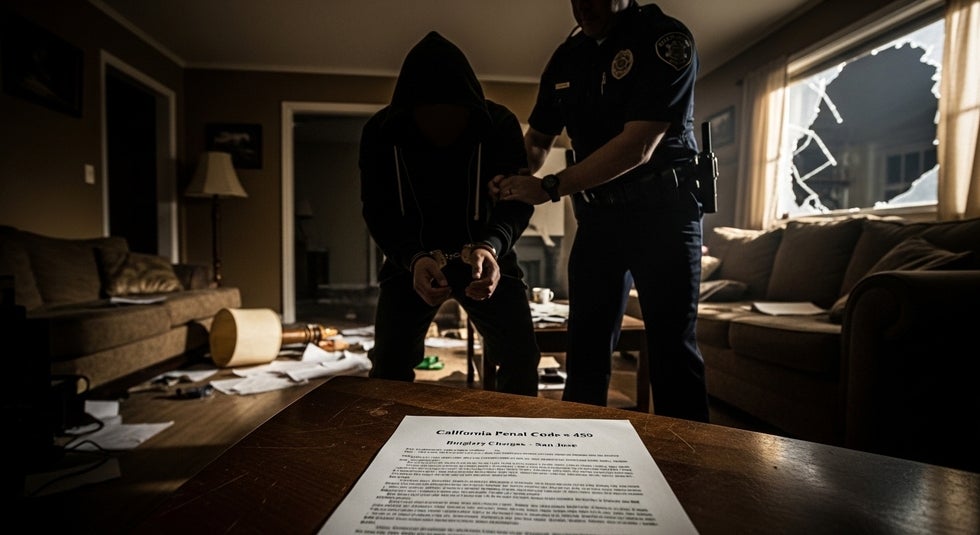
Most people picture burglary as breaking into a home at night. California law is far broader. Under Penal Code § 459, burglary occurs the moment a person enters any structure a house, apartment, store, office building, locked vehicle, or even an open commercial space with the intent to commit a theft or felony inside. No forced entry is required. No theft actually has to occur. Walking through an unlocked door with criminal intent at the moment of entry is legally sufficient for a burglary conviction in Santa Clara County.
That definition and particularly the intent element is both the statute's reach and its greatest vulnerability. Because the prosecution must prove what was in our client's mind at the exact moment they entered the structure, and because that intent must be inferred entirely from circumstantial evidence, burglary cases in San Jose are among the most vigorously defended property crime prosecutions in Santa Clara County. The stakes justify that effort: first degree residential burglary is always a felony, always a strike, and always carries a potential 6-year prison sentence.
Whether you are searching for a burglary defense attorney in San Jose, trying to understand the difference between first and second degree burglary in Santa Clara County, or researching the Three Strikes implications of a burglary charge, The Bulldog Law has the answers. Our criminal defense blog covers burglary defense strategy in detail, and we fight these cases throughout Santa Clara County.
First Degree vs. Second Degree Burglary: What the Distinction Means for Your Case
First Degree Burglary Residential Always a Felony
First degree burglary involves the entry of an inhabited dwelling any house, apartment, hotel room, vessel, floating home, or structure currently used for residential purposes, whether or not anyone is home at the time. First degree residential burglary is always a felony in California. It is never a misdemeanor. It carries 2, 4, or 6 years in California state prison. It is a serious felony strike under PC § 1192.7(c) and a violent felony under PC § 667.5(c) when someone is present inside. In Santa Clara County, first degree burglary prosecutions involving occupied homes are treated with the highest level of prosecutorial priority.
Second Degree Burglary Commercial A Wobbler
Second degree burglary covers all other structures: commercial buildings, warehouses, storage units, offices, vehicle interiors, and any non-residential space. Second degree burglary is a wobbler Santa Clara County prosecutors have discretion to charge it as a felony or misdemeanor depending on the circumstances and the defendant's prior record. Felony second degree carries 16 months, 2, or 3 years in state prison. Misdemeanor second degree carries up to 1 year in county jail. Getting a second degree charge filed or reduced as a misdemeanor is one of the first objectives of every commercial burglary defense.
THE INTENT ELEMENT IS EVERYTHING: Burglary is complete at the moment of entry with criminal intent even if nothing is stolen, even if the defendant changed their mind and left immediately, and even if the door was unlocked. This means the prosecution's entire case rests on proving what our client intended when they crossed the threshold. Proving a mental state from circumstantial evidence the prosecution's most difficult task is our primary target in every burglary defense.
Three Strikes Consequences in Santa Clara County
First degree residential burglary is both a serious and violent felony strike under California's Three Strikes law. A prior residential burglary strike doubles any subsequent felony sentence. Two prior strikes combined with a new serious or violent felony triggers 25 years to life. The Bulldog Law files Romero motions asking the sentencing judge to strike a prior conviction in the interest of justice under PC § 1385 in every burglary case where our client's background and circumstances support judicial discretion. A successful Romero motion is among the most consequential defense victories available in any strike case.
How SJPD and Santa Clara County Build Burglary Cases
Smart Home Surveillance and Ring Doorbells
San Jose's residential neighborhoods from Willow Glen and Almaden Valley to Evergreen and Berryessa are heavily surveilled through Ring doorbells, Nest cameras, and neighborhood watch camera networks. SJPD obtains this footage rapidly after a burglary report. Silicon Valley's tech-savvy homeowners often have multi-angle, high-resolution footage that captures not just the entry but the approach, the vehicle used, and the exit. We subpoena the complete unedited footage, challenge authentication and identification reliability, and analyze whether the footage actually depicts our client or someone who merely resembles them.
Cell Phone Location Data The Carpenter Challenge
SJPD and the Santa Clara County Sheriff increasingly use historical cell phone location data to place suspects at or near burglary scenes. Under the Supreme Court's Carpenter v. United States decision (2018), the government must obtain a warrant for historical cell site location information. We challenge every use of cell location data for warrant compliance, the technical accuracy of the location analysis, and the government's characterization of general area data as proof of specific presence at the burglary location.
Physical Evidence and DNA
The Santa Clara County Crime Lab analyzes fingerprints, DNA, shoe impressions, and tool marks recovered from burglary scenes. We challenge the collection methodology, chain of custody, and the scientific reliability of each category of physical evidence. DNA evidence in particular requires strict collection and storage protocols any deviation creates suppression and reliability arguments that we pursue aggressively.
Possession of Stolen Property
Many San Jose burglary prosecutions begin when police find a person in possession of property recently reported stolen. California law allows an inference of theft from recent possession of stolen goods but that inference is not conclusive. We present evidence of innocent acquisition purchase from a third party, gift, or trade and challenge the prosecution's identification of the property as the specific items taken in the alleged burglary.
Santa Clara County Courthouses for Burglary Cases
PC § 459 burglary charges are State offenses prosecuted in the Santa Clara County Superior Court:
Santa Clara County Superior Court Hall of Justice
191 North First Street, San Jose, CA 95113
Santa Clara County Superior Court Palo Alto Courthouse
270 Grant Avenue, Palo Alto, CA 94306
Santa Clara County Superior Court Morgan Hill Courthouse
15979 Concord Circle, Morgan Hill, CA 95037
The Bulldog Law appears regularly across all three Santa Clara County Superior Court locations. We know the burglary prosecutors, the judges who handle strike allegations, and the evidentiary standards applied to surveillance footage and cell location data in each division.
Burglary Defense Strategies in Santa Clara County
The Bulldog Law's theft and burglary defense practice targets the intent element, the identification evidence, and the strike allegation in every San Jose burglary case:
Attacking the Intent Element
The prosecution must prove beyond a reasonable doubt that our client intended to commit a theft or felony at the exact moment of entry. Evidence of innocent purpose a delivery, a service call, visiting a friend, entering a business during operating hours for a lawful reason directly negates the intent element. When intent must be inferred from circumstantial evidence alone, we present an innocent explanation that creates reasonable doubt about the prosecution's theory of the entry.
Permission and Consent Defense
If our client had permission express or implied to enter the structure, no burglary occurred regardless of what happened inside. Consent defenses arise in landlord-tenant disputes, family property conflicts, and situations where the defendant had a prior relationship with the occupant that gave them a reasonable basis to believe entry was authorized. We present evidence of the permission or implied authority and challenge the prosecution's characterization of a consensual entry as unlawful.
Misidentification Challenge
San Jose burglary prosecutions based on surveillance footage, Ring doorbell video, or neighbor descriptions are vulnerable to misidentification challenges. We challenge the quality and viewing conditions of every surveillance image, the procedures used during any police identification, and the reliability of any witness identification made under high-stress conditions. Expert testimony on eyewitness memory science strengthens these challenges significantly before a Santa Clara County jury.
Fourth Amendment Suppression of Evidence
Physical evidence, cell phone data, and statements obtained during an unlawful search of our client's home or vehicle are suppressible. We examine every search involved in the case for constitutional violations and file suppression motions aggressively when violations exist. A successful suppression motion can eliminate the prosecution's physical evidence entirely.
Romero Motion Striking the Strike
When a prior first degree burglary strike is alleged, we file a detailed Romero motion presenting our client's full background their employment history, family circumstances, rehabilitation efforts, the nature of the prior offense, and the time that has passed since the prior conviction. Judges in Santa Clara County have granted Romero motions in appropriate cases, and the sentencing difference between striking and not striking a prior can be measured in years. We prepare these motions with the depth and specificity that gives them the best chance of success.
Arrested for Burglary in San Jose? Act Immediately
- Invoke your right to remain silent completely. Do not explain your purpose for being at the location, your relationship to any property found on you, or your movements that day to SJPD officers or the Santa Clara County Sheriff. Every statement you make is in the police report.
- Do not consent to any search of your home, vehicle, or phone. SJPD burglary follow-up investigations routinely include requests to search a suspect's residence for stolen property. Require a warrant for every search beyond what is already authorized.
- Identify alibi evidence immediately. Digital records phone location data, credit card transactions, app usage, rideshare records that place you somewhere other than the burglary location at the time of the alleged offense are critical. Preserve this evidence before it becomes unavailable.
- If you are alleged to have been in possession of stolen property, do not attempt to explain how you obtained it without counsel present. The innocent acquisition defense is fact-intensive and must be built through proper investigation, not an improvised explanation at the scene of arrest.
- Booking for burglary arrests in San Jose typically occurs at the Main Jail Complex, 150 W. Hedding Street, San Jose, CA 95110. First degree residential burglary is a no-bail-schedule offense that will require a bail hearing. The Bulldog Law appears at bail hearings and fights for release at every stage.
- Call The Bulldog Law at (888) 928-1609. In burglary cases, surveillance footage is overwritten quickly and witness memories fade fast. We begin the defense investigation from the first call before the prosecution has locked in its evidence.
Burglary Defense Across Santa Clara County
The Bulldog Law represents clients facing burglary charges throughout Santa Clara County. Whether you need a burglary defense attorney in San Jose, a PC 459 lawyer in Cupertino, or representation for a residential burglary charge in Los Gatos, we serve your community:
Palo Alto / Los Altos Hills: North County clients in Palo Alto, Los Altos Hills, and Los Altos where high-value residential burglary cases are aggressively prosecuted can reach The Bulldog Law through our Palo Alto office page. North County burglary cases are heard at the Palo Alto Courthouse, 270 Grant Avenue.
Saratoga / Monte Sereno: West Valley clients in Saratoga and Monte Sereno communities with some of the highest-value residential properties in Santa Clara County can contact us through our Saratoga office page. These cases are prosecuted at the Hall of Justice.
Gilroy / Morgan Hill: South County clients in Gilroy and Morgan Hill can reach us through our Gilroy office page. South County burglary cases are heard at the Morgan Hill Courthouse, 15979 Concord Circle.
We also serve clients in Campbell, Cupertino, Mountain View, Santa Clara, Milpitas, and all surrounding Santa Clara County communities.
View our complete San Jose service area or contact our San Jose office directly:
San Jose Office
The Bulldog Law San Jose, California Phone: (888) 928-1609
Frequently Asked Questions
Can I be convicted of burglary in San Jose if I never stole anything?
Yes. Under PC § 459, burglary is complete at the moment of entry with criminal intent regardless of whether a theft or felony was actually committed. If you entered a structure intending to steal but left empty-handed, changed your mind, or were interrupted, you have still committed burglary in California. This is why the intent element what was in your mind at the exact moment you crossed the threshold is the central battleground in every San Jose burglary defense. Challenging the prosecution's ability to prove that specific intent beyond a reasonable doubt is the most effective defense strategy available.
What makes burglary first degree vs. second degree in Santa Clara County?
First degree burglary involves an inhabited dwelling any structure currently used as a residence, including apartments, hotel rooms, and mobile homes, whether or not anyone is home. It is always a felony and a strike. Second degree burglary covers all other structures commercial buildings, warehouses, vehicles, and any non-residential space. It is a wobbler chargeable as a felony or misdemeanor. The distinction matters enormously: first degree carries up to 6 years and a permanent strike on your record, while second degree misdemeanor carries up to 1 year in county jail with no strike consequences.
Is vehicle burglary a Three Strikes offense in California?
Vehicle burglary under PC § 459 is second degree burglary a wobbler, not a strike in most circumstances. However, vehicle burglary charged as a felony does count as a prior felony conviction that affects sentencing in future cases, even if it does not carry strike status. When vehicle burglary is combined with other charges grand theft auto, possession of stolen property, or prior strike allegations the cumulative consequences can be significant. The Bulldog Law analyzes every charging document carefully for any enhancement or strike allegation that is legally or factually unsupported.
What is a Romero motion and how does it work in Santa Clara County?
A Romero motion named after People v. Superior Court (Romero) (1996) asks the sentencing judge to exercise discretion under PC § 1385 to strike a prior strike conviction in the interest of justice. A successful Romero motion prevents a prior first degree burglary strike from doubling the current sentence or triggering the 25-years-to-life Three Strikes term. These motions require a detailed factual presentation of the defendant's background, rehabilitation, the nature of the prior offense, and the circumstances of the current charge. The Bulldog Law prepares comprehensive Romero motions in every Santa Clara County burglary case where a prior strike is alleged.
Can entering an open business with intent to steal be charged as burglary in San Jose?
Yes. Entering a commercial business that is open to the public a store, a restaurant, an office building with the intent to steal can still constitute second degree commercial burglary under PC § 459. California does not require unlawful or forcible entry. The unlawfulness comes from the intent, not the entry. However, for shoplifting in a commercial establishment where the value is $950 or less, Proposition 47 now requires that the charge be filed as shoplifting under PC § 459.5 a misdemeanor rather than commercial burglary. We challenge improper commercial burglary filings in cases that should have been charged as Prop 47 misdemeanor shoplift