
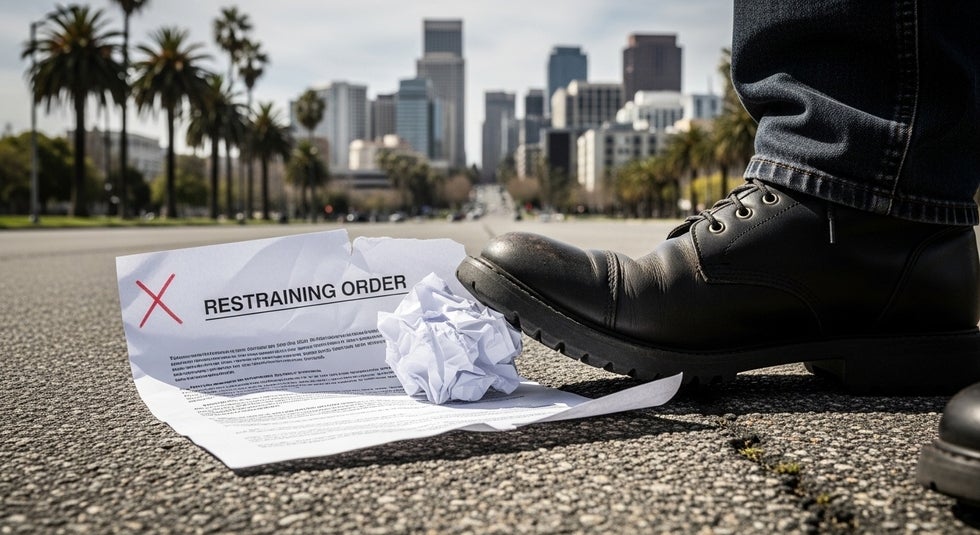
PC § 273.6: Types of Orders, How Violations Are Charged, and What Defense Options Exist in Santa Clara County
A restraining order violation in San Jose can be charged as a misdemeanor or, in some circumstances, a felony and it can be prosecuted even when both parties agree the contact was welcome. This surprises many people. A restraining order is a court order, not a private agreement. Once it is in place, the protected party cannot legally consent to contact with the restrained party.
A text message replied to by the protected person, a door answered voluntarily, a meeting arranged by mutual agreement all of these can still result in criminal charges against the restrained party under PC § 273.6.
Santa Clara County's Santa Clara County Superior Court issues thousands of domestic violence restraining orders every year. The Santa Clara County DA's Family Violence Unit prosecutes violations aggressively, and SJPD responds to alleged violations with the same priority as domestic violence incidents themselves. Understanding exactly what your order prohibits, how violations are proven, and what defenses exist is essential to protecting yourself after a restraining order is issued.
Whether you are looking for a restraining order violation attorney in San Jose, trying to understand whether a specific contact violated your CPO, or researching the difference between misdemeanor and felony violations in Santa Clara County, The Bulldog Law covers protective order defense on defense blog and represents restrained parties throughout Santa Clara County.
The Four Types of Protective Orders in Santa Clara County
Not all restraining orders are the same. The type of order that was issued determines the court that issued it, how long it lasts, and what conduct it prohibits. Knowing which order you are subject to is the starting point of every violation defense.
Emergency Protective Order (EPO)
An EPO is issued by a law enforcement officer at the scene of a domestic violence incident typically by the SJPD officer who responded to the call. It takes effect immediately and lasts 5 to 7 days. The EPO is designed to provide immediate short-term protection while the parties seek longer-term civil or criminal orders. Violating an EPO is charged under PC § 273.6 and is prosecuted as seriously as violating any other protective order, despite the EPO's temporary nature.
Criminal Protective Order (CPO)
A CPO is issued by the Santa Clara County Superior Court in connection with a pending criminal domestic violence case. It is typically issued at the defendant's arraignment and lasts the duration of the criminal proceedings often extended for up to 10 years upon conviction. The CPO may prohibit all contact with the protected party, require the restrained party to move out of a shared residence, and require surrender of all firearms. Violating a CPO while a criminal case is pending is treated with particular severity because it directly implicates the court's authority.
Domestic Violence Restraining Order (DVRO)
A DVRO is a civil order issued by the Santa Clara County Superior Court Family Law Division in a standalone civil proceeding separate from any criminal case. It can last up to 5 years and is renewable. DVROs are commonly sought during divorce proceedings, custody disputes, and situations where no criminal charges have been filed. Violating a DVRO is still charged criminally under PC § 273.6.
Civil Harassment Restraining Order
A civil harassment order covers relationships that do not fall under domestic violence law neighbors, coworkers, acquaintances, and others. It is issued by the Superior Court and can prohibit contact, require a stay-away distance, and restrict specific conduct. Violations are charged under PC § 273.6 in the same manner as DV restraining order violations.
CRITICAL POINT: The protected party's invitation or consent to contact does NOT make the contact lawful. Only the issuing court can modify or terminate a restraining order. Until that happens, any contact prohibited by the order even mutual contact can result in criminal charges against the restrained party. This is one of the most misunderstood aspects of restraining order law in Santa Clara County.
PC § 273.6: What the Prosecution Must Prove
To secure a conviction for restraining order violation under PC § 273.6, the Santa Clara County DA must prove three elements beyond a reasonable doubt:
- A court lawfully issued a protective order
- The defendant had notice of the order meaning they knew the order existed and knew its terms
- The defendant willfully violated a term of the order
Each element is independently challengeable. The notice element is the most frequently contested — a defendant who was not properly served with the order, who did not understand the order's specific prohibitions, or who had a good faith misunderstanding of what the order covered may lack the required knowledge to sustain a conviction.
Misdemeanor vs. Felony Violation
A first violation of PC § 273.6 is typically a misdemeanor carrying up to 1 year in Santa Clara County jail and a fine up to $1,000. However, the charge becomes a wobbler chargeable as a felony when: the violation involved an act of violence or a credible threat of violence, the defendant has a prior PC § 273.6 conviction within 7 years, or the violation involved a specific class of protected persons. Felony violations carry 16 months, 2 or 3 years in state prison.
Additional Consequences Beyond Jail
- Mandatory 52-week Batterer's Intervention Program in many cases
- Federal firearm prohibition under 18 U.S.C. § 922(g)(8) if the underlying order qualifies as a domestic violence restraining order
- Immigration consequences for non-citizens violations of DV protective orders can be grounds for deportability
- Impact on pending family law proceedings a violation can significantly affect custody and visitation arrangements in concurrent divorce or custody cases
- Bail revocation in cases where the CPO was issued as a condition of release in an underlying criminal case
How SJPD and Santa Clara County Build PC § 273.6 Cases
Digital Evidence The Primary Prosecution Tool
The vast majority of restraining order violation cases in Santa Clara County are built on digital evidence text messages, phone call records, emails, social media messages, and location data. When a protected party reports a violation to SJPD, officers immediately document all digital communications they claim constitute violations. We obtain the complete communication record not just the excerpts the prosecution has selected and present the full context, including any messages from the protected party that initiated or invited the contact.
GPS and Location Data
Stay-away distance violations appearing within a specified distance of the protected party's home, school, or workplace are increasingly proven through cell phone GPS records, vehicle GPS data, and smart device location history. We challenge the accuracy of location data, the specific distance requirements of the order, and the reliability of the government's technical analysis of location evidence.
Protected Party Testimony and Credibility
When the protected party reports the violation, their testimony is the foundation of the prosecution's case. We investigate the protected party's motive to report particularly in the context of ongoing divorce, custody, or financial disputes where a reported violation can provide leverage in civil proceedings. A protected party who has their own reasons to falsely report a violation is a powerful subject for cross-examination.
The Mutual Contact Problem
One of the most common factual patterns in Santa Clara County restraining order cases is mutual contact the protected party initiates or invites communication and then reports it as a violation. California courts have consistently held that the protected party's invitation does not provide a defense to the restrained party's violation. But the protected party's own conduct is highly relevant to the willfulness element and to the credibility of their testimony about the circumstances of the contact.
Where Restraining Order Violation Cases Are Heard in Santa Clara County
PC § 273.6 violations are prosecuted in the Santa Clara County Superior Court:
Santa Clara County Superior Court Hall of Justice
191 North First Street, San Jose, CA 95113
Santa Clara County Superior Court Palo Alto Courthouse
270 Grant Avenue, Palo Alto, CA 94306
Santa Clara County Superior Court Morgan Hill Courthouse
15979 Concord Circle, Morgan Hill, CA 95037
When a CPO violation occurs in a pending criminal case, the violation is typically handled in the same courtroom as the underlying case. The Bulldog Law appears regularly in all three Santa Clara County Superior Court locations and knows the Family Violence Unit prosecutors who handle these cases.
Defense Strategies for PC § 273.6 in San Jose
The Bulldog Law's domestic violence and protective order defense practice identifies every legal and factual defense available in each Santa Clara County restraining order violation case:
Lack of Notice Defense
The prosecution must prove the defendant had actual notice of the order and its specific terms. If the defendant was not properly served, if the order was not clearly communicated, or if the specific prohibited conduct was genuinely ambiguous, the notice element may be contested. We examine the service record for every protective order and challenge any deficiency in how the order was communicated to our client.
Good Faith Misunderstanding
A genuine, reasonable misunderstanding of what the order prohibited can negate the willfulness element. If the order permitted contact for child custody exchanges but our client understood it to permit broader communication, the violation may lack the required willful intent. We present evidence of our client's good faith interpretation of the order's terms and challenge the prosecution's ability to prove deliberate, knowing violation.
Challenging the Communication Evidence
Digital communication evidence is frequently presented selectively the prosecution shows the restrained party's messages without showing the protected party's initiating messages or invitations. We obtain the complete communication record in both directions and present the full context that the prosecution has stripped from its evidence. When the protected party initiated contact, their own messages significantly undermine the prosecution's narrative about the nature of the violation.
Order Modification and Vacatur
The most effective long-term solution to a restraining order violation case is often modifying or vacating the underlying order. If the circumstances that led to the order have changed if the parties have reconciled, if the protected party no longer wishes to be protected, or if the order was obtained in connection with a civil dispute that has since resolved a motion to modify or terminate the order can be filed in the issuing court. The Bulldog Law handles order modification proceedings simultaneously with criminal defense in cases where modification serves the client's long-term interests.
Attacking Credibility and Motive
When the reported violation coincides with a hotly contested divorce, custody dispute, or financial proceeding, the protected party's motive to report is a genuine issue. We investigate the civil proceedings timeline, the protected party's financial interests, and any history of prior false reports to expose the litigation advantage the protected party gains from the criminal complaint. Juries in Santa Clara County understand the dynamics of acrimonious separations.
Charged With Violating a Restraining Order in San Jose? Act Now
- Stop all contact with the protected party immediately and completely. Any additional contact after you learn of a violation charge gives prosecutors additional counts and demonstrates continued disregard for court orders. Comply strictly with every term of the order from this moment forward.
- Do not ask friends or family members to contact the protected party on your behalf. Third-party contact made at your direction or request can be charged as indirect violation of the protective order and as witness tampering.
- Preserve every communication between you and the protected party in both directions. The protected party's own messages initiating contact, inviting responses, or otherwise contradicting the prosecution's narrative are critical defense evidence. Do not delete anything.
- Gather documentation of any child custody exchange requirements, co-parenting communication agreements, or other court-approved contact provisions that you relied on in good faith. Evidence of authorized contact under a custody order or approved communication plan is central to the good faith defense.
- Do not discuss the alleged violation with anyone other than your attorney. Statements made to mutual friends, family members, or coworkers about the circumstances of the contact can be reported to law enforcement and used as admissions.
- Call The Bulldog Law at (888) 928-1609. In restraining order cases, the charging decision and bail conditions are determined quickly. We appear at arraignment to argue for the least restrictive conditions and begin building the defense immediately.
Restraining Order Defense Across Santa Clara County
The Bulldog Law represents clients facing restraining order violation charges throughout Santa Clara County. Whether you need a protective order defense attorney in San Jose, help with a CPO violation in Palo Alto, or representation for a DVRO violation in South County, we serve your community:
Cupertino / Santa Clara: West Valley clients in Cupertino, Santa Clara, and Sunnyvale can reach The Bulldog Law through our Cupertino office. These cases are heard at the Hall of Justice, 191 North First Street.
Los Altos / Mountain View: North County clients in Los Altos, Mountain View, and Palo Alto can contact us through our Los Altos office. North County restraining order cases are heard at the Palo Alto Courthouse, 270 Grant Avenue.
Morgan Hill / Gilroy: South County clients in Morgan Hill, Gilroy, and Monte Sereno can reach us through our Morgan Hill office. South County cases are heard at 15979 Concord Circle, Morgan Hill.
We also serve clients in Campbell, Los Gatos, Saratoga, Milpitas, and all surrounding Santa Clara County communities.
San Jose Office
The Bulldog Law San Jose, California Phone: (888) 928-1609
Frequently Asked Questions: Restraining Order Violations in San Jose
Can I be charged with violating a restraining order if the protected party contacted me first?
Yes and this is the most common misconception in restraining order cases. A protective order is a court order directed at the restrained party not a bilateral agreement. The protected party's invitation or consent to contact does not provide a legal defense to the restrained party's violation. However, the protected party's conduct in initiating contact is highly relevant to the willfulness element of the charge and to the credibility of their testimony. We use the protected party's own initiating messages to challenge the prosecution's narrative and present the full context of the communication to the jury.
What is the difference between an EPO, CPO, and DVRO in Santa Clara County?
An Emergency Protective Order (EPO) is issued by a law enforcement officer at the scene of a DV incident and lasts 5 to 7 days. A Criminal Protective Order (CPO) is issued by the Superior Court in connection with a pending criminal case and lasts the duration of the case, extended up to 10 years upon conviction. A Domestic Violence Restraining Order (DVRO) is a civil order issued in a standalone family law proceeding, lasting up to 5 years and renewable. All three can be violated under PC § 273.6. The CPO is generally the most consequential because violating it while a criminal case is pending can result in bail revocation and demonstrates disregard for the court's authority.
Can a restraining order violation be charged as a felony in Santa Clara County?
Yes. PC § 273.6 becomes a wobbler chargeable as a felony in three circumstances: the violation involved an act of violence or a credible threat of violence, the defendant has a prior PC § 273.6 conviction within 7 years, or the violation involved certain protected classes of victims. A felony violation carries 16 months, 2 or 3 years in state prison. Even a misdemeanor violation carries up to 1 year in county jail. The Bulldog Law evaluates every restraining order violation charge for the specific facts that determine whether the misdemeanor or felony charging standard applies.
How can I get a restraining order modified or terminated in San Jose?
A restraining order can be modified or terminated by filing a motion in the issuing court. For EPOs and CPOs, modifications are handled in the criminal court. For DVROs, modifications are handled in the family law division of the Santa Clara County Superior Court. To modify or terminate an order, the moving party must demonstrate that the circumstances have changed sufficiently to justify the modification. The protected party has the right to appear and oppose the modification. The Bulldog Law files restraining order modification motions in cases where the changed circumstances support relief and coordinates these civil proceedings with the client's overall legal strategy.
Will a restraining order violation conviction appear on a background check in Silicon Valley?
Yes. A PC § 273.6 conviction misdemeanor or felony appears on criminal background checks conducted by most Silicon Valley tech employers, background screening services, and professional licensing boards. The conviction is particularly significant for professionals in roles requiring security clearances, work with vulnerable populations, or positions of financial trust.
Upon successful completion of probation, a misdemeanor PC § 273.6 conviction is eligible for expungement under PC § 1203.4. The Bulldog Law pursues expungement for every eligible client as part of complete representation.