
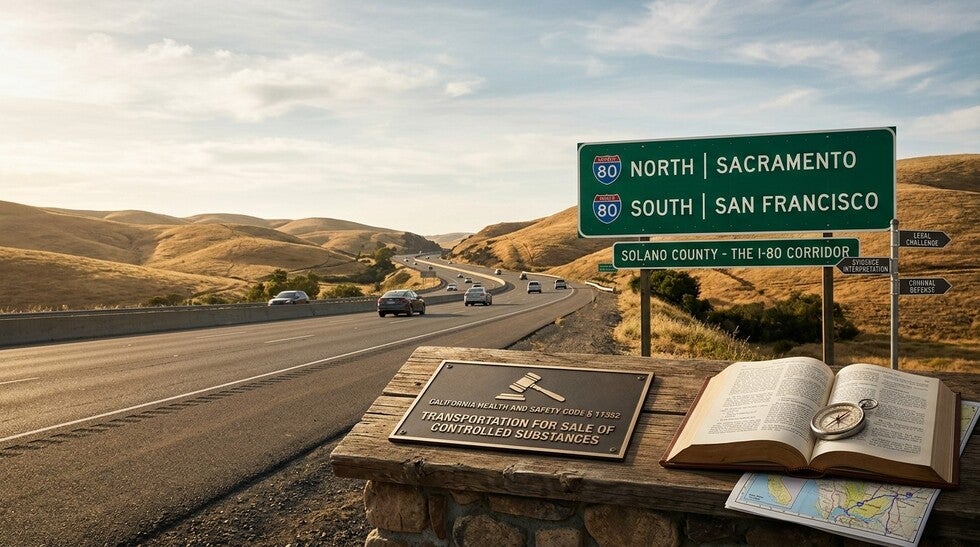
HS § 11352 Transportation for Sale: The I-80 Bay Area-Sacramento Corridor, the Constitutional Stop Challenge, the Transportation Intent Element, and What Up to Nine Years Means for Solano County's Non-Citizen Community
HS § 11352 transportation of a controlled substance for sale is the charge most frequently generated by CHP Solano Area's I-80 drug interdiction operations. The statute carries three, four, or nine years in state prison significantly more than HS § 11351 possession for sale and constitutes a drug trafficking aggravated felony under federal immigration law, permanently barring cancellation of removal, asylum, adjustment of status, and all future H-2A guestworker visa applications for non-citizen defendants.
Solano County sits directly on the Bay Area-Sacramento drug transportation corridor. CHP Solano Area's I-80 interdiction operations target vehicles moving between the Bay Area's drug supply networks and Sacramento's distribution areas, generating HS § 11352 charges from vehicle stops on one of California's highest-volume commuter and freight corridors. The constitutional validity of every one of those stops determines whether the evidence that followed is admissible at 600 Union Avenue in Fairfield.
The Constitutional Stop The First and Most Important Challenge
Every HS § 11352 charge arising from an I-80 vehicle stop depends entirely on whether that stop was constitutionally valid. CHP Solano Area needs reasonable articulable suspicion of a specific Vehicle Code violation to initiate a traffic stop. Not a drug courier profile. Not a general sense that the vehicle's origin or direction is suspicious. Not a pattern-recognition instinct formed by working a high-trafficking corridor. A specific, documented, articulable reason.
The enforcement intensity of I-80 through Fairfield and Vacaville creates pressure on stop justifications that sometimes produces stops based on profile or general corridor enforcement strategy rather than specific observed conduct. When the reason documented in the officer's report doesn't match the dashcam footage when the lane change wasn't unsafe, when the following distance was appropriate, when the stop basis is vague or constructed after the fact the stop is challenged at 600 Union Avenue. When the stop fails constitutional scrutiny, everything discovered during it is suppressed. Without the controlled substance, no HS § 11352 charge can proceed.
The I-80 Bay Area-Sacramento corridor enforcement dynamic: Interstate 80 between the Bay Area and Sacramento through Solano County is one of California's most actively monitored drug transportation corridors. CHP Solano Area's interdiction focus on this corridor means that vehicle stops are more frequent per mile of driving than on comparable highways with lower drug trafficking profiles.
This enforcement intensity creates a specific constitutional stop analysis challenge: the more active the interdiction focus, the more pressure officers face to initiate stops based on factors that don't meet the constitutional standard. We examine every I-80 Solano County drug stop for the specific documented basis and compare it against the dashcam footage at the first consultation. The stop challenge is the most powerful defense tool available in most HS § 11352 cases arising from this corridor, because without the stop there is no evidence.
The Transportation Intent Element
HS § 11352 requires proof of two elements alongside the stop's constitutional validity: possession of the controlled substance, and intent to sell at the time of transportation. A defendant transporting drugs for personal use along I-80 between the Bay Area and Sacramento even in quantities that appear large is not transporting for sale. The sales intent element is contested through the same upgrade evidence analysis that applies in HS § 11351 possession for sale cases.
Quantity is the most frequently cited sales intent factor in I-80 corridor stops. But quantity alone doesn't establish sales intent. Personal use quantities vary significantly between individuals based on tolerance, frequency, access patterns, and the specific circumstances of the purchase that preceded the transportation. We document the defendant's specific personal use history, purchasing pattern, and the personal use explanation for the quantity involved in every HS § 11352 upgrade challenge at 600 Union Avenue.
Packaging is the second most frequently cited factor. Pre-packaged units suggest distribution rather than personal use. But packaging patterns also reflect the way drugs are sold in specific markets regardless of the buyer's intent. A person who purchased pre-packaged units for personal use from a Bay Area market where pre-packaging is standard didn't create sales packaging by making that purchase. The packaging reflects the seller's distribution practice, not the defendant's sales intent.
Vallejo Community and Entrapment
Vallejo generates HS § 11352 cases from law enforcement operations that use confidential informants and undercover officers to arrange controlled substance transactions. In cases where a Solano County Sheriff or Vallejo PD undercover operation facilitated or induced a drug transportation that would not have occurred without law enforcement's continuous involvement, the entrapment defense is available at 321 Tuolumne Street in Vallejo.
The entrapment analysis in HS § 11352 undercover cases requires examining the complete history of the law enforcement contact who initiated the sales discussion, how many times officers escalated after the defendant hesitated, whether the defendant demonstrated any predisposition to drug trafficking before law enforcement made contact, and whether the transportation that occurred was the product of the defendant's own initiative or law enforcement's persistent facilitation. We analyze the complete informant and undercover officer conduct record in every applicable Vallejo HS § 11352 case.
H-2A Dixon Agricultural Workers The Permanent Immigration Bar
For Dixon's H-2A agricultural workforce, an HS § 11352 conviction constitutes a drug trafficking aggravated felony under 8 U.S.C. § 1101(a)(43)(B), permanently barring cancellation of removal, asylum, adjustment of status, and all future H-2A guestworker visa applications. This consequence is permanent and irreversible. Reducing from HS § 11352 transportation for sale to simple possession misdemeanor through the stop challenge which excludes all evidence when the stop fails or through the transportation intent challenge at 600 Union Avenue is the only defense outcome that avoids this permanent immigration consequence. We address the immigration analysis simultaneously from the first consultation in every Dixon H-2A defendant HS § 11352 case.
Travis AFB Service Members Security Clearance Termination
A drug trafficking conviction under HS § 11352 is a clearance-terminating adverse factor under the SEAD 4 adjudicative guidelines. Drug trafficking offenses trigger mandatory comprehensive clearance review and, in virtually every case, clearance revocation for positions requiring TS or higher access. For Travis AFB service members and contractors whose careers depend on their clearances, the stop challenge and the transportation intent challenge are pursued as absolute defense priorities simultaneously with the clearance dimension analysis. We address both from the first consultation in every Travis AFB HS § 11352 case.
Two Courthouses
Solano County Superior Court
Main Courthouse: 600 Union Avenue, Fairfield, CA 94533
Vallejo Branch: 321 Tuolumne Street, Vallejo, CA 94590
After an HS § 11352 Arrest in Solano County
- Invoke your right to remain silent absolutely. Do not explain the drugs, the transportation, the quantity, the packaging, or your purpose without an attorney.
- Do not consent to additional searches beyond what has occurred.
- Note the specific reason the officer gave for the I-80 stop. This is the most important fact in the entire case.
- If you are H-2A, DACA, or any non-citizen, contact The Bulldog Law immediately. The stop challenge and immigration analysis begin simultaneously.
- If you are a Travis AFB service member or contractor, contact The Bulldog Law before speaking to your chain of command or contracting officer.
- Call (888) 928-1609.
Fairfield: Fairfield office | Vallejo: Vallejo office | Dixon: Dixon office | Vacaville: Vacaville office | (888) 928-1609
HS § 11352 Defense Questions in Solano County
How does the I-80 stop challenge work in Solano County HS § 11352 cases?
A constitutional stop requires reasonable articulable suspicion of a specific Vehicle Code violation. When the documented stop reason doesn't match the dashcam footage when the stop appears to have been based on a profile rather than a specific observed violation a motion to suppress is filed at 600 Union Avenue in Fairfield. If granted, all evidence from the stop is excluded. Without the controlled substance, the HS § 11352 charge cannot proceed. The stop challenge is the most powerful defense tool available in most I-80 Solano County drug trafficking cases precisely because the stop is the foundation on which everything else depends.
How does the transportation intent element work in HS § 11352 cases?
HS § 11352 requires proof that the defendant transported the controlled substance with the intent to sell it not merely that they had it in their vehicle during travel. A person transporting drugs for personal use along I-80, even in quantities that appear large, is not transporting for sale under HS § 11352. We contest the sales intent element through the defendant's personal use history, purchasing pattern, the innocent explanation for the quantity, and the specific circumstances of the purchase that preceded the transportation.
The prosecution must prove sales intent beyond a reasonable doubt at 600 Union Avenue, and every individual factor they cite for sales intent has an innocent explanation we develop and present.
How does HS § 11352 permanently affect H-2A workers in Dixon?
An HS § 11352 conviction constitutes a drug trafficking aggravated felony under 8 U.S.C. § 1101(a)(43)(B), permanently barring cancellation of removal, asylum, adjustment of status, and all future H-2A agricultural guestworker visa applications. For Dixon's seasonal agricultural workforce, this permanently ends their eligibility for the federal guestworker program and closes every pathway to lawful immigration status in the United States.
The stop challenge which excludes all evidence when the I-80 stop was constitutionally invalid and the transportation intent challenge are both pursued simultaneously as the only defense outcomes that avoid this permanent consequence. We address immigration analysis from the first consultation in every Dixon H-2A HS § 11352 case.
For more on I-80 Bay Area-Sacramento corridor stop challenges, transportation intent element defense, Dixon H-2A permanent immigration bar, Travis AFB security clearance termination, Vallejo entrapment analysis, and drug trafficking defense at Solano County Superior Court, visit Bulldog blog.