
PC § 187: The Preliminary Hearing Strategy at Two Courthouses, AB 333's Gang Enhancement Requirements, Vallejo's Community Confrontation Context, and SB 1437's Modified Felony Murder Rule
A murder conviction in Solano County carries consequences that define the rest of a person's life. First degree willful, deliberate, premeditated carries 25 years to life. Second degree carries 15 years to life. Special circumstances gang-related murder, murder for financial gain, murder during a listed felony produce life without the possibility of parole. Every sentence runs at 85% minimum. And Solano County's DA's office, which prosecutes homicide cases from Vallejo's neighborhoods, Fairfield's community, and Vacaville's diverse population, brings significant investigative resources to every murder case from the moment of arrest.
The defense advantage that neutralizes this prosecutorial head start is parallel investigation independent of law enforcement's version, beginning from the first day of representation. Every witness the prosecution intends to call is located and interviewed before their account solidifies. Every surveillance camera near the incident is identified before retention windows close.
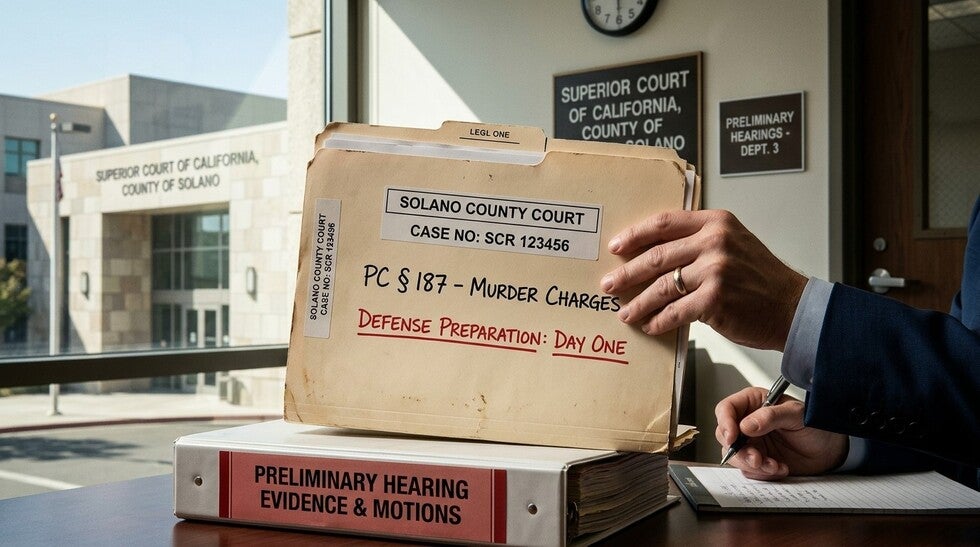
Every forensic assumption is reviewed by independent experts before the preliminary hearing builds the official record. The preliminary hearing at 321 Tuolumne Street in Vallejo or 600 Union Avenue in Fairfield is the first major opportunity to test the prosecution's evidence under oath, create impeachment material, and establish the factual record that shapes every subsequent proceeding.
The Preliminary Hearing Where the Defense Record Begins
California's preliminary hearing requires the prosecution to establish probable cause. In a Solano County murder case, it's the first opportunity to cross-examine key witnesses under oath and on the record. Inconsistencies established at the preliminary hearing become permanent impeachment material. A witness who testifies differently at trial than at the preliminary hearing has a credibility problem that the defense created months earlier and that follows them to the witness stand.
The first-to-second degree reduction argument is made here. Where premeditation and deliberation can be challenged through the specific circumstances of the incident the absence of planning, the impulsive character of the confrontation, the emotional state that preceded the killing the reduction from first degree to second degree eliminates a minimum ten-year gap before any parole consideration: 25-to-life versus 15-to-life. That reduction, achieved at the preliminary hearing at either Solano County courthouse, is often the single most consequential strategic achievement in the early phase of the defense.
Gang Enhancements and AB 333 in Solano County
AB 333's heightened requirements in Solano County: The 2022 STEP Act reform through AB 333 substantially increased the evidentiary requirements for PC § 186.22 gang enhancement allegations in Solano County. Prosecutors must now prove the gang's pattern of criminal activity through predicate offenses committed after AB 333's effective date not through historical offense records that predate the reform. Each predicate offense must be separately proven, not merely alleged from a gang expert's general testimony.
The gang must be shown to have a primary activity of criminal conduct rather than merely some criminal history among its members. And the specific murder must be proven to have been committed to benefit, promote, or assist the gang rather than for personal reasons unconnected to organizational purpose. In Vallejo cases where gang enhancement allegations produce special circumstance LWOP exposure, AB 333's requirements give defense counsel specific, granular grounds to challenge every element of the enhancement at 321 Tuolumne Street.
Vallejo's history of gang enforcement generates PC § 186.22 gang enhancement allegations in murder cases from its neighborhoods. Solano County's DA's office prosecutes these cases with the gang expert testimony, documented gang membership evidence, and predicate offense records that AB 333 now requires to be substantially more rigorous than the pre-2022 standard allowed. We challenge every gang enhancement allegation through AB 333's specific requirements in every Solano County murder case where the enhancement is alleged, and we challenge the LWOP special circumstance exposure that the gang murder allegation produces when the enhancement is successfully contested.
Vallejo's Filipino Community Imperfect Self-Defense
Vallejo's Filipino community one of the largest in California, concentrated throughout the city from the waterfront neighborhoods to the Hiddenbrooke and Carquinez areas generates murder cases from confrontations whose prior history, family dynamics, and cultural context are frequently more relevant to the defense than what any police report captures from the incident itself.
Imperfect self-defense a genuine, subjective belief in the necessity of force that was objectively unreasonable reduces murder to voluntary manslaughter: three, six, or eleven years rather than fifteen to twenty-five years to life.
In Filipino community confrontations, the complete prior relationship between the defendant and the deceased, the history of prior threatening conduct, and the specific cultural context of what constituted a credible and immediate threat within the community's framework provide the foundation for this reduction when it's developed through parallel community investigation from the first day of representation. That evidence exists in the community. It requires qualified cultural competence to access, and it requires beginning the investigation before the prosecution's version becomes the established record.
Vallejo's Black Community Heat of Passion
Vallejo's Black community concentrated in the South Vallejo and Glen Cove neighborhoods, with deep roots in the city's history tied to the Mare Island Naval Shipyard's workforce generates homicide cases where heat of passion evidence arises from confrontation dynamics whose complete history is compressed into a police report that documents only the final moment. Heat of passion from adequate provocation reduces murder to voluntary manslaughter when the killing resulted from sudden quarrel or passion upon adequate provocation that would cause a reasonable person to act rashly without time to cool.
The prior threatening conduct of the deceased, the history of the dispute between the parties, the specific triggering event and its meaning in the context of the parties' relationship all of this is defense evidence that must be developed through community investigation that begins on the first day of representation. The parallel investigation that locates witnesses, documents prior incidents, preserves communications, and interviews community members who knew both the defendant and the deceased is what makes the voluntary manslaughter reduction available at 321 Tuolumne Street. Without that investigation, the prosecution's version of an unprovoked killing is the only version the court sees.
SB 1437 and the Modified Felony Murder Rule
SB 1437 substantially narrowed California's felony murder rule. Non-killer co-defendants in Solano County murder cases can only be convicted of felony murder when the prosecution proves intent to kill, major participant status in the underlying felony, and reckless indifference to human life. The broad aiding-and-abetting theories that previously produced murder liability for peripheral participants in underlying felonies no longer support the charge under the modified rule.
For defendants already convicted under pre-SB 1437 standards, PC § 1172.6 resentencing petitions remain available at both Solano County courthouse locations. The Bulldog Law evaluates SB 1437 resentencing eligibility in every applicable Solano County case and challenges every prosecution theory under the modified rule in new co-defendant murder cases at 600 Union Avenue and 321 Tuolumne Street.
Two Courthouses
Solano County Superior Court
Main Courthouse: 600 Union Avenue, Fairfield, CA 94533
Vallejo Branch: 321 Tuolumne Street, Vallejo, CA 94590
Vallejo and Benicia murder cases proceed at 321 Tuolumne Street. Fairfield, Vacaville, and surrounding area cases proceed at 600 Union Avenue. The Bulldog Law provides comprehensive murder defense at both Solano County courthouse locations with parallel investigation beginning from the first day of representation.
When to Act in a Solano County Murder Case
- Retain defense counsel immediately. Every day without representation is a day the prosecution's version develops without challenge and witnesses' memories align with the official account.
- Invoke your right to remain silent explicitly and maintain it absolutely. Do not speak to Vallejo PD, Fairfield PD, Vacaville PD, Solano County Sheriff, or any investigator.
- Do not discuss the case with anyone in custody. All jail facility communications are recorded and reviewed by law enforcement.
- If this involves Vallejo's Filipino or Black community, preserve all records of the prior relationship, conflict history, and any prior threatening conduct by the deceased.
- If any non-citizen defendant is involved, contact The Bulldog Law immediately about aggravated felony immigration consequences.
- Call The Bulldog Law at (888) 928-1609. Parallel investigation must begin immediately.
Vallejo: Vallejo office | Fairfield: Fairfield office | Vacaville: Vacaville office | (888) 928-1609
Murder Defense Questions in Solano County
What is the difference between first and second degree murder in Solano County?
First degree murder requires willfulness, deliberation, and premeditation a conscious decision to kill made before the act, with time to reflect on that decision. Second degree covers intentional killings without premeditation and killings based on implied malice a conscious disregard for human life. The practical sentencing difference is enormous: 25-to-life for first degree versus 15-to-life for second degree, a minimum ten-year gap before any parole consideration. The premeditation challenge which argues from evidence of the confrontation's impulsive character, the emotional state that preceded it, and the absence of any planning is built from the first day of representation and presented at the preliminary hearing at 321 Tuolumne Street or 600 Union Avenue before the prosecution's deliberate narrative becomes the established version.
How does AB 333 affect gang enhancement murder charges in Solano County?
AB 333 requires the prosecution to prove the gang's predicate offenses through separately established post-2022 conduct, demonstrate the gang's primary criminal activity, and establish that the specific murder was committed to benefit or assist the gang rather than for personal reasons. In Vallejo gang murder cases, where the DA's gang prosecution history is extensive and where the gang expert testimony that supported convictions before 2022 now must meet a substantially higher standard, each of these requirements gives defense counsel specific grounds to challenge the enhancement and the LWOP special circumstance exposure at 321 Tuolumne Street. When the gang special circumstance is successfully challenged, LWOP exposure is eliminated and the case returns to the standard murder framework.
How does imperfect self-defense work in Vallejo's Filipino community murder cases?
Imperfect self-defense requires a genuine, subjective belief in the necessity of force that was objectively unreasonable meaning the defendant actually believed they needed to act to defend themselves, even if that belief wasn't reasonable by an objective standard. In Vallejo's Filipino community confrontation cases, the prior history of the conflict, the prior threatening conduct of the deceased, and the specific cultural context of what constituted a credible and immediate threat within the community provide the foundation for this defense. That evidence requires community investigation from the first day of representation before witnesses' memories align with the prosecution's account, before community members become unavailable, and before the opportunity to document what the parties' relationship actually looked like before the incident is lost. The reduction this produces from murder to voluntary manslaughter, from decades to years is built from that investigation.
For more on the Solano County preliminary hearing strategy, AB 333 gang enhancement challenges, Vallejo Filipino community imperfect self-defense, Vallejo Black community heat of passion, SB 1437 felony murder reform, and murder defense at Solano County Superior Court, visit blog.