
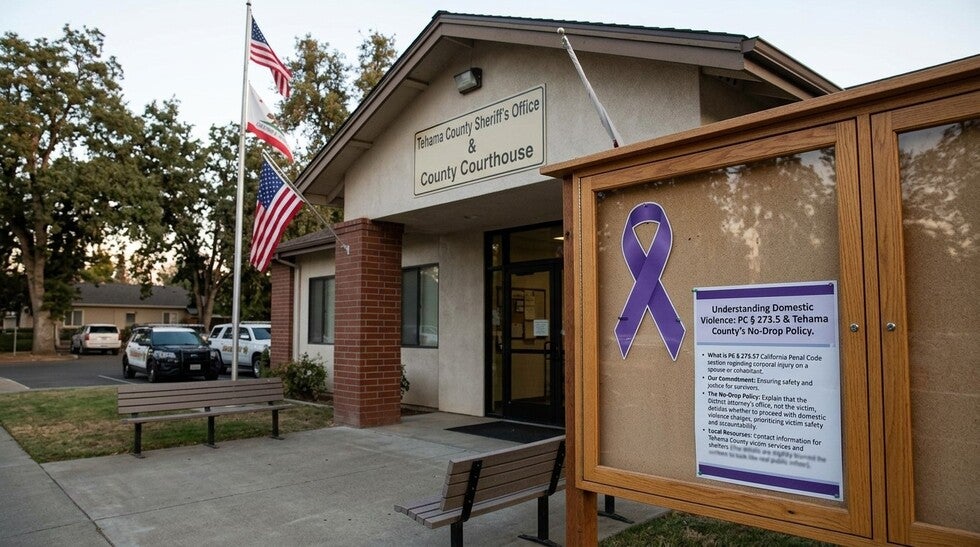
Tehama County's no-drop domestic violence prosecution policy places charging authority with the DA, not the alleged victim. When Red Bluff PD, Corning PD, or Tehama County Sheriff deputies respond to a DV call and document injuries, the 911 recording, body camera footage, and statements made before anyone has had time to reconsider, that documentation goes to the DA. The alleged victim's subsequent decision not to cooperate is a factor the DA weighs alongside the independent evidence. It is not a veto.
In a county of approximately 65,000 residents where Red Bluff's tight-knit community means the courthouse, the employer, the Grange hall, and the neighbor at the end of the ranch road are all connected a DV conviction's visibility extends far beyond the formal background check. A conviction at 633 Washington Street is community knowledge in Red Bluff in ways it never is in a city of five million. This amplified consequence is part of why fighting every available defense from the first day of arrest not waiting for the case to resolve on its own matters more in Tehama County than in a larger, more anonymous urban jurisdiction.
The Charge and Its Federal Consequences
PC § 273.5 corporal injury to a spouse or cohabitant is a wobbler. Felony carries two, three, or four years. Misdemeanor carries up to one year. Both designations felony and misdemeanor alike trigger the Lautenberg Amendment's permanent federal prohibition on firearms possession under 18 U.S.C. § 922(g)(9). Both require a certified 52-week Batterer's Intervention Program. Both carry immigration consequences for non-citizen defendants. The misdemeanor classification reduces none of these permanent federal consequences.
PC § 243(e)(1) domestic battery when no visible injury is documented is a misdemeanor. Lautenberg still applies. In Tehama County's ranching and agricultural community, where firearms are part of daily work life on every ranch property, the Lautenberg prohibition's practical effect is immediate and severe.
Tehama County ranching CDL workforce and the Lautenberg trap: Tehama County's cattle ranching economy celebrated at the Red Bluff Bull and Gelding Sale, one of the largest cattle sales in the western United States employs ranchers, ranch hands, and agricultural transport operators whose daily work involves both firearms and CDL vehicles. The Lautenberg Amendment's permanent federal firearms prohibition creates a specific problem for Tehama County's ranching workforce: a DV conviction felony or misdemeanor permanently ends the ability to possess firearms, which affects the ranching operation's day-to-day function for wildlife management, livestock protection, and property security. For CDL-holding ranch operators, the combination of Lautenberg exposure and CDL background check consequences makes DV diversion producing full dismissal with no conviction the absolute top priority in every eligible ranching community DV case at 633 Washington Street.
Self-Defense Evidence in Tehama County DV Cases
Self-defense evidence must be preserved immediately after any bilateral confrontation. Photographs of the defendant's own injuries, taken within hours before bruises fade, are the most time-sensitive evidence in every Tehama County DV case. Medical records from any treatment sought, documentation of the alleged victim's prior threatening conduct through text messages and prior incident history, and community witness accounts from the ranching and agricultural neighborhoods where most Tehama County DV cases arise all of this is defense evidence that must be developed from the first day of representation.
Body camera footage from Red Bluff PD, Corning PD, and Tehama County Sheriff has limited retention windows. We request it on the first day of representation, not after the arraignment, not after the first hearing. The footage sometimes captures the scene's physical dynamic in ways that contradict the written report's primary aggressor determination. In bilateral ranching community confrontations where both parties participated and both parties have known each other for years, that footage often tells a more complete story than the responding officer's three-paragraph incident description.
Corning's Agricultural Community H-2A Workers
Corning's olive, almond, and walnut agricultural workforce includes H-2A seasonal guestworkers whose immigration status makes the DV conviction's immigration consequence the most urgent defense priority. A PC § 273.5 conviction constitutes a crime of domestic violence under federal immigration law, triggering deportability and permanently affecting future H-2A visa applications. DV diversion under PC § 1000.6 completing the 52-week BIP and receiving full charge dismissal with no conviction is the only outcome that avoids all immigration consequences simultaneously. We evaluate DV diversion eligibility at the first consultation in every Corning H-2A agricultural workforce DV case.
Small County Considerations Community Visibility
In Tehama County's tight-knit community of 65,000 people, a DV conviction's visibility operates differently than in an urban county of millions. The Red Bluff employer who runs a background check often knows the applicant by name from the county fair or the Bull and Gelding Sale. The neighbor who serves on the water district board knows what happened at 633 Washington Street. The agricultural business partner whose relationship the family's ranch depends on hears about convictions from the county's interconnected social network. In this environment, a civil compromise that produces full dismissal, a diversion outcome that results in no conviction, or a self-defense finding that results in acquittal carries community-level value that it simply doesn't carry in a large anonymous urban courthouse.
DV Diversion The Resolution That Avoids Every Permanent Consequence
PC § 1000.6 DV diversion requires completing a certified 52-week BIP. Upon successful completion, the charges are dismissed without any conviction being entered. No Lautenberg trigger. No immigration consequence. No background check entry in Red Bluff's small-county employer community. No conviction record at 633 Washington Street. We evaluate diversion eligibility at the first consultation in every eligible Tehama County DV case and pursue it wherever the client qualifies.
The Courthouse
Tehama County Superior Court
633 Washington Street, Red Bluff, CA 96080
After a DV Arrest in Tehama County
- Comply absolutely with every term of the Emergency Protective Order. Contact while the EPO is active creates a new charge.
- Photograph your own injuries immediately. This is the most time-sensitive action in any bilateral DV case.
- If you hold a ranching or agricultural CDL, contact The Bulldog Law immediately about Lautenberg and CDL consequences.
- If you are H-2A or any non-citizen, contact The Bulldog Law immediately about immigration consequences.
- Do not discuss the incident with neighbors, community members, or coworkers in Red Bluff's tight-knit community before consulting an attorney.
- Call (888) 928-1609.
Red Bluff: Red Bluff office | Corning: Corning office | Tehama: Tehama office | (888) 928-1609
DV Defense Questions in Tehama County
Can the Tehama County DA proceed if the alleged victim recants?
Yes. The DA proceeds using the 911 recording, body camera footage, injury photographs, and other independent evidence collected at the scene. A recanting alleged victim significantly weakens the prosecution's case but in cases where the body camera footage is compelling and injuries were well-documented, the DA can proceed without testimony from the alleged victim at 633 Washington Street. In Red Bluff's small county community, the decision not to fight the charge in the expectation that it will disappear when the alleged victim doesn't cooperate regularly produces outcomes that defendants didn't anticipate.
How does Lautenberg affect Tehama County's ranching community specifically?
Tehama County's cattle ranching operations depend on firearms for wildlife management, livestock protection from predators, and property security on the large-acreage properties that define the county's rural landscape. The Lautenberg Amendment's permanent federal firearms prohibition means that a DV conviction misdemeanor or felony immediately and permanently ends the ability to possess the firearms that ranch operations require. This is not a theoretical consequence for Red Bluff's ranching community. It affects the ranch's daily operations and the ranch operator's ability to do their job from the day of conviction forward. DV diversion producing full dismissal is the only outcome that avoids this consequence entirely at 633 Washington Street.
How does DV diversion work for Corning's H-2A agricultural workforce?
PC § 1000.6 DV diversion requires completing a certified 52-week Batterer's Intervention Program. Upon successful completion, the charges are dismissed without any conviction being entered no crime of domestic violence conviction under federal immigration law, no deportability trigger, no permanent H-2A visa bar. Eligibility requires no prior DV conviction, no prior DV diversion, no allegation of serious bodily injury, and no firearm involvement.
For Corning's H-2A olive and almond workforce whose immigration status and guestworker visa eligibility depend on avoiding DV convictions, diversion is the absolute defense priority. We evaluate eligibility at the first consultation in every applicable Tehama County DV case.
For more on Tehama County's no-drop DV prosecution, Red Bluff's small-county community visibility, ranching CDL Lautenberg consequences, Corning H-2A agricultural worker immigration stakes, DV diversion eligibility, and DV defense at the Tehama County Superior Court, visit Bulldog defense blog.