
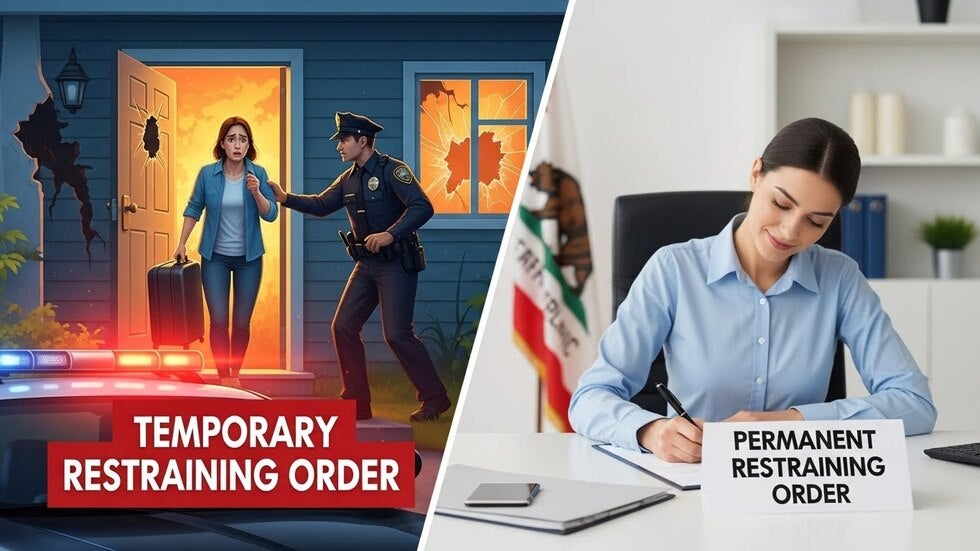
When facing domestic violence, understanding the legal protections available is crucial for safety and peace of mind. California law provides two primary types of restraining orders: Domestic Violence Temporary Restraining Orders (DVTROs) and Domestic Violence Restraining Orders (DVROs). While both serve to protect victims, they differ significantly in process, duration, and scope. This guide explains these differences and how to navigate the restraining order process effectively.
What is a Domestic Violence Temporary Restraining Order (DVTRO)?
A Domestic Violence Temporary Restraining Order provides immediate, short-term protection for victims of domestic violence. These orders are designed as emergency measures when protection cannot wait for a full court hearing.
Key Features of DVTROs
- Immediate Protection: DVTROs can be issued without prior notice to the respondent (the person being restrained)
- Short Duration: Typically effective only until the court hearing date (usually within 21-25 days)
- Ex Parte Process: The court can issue the order based solely on the petitioner's statement and evidence
- Basic Provisions: Usually includes no-contact and stay-away orders
The DVTRO Application Process
To obtain a DVTRO in California, you must complete several specific Judicial Council forms:
- DV-100: Request for Domestic Violence Restraining Order (the primary application form)
- DV-210: Notice of Court Hearing (specifies when the full hearing will take place)
- CLETS-001: Confidential CLETS Information Form (ensures the order is entered into law enforcement databases)
The court reviews these applications quickly, often on the same day they're filed. If approved, the DVTRO takes effect immediately, even before the respondent is served with papers.
What is a Domestic Violence Restraining Order (DVRO)?
A Domestic Violence Restraining Order is a longer-term protection order issued after a formal court hearing where both parties have the opportunity to present their case.
Key Features of DVROs
- Extended Protection: Can last up to five years and may be renewed
- Comprehensive Provisions: May include additional protections beyond the DVTRO
- Full Hearing Required: Both parties have the opportunity to present evidence and testimony
- Additional Terms Available: Can address custody, visitation, support, and property control
The DVRO Hearing Process
At the DVRO hearing:
- Both parties may present evidence, including testimony, witnesses, and documentation
- The judge evaluates all evidence presented using the "clear and convincing evidence" standard
- If granted, the DVRO replaces the DVTRO and provides longer-term protection
- The court may modify terms from the DVTRO based on evidence and circumstances
Key Differences Between DVTROs and DVROs
The primary differences between these two types of restraining orders involve:
-
Procedural Requirements
DVTRO:
- Can be issued without notice to the respondent
- Requires only the petitioner's declaration and evidence
- Provides immediate, temporary protection
DVRO:
- Requires a noticed hearing with both parties
- Both sides may present evidence and arguments
- Provides longer-term protection after full due process
-
Duration and Scope
DVTRO:
- Short-term, typically lasting until the court hearing (within 21-25 days)
- Focused primarily on immediate safety concerns
- May have limited provisions
DVRO:
- Long-term, lasting up to five years with possibility of renewal
- Comprehensive protection addressing multiple aspects of the relationship
- May include additional terms like custody, support, and property control
Case Example: Flexibility in Restraining Orders
The case of Malinowski v. Martin (93 Cal. App. 5th 681) demonstrates the court's ability to adapt restraining orders to changing circumstances. In this case, the court initially issued a DVTRO with strict no-contact provisions. However, after considering the family dynamics, the court later modified the order to allow limited contact specifically for child visitation purposes.
This case highlights an important principle: restraining orders are not rigid instruments but can be tailored to balance safety concerns with other legitimate interests, such as parent-child relationships.
Modifications and Continuances
Circumstances often change after a restraining order is issued. California law recognizes this reality and provides mechanisms for addressing these changes:
- If a DVRO hearing is continued, the DVTRO generally remains in effect until the hearing concludes
- Courts may modify DVTROs when granting continuances or in response to changing situations
- Either party may request modifications based on new circumstances or information
Ensuring Enforcement of Restraining Orders
For any restraining order to be effective, law enforcement must be able to enforce it. California's system for enforcement includes:
- Entry into the California Law Enforcement Telecommunications System (CLETS)
- Required filing of form CLETS-001 with complete identifying information
- Obligation to carry copies of the order at all times
- Immediate reporting of violations to law enforcement
How to Prepare for a Restraining Order Proceeding
If you're seeking protection through a restraining order, consider these preparation tips:
- Document everything: Keep detailed records of all incidents with dates, times, and descriptions
- Gather evidence: Collect text messages, emails, voicemails, photographs, and witness statements
- Seek legal assistance: Consider consulting with a domestic violence attorney for guidance
- Prepare testimony: Be ready to clearly explain why you need protection
- Understand the process: Familiarize yourself with court procedures to reduce anxiety
Conclusion
Both DVTROs and DVROs serve vital roles in protecting victims of domestic violence in California. Understanding the differences between these legal remedies can help victims navigate the system more effectively and obtain the protection they need.
If you're facing domestic violence, remember that immediate help is available through emergency services (911), domestic violence hotlines, and legal resources. For assistance navigating the restraining order process, consider reaching out to experienced family law attorneys who can guide you through each step.
For more information about domestic violence protection, child custody concerns, or other family law matters, visit The Bulldog Law Firm blog for additional resources and guidance.