
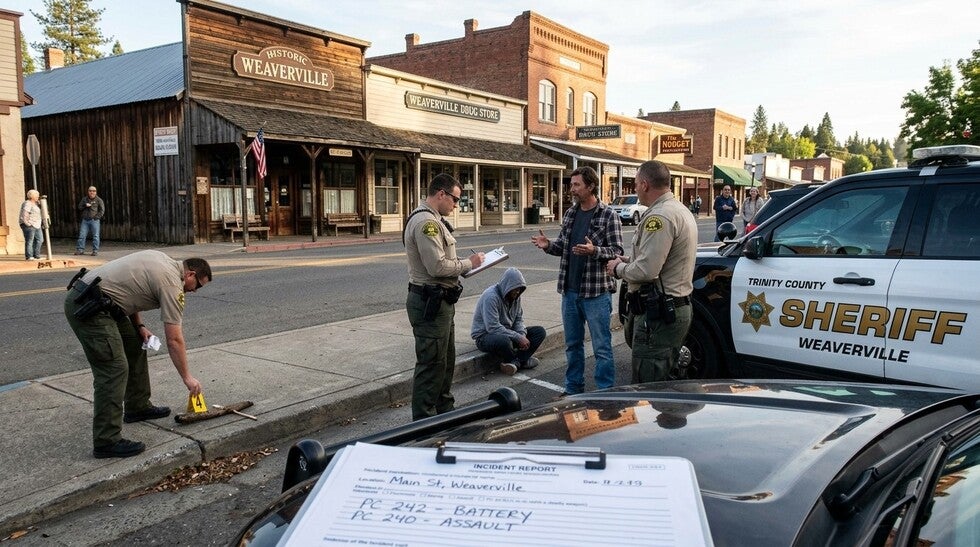
Assault and Battery in Trinity County cases often turn on context. A fight outside a Weaverville business, a mining claim dispute near the Trinity River, a logging crew confrontation, a cannabis property security incident, or a family argument on a remote road can all lead to charges under Penal Code 240, Penal Code 242, or Penal Code 245.
The most important question is often whether prosecutors can turn a misdemeanor assault or battery into a felony assault with a deadly weapon or force likely to produce great bodily injury. In Trinity County, where work tools, mining equipment, logging gear, firearms, vehicles, and cannabis cultivation equipment may be nearby during everyday disputes, the defense must separate mere presence of an object from actual use as a weapon.
Assault and Battery in Trinity County under PC 240 and PC 242
California assault and battery are not the same offense. Penal Code 240 assault is an unlawful attempt, coupled with present ability, to commit a violent injury on another person. Penal Code 242 battery is the willful and unlawful use of force or violence on another person.
In plain English, assault can involve an attempted or threatened application of force when the person has the present ability to act. Battery requires actual harmful or offensive touching, even if the injury is minor or there is no visible injury.
Because people often use the words interchangeably, the difference between assault and battery can become important when reviewing the police report, witness statements, and the exact charge filed in court.
Simple battery and misdemeanor exposure
Simple battery under PC 242 is usually a misdemeanor. A conviction can carry up to six months in county jail, a fine, probation, anger management, stay-away orders, restitution, and other conditions. Even when jail is not imposed, a conviction can affect employment, licensing, immigration, firearms, family court, and reputation.
In Trinity County, the informal consequences can be serious. A fight that becomes a public case at 11 Court Street in Weaverville may become known quickly through a small community. A dismissal, reduction, civil compromise, or acquittal can matter far beyond the formal court record.
For additional comparison across California courts, whether assault and battery are the same under California law depends on the elements prosecutors must prove, not just the words used by witnesses.
The PC 245 escalation risk
Penal Code 245 can be charged when prosecutors allege assault with a deadly weapon, assault with force likely to produce great bodily injury, assault with a firearm, or related aggravated conduct. This is where many Trinity County cases become much more serious.
PC 245 is often a wobbler, meaning it can be charged as a misdemeanor or felony depending on the facts and criminal history. A felony conviction can carry state prison exposure and may create serious felony or strike consequences depending on the specific charge and findings.
The defense must challenge whether the facts really support the aggravated theory. A shove, argument, brief struggle, or object nearby does not automatically prove assault with a deadly weapon. Prosecutors must prove the required act, ability, intent, and dangerousness under the actual circumstances.
Deadly weapon allegations in mining and logging disputes
Trinity County's work environments often contain tools that can be dangerous if used as weapons. Mining picks, shovels, sluice parts, logging chokers, chainsaws, axes, pry bars, winches, and vehicle equipment may be present during a dispute.
Presence is not the same as use. A chainsaw in a truck bed, a logging choker on the ground, or a mining tool leaning against equipment does not become a deadly weapon simply because an argument occurred nearby. The prosecution must prove that the object was used, or threatened to be used, in a way likely to cause great bodily injury.
Defense evidence may include:
- Photographs of where the object was located.
- Body camera footage showing whether the item was handled.
- Witness statements about what was actually said or done.
- Tool condition, distance, weight, and accessibility.
- Worksite layout and normal presence of equipment.
- Evidence that the object was never raised, swung, pointed, or used to threaten.
Assault with a deadly weapon versus assault with a firearm
California treats firearms differently from many other objects. An assault with a firearm charge can carry separate statutory exposure and different factual issues than an assault involving another alleged deadly weapon.
In Trinity County, firearms may be present for hunting, wildlife protection, ranch work, remote property security, or transportation through rural areas. Lawful possession or proximity to a firearm is not the same as assault with a firearm. The defense must examine whether the firearm was displayed, pointed, loaded, used, referenced, or connected to the alleged threat.
When prosecutors compare weapon theories, assault with a deadly weapon versus assault with a firearm can change charging exposure, negotiation leverage, and trial strategy.
Self-defense in remote Trinity County confrontations
Self-defense can apply when a person reasonably believes they are in imminent danger of being touched unlawfully or suffering bodily injury, reasonably believes immediate force is necessary to defend against that danger, and uses no more force than reasonably necessary.
Remote location matters. A person confronted at night on a cannabis property, mining claim, forest road, or isolated cabin may reasonably perceive danger differently than someone in a crowded urban area with immediate help nearby. Long law enforcement response times, lack of cell service, prior threats, trespass, darkness, and inability to retreat safely can all affect the defense.
Important evidence includes injuries to the accused, torn clothing, property damage, prior threatening messages, lighting conditions, distance from town, availability of help, and the history between the parties.
Cannabis cultivation security confrontations
Trinity County cannabis properties can create unique assault and battery allegations. Disputes may involve trespassers, workers, neighbors, business partners, theft concerns, harvest conflicts, equipment, irrigation, access roads, or property boundaries.
When someone enters a remote cultivation site without permission, the defense may need to explain why the accused believed there was an immediate threat. But self-defense does not give a person unlimited authority to use force. The response must still be reasonable under the circumstances.
Defense strategy should gather:
- Property records and lease documents.
- Prior communications about access or trespass.
- Security camera footage.
- Lighting, road, gate, and distance evidence.
- Statements from workers or neighbors.
- Evidence of prior thefts, threats, or confrontations.
Civil compromise for misdemeanor battery in Weaverville
California civil compromise may allow dismissal of certain misdemeanor cases when the injured party has a civil remedy, receives satisfaction, and the court approves the compromise. This remedy is limited and does not apply to every assault or battery case. It is generally unavailable for more serious allegations, certain protected-person cases, or cases where public interests prevent compromise.
In appropriate Trinity County misdemeanor battery cases, civil compromise can be powerful. A mining dispute, neighborhood altercation, worksite argument, or minor fight between people who must continue living in the same small community may be better resolved through compensation and dismissal than through a conviction.
The defense should evaluate civil compromise early, before positions harden and before the case creates more public damage.
Comparing Trinity County assault cases to other California counties
The statutes are statewide, but local context matters. A case in Trinity County may involve rural roads, small-community reputation, tools, firearms, remote response times, and local witness networks. A case in a coastal, agricultural, urban, or suburban county may involve different factual assumptions.
For example, assault and battery defense in San Luis Obispo County may involve college, tourism, ranch, or coastal community facts. Assault and battery defense in Santa Barbara County may involve different local court dynamics, nightlife cases, and domestic or public altercations.
In more densely populated regions, assault and battery defense in Santa Clara County may focus on surveillance, workplace allegations, technology employment, or urban police response. In agricultural regions, assault and battery defense in Tulare County may involve farm labor, rural property, and equipment-related disputes.
Trinity County cases require the same statutory analysis, but the defense must translate the facts of rural life into legal arguments that prevent exaggeration.
When assault allegations involve sexual conduct
Some cases use the word assault in a non-technical way. A person may be accused of physical assault, sexual assault, or both. These are legally different categories with different elements, penalties, defenses, and collateral consequences.
If the allegation involves nonconsensual sexual contact, force, coercion, incapacitation, or federal jurisdiction, the defense must treat it as a separate and more serious legal category. Federal rape and sexual assault defense strategies may be relevant when the accusation involves federal land, interstate issues, military property, tribal jurisdiction, or federal charging authority.
A defendant should never assume that a case called “assault” is limited to PC 240 or PC 242. The exact statute controls the defense.
Evidence to preserve after an assault or battery arrest
The most important evidence can disappear quickly. Bruises change, scratches heal, tools are moved, videos are overwritten, and witnesses discuss the incident with others.
- Photograph your own injuries immediately and again over the next several days.
- Preserve clothing, broken property, tools, and objects allegedly involved.
- Identify witnesses who saw the incident or heard threats beforehand.
- Save texts, voicemails, social media messages, and call logs.
- Document the location, lighting, distance, terrain, and access conditions.
- Request preservation of body camera, dash camera, and surveillance footage.
- Gather property, mining claim, worksite, or cannabis operation records if relevant.
- Do not contact the alleged victim if a protective order or no-contact order exists.
Trinity County Superior Court and what to expect
Assault and battery cases in Trinity County are generally handled at Trinity County Superior Court, located at 11 Court Street, Weaverville, CA 96093. The court may handle arraignment, protective orders, release terms, discovery, pretrial conferences, motions, plea negotiations, trial, sentencing, probation, and restitution.
At arraignment or early hearings, the court may impose no-contact orders, stay-away orders, firearm restrictions, travel conditions, or other terms. A defendant should understand the order before leaving court. Violating a protective order can create a new criminal charge.
Trinity County Superior Court, prosecutors, law enforcement agencies, judges, and public offices are independent public institutions. Bulldog Law is not affiliated, endorsed, partnered, connected, or associated with any court, prosecutor, judge, police agency, sheriff's office, or government entity.
What to do after an assault arrest in Trinity County
- Do not explain the incident to officers without legal counsel.
- Photograph injuries immediately.
- Write down the timeline before memory fades.
- Identify whether any object was actually used or merely nearby.
- Preserve evidence of self-defense, property rights, or prior threats.
- Do not contact witnesses in a way that could be viewed as pressure.
- Do not violate any protective order, even if the other person contacts you first.
- If you are not a U.S. citizen, get immigration analysis before any plea.
Assault and Battery in Trinity County lawyers in California
Bulldog Law defends clients accused of assault, battery, assault with a deadly weapon, assault with a firearm, self-defense incidents, cannabis property confrontations, mining disputes, logging worksite fights, and rural Trinity County altercations.
Assault and Battery in Trinity County requires careful attention to the difference between PC 240, PC 242, and PC 245. The defense should challenge exaggerated weapon claims, preserve self-defense evidence, evaluate civil compromise, and address the local consequences of a conviction in Weaverville's small community from the start of the case.