
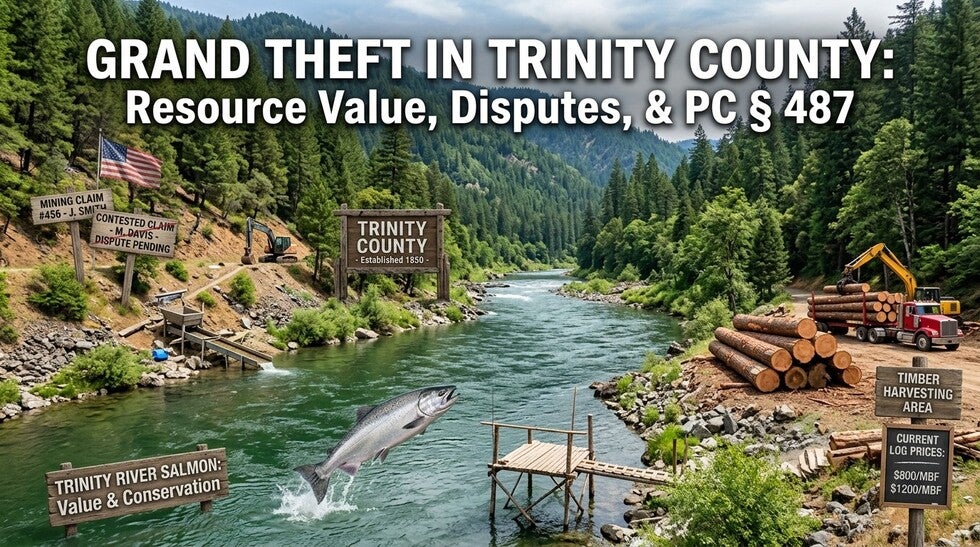
Grand Theft in Trinity County cases often turn on valuation, location, and intent. Under California Penal Code 487, theft can be charged as grand theft when the value of the property, money, labor, or real property taken exceeds $950, or when specific categories of property are involved, such as certain vehicles or firearms. In Trinity County, the hard question is often not whether property was missing, but what it was actually worth and whether the accused had criminal intent.
That matters in a rural county where alleged theft can involve Trinity River salmon or steelhead, timber from Shasta-Trinity National Forest areas, mining claim disputes, cannabis cultivation equipment, remote machinery, vehicles, tools, firearms, cryptocurrency, or business records. The defense must challenge the prosecution's valuation before an inflated number turns a disputed incident into a felony.
Grand Theft in Trinity County and the $950 threshold
California grand theft depends heavily on value. The prosecution may try to use replacement cost, retail pricing, owner estimates, or speculative future value. The defense should focus on fair market value at the time and place of the alleged taking.
Fair market value generally means what a willing buyer and willing seller would agree to in an ordinary transaction, with both sides knowing the relevant facts and neither forced to buy or sell. That standard can be very different from what an owner paid years earlier or what it would cost to buy a brand-new replacement today.
For a broader comparison of how California prosecutors build theft cases, grand theft defense under PC 487 in Ventura County shows why valuation, intent, and evidence quality often determine whether a case remains felony-level or can be reduced.
Why valuation is different in Trinity County
Trinity County property does not always fit simple urban retail pricing. A generator located off a remote forest road, a used excavator on a mining claim, timber before processing, fish taken from a river, or cannabis infrastructure in a rural grow site may require a specialized valuation method.
Important valuation questions include:
- Was the property new or used?
- What was its condition at the time of the alleged taking?
- Could it realistically be sold where it was located?
- Did remote access reduce its market value?
- Was the valuation based on wholesale, retail, replacement, or speculative pricing?
- Was the item part of a regulated market, such as timber, fish, cannabis, or mining?
- Did the prosecution aggregate multiple items correctly?
The difference between $900 and $1,100 can determine whether a case is charged as petty theft or grand theft. That makes independent valuation one of the first defense priorities.
Trinity River salmon and steelhead valuation
Alleged theft or unlawful taking involving Trinity River salmon or steelhead can raise unique valuation questions. Prosecutors or agencies may try to rely on retail fish prices, conservation values, replacement values, or statutory resource calculations. The defense should not accept a number without asking how it was calculated.
If the case is charged as theft based on market value, the defense should examine whether the value reflects a lawful market price for the fish at the time of the alleged taking, rather than a grocery store price for prepared fillets or a speculative environmental value. If restitution or resource penalties are also sought, those issues should be separated from the grand theft threshold analysis.
Fish and wildlife cases may also involve regulatory violations, licensing issues, season restrictions, gear rules, tribal rights, commercial versus recreational activity, and proof of who actually took or possessed the fish.
Timber theft and stumpage pricing
Timber theft allegations in Trinity County may involve Shasta-Trinity National Forest land, private timberland, logging sites, firewood, equipment, or harvested logs. The prosecution's valuation can become inflated if it uses finished lumber retail prices instead of the value of the timber as taken.
Standing timber, logs, and finished lumber are not the same product. Stumpage value, species, grade, volume, harvest rights, access costs, hauling, milling, and market conditions can all affect value. Ponderosa pine, Douglas fir, white fir, incense cedar, and other species may have different values depending on condition and use.
A defense valuation may require forestry records, USFS pricing information where federal timber is involved, mill receipts, appraisals, scaling records, photographs, and expert review. The prosecution must prove the value that supports grand theft, not simply assume the highest possible retail number.
Mining claim disputes and claim of right defense
Trinity County's mining history creates another category of theft cases: disputes over gold, tools, pumps, sluices, vehicles, equipment, access roads, and claim boundaries. These cases often involve genuine disagreements about who had the right to work a particular area or possess certain equipment.
A good-faith claim of right can defeat theft intent when a person honestly believed they had a right to the property. The belief does not have to be legally perfect, but it must be genuine and in good faith. This defense can be important when mining claim records, BLM filings, boundary markers, old agreements, family arrangements, or partnership disputes create confusion.
Evidence may include:
- BLM mining claim records.
- County recordings and maps.
- Boundary markers, stakes, GPS records, or survey notes.
- Written agreements between partners or claim holders.
- Prior permission to mine or use equipment.
- Communications showing a good-faith belief in authorization.
The defense should frame the issue as a property or boundary dispute when the evidence supports it, not a criminal theft case.
Remote equipment depreciation and access difficulty
Remote equipment cases are common in rural theft prosecutions. The alleged property may include generators, water tanks, pumps, trailers, chainsaws, forestry tools, mining equipment, cannabis cultivation infrastructure, fencing, solar panels, batteries, vehicles, or cabin property.
Owners often value equipment based on replacement cost. But used equipment in a remote Trinity County location may be worth less because of age, damage, missing parts, weather exposure, limited resale market, and the cost of retrieval from rough roads or private land.
The defense should document condition, serial numbers, age, repair history, comparable used sales, transport cost, and whether the item was functional. A prosecutor's value estimate may collapse when the item is treated as depreciated rural equipment instead of new retail property.
Vehicles, trailers, and enhanced theft exposure
Vehicle-related theft can create separate consequences. Grand theft auto, unlawful taking or driving of a vehicle, receiving a stolen vehicle, or trailer theft may be charged differently depending on the facts. Prior vehicle theft convictions can also increase exposure.
In rural areas, cases may involve logging trucks, ATVs, side-by-sides, trailers, work trucks, equipment haulers, or vehicles used on private roads. The defense should examine ownership, permission, keys, prior use, mechanical condition, and whether the case is really a civil dispute over shared property or employment equipment.
When a prior vehicle theft history is alleged, enhanced vehicle theft exposure under California Penal Code 666.5 can change the case strategy and make early reduction or dismissal efforts especially important.
Cannabis property, cryptocurrency, and financial theft theories
Grand theft in Trinity County can also involve cannabis property, harvested cannabis, cash, digital wallets, business funds, or crypto assets. Cannabis valuation can be difficult because licensed wholesale pricing, unlicensed market pricing, retail dispensary pricing, moisture content, quality, testing status, and regulatory legality can all affect value.
Cryptocurrency cases raise different proof issues. The prosecution may need to prove ownership, access, wallet control, transaction tracing, exchange records, value at the time of taking, and whether the accused knowingly participated in the transfer.
Large digital theft cases may also trigger federal attention, especially when funds move through exchanges, mixers, or interstate financial systems. A California cryptocurrency theft and money laundering conspiracy case shows how theft allegations can expand when digital assets and financial tracing are involved.
Identity theft and document-based grand theft cases
Some Trinity County theft cases involve more than physical property. A person may be accused of using another person's identity, documents, account access, checks, tax information, benefits, or online credentials to obtain property or money.
When identity evidence is involved, the defense should examine whether the accused knowingly used another person's information, whether permission existed, whether the records were accurate, and whether the alleged loss amount was properly calculated.
Digital access does not always prove identity theft. Shared devices, family accounts, business logins, saved passwords, old authorizations, and mistaken attribution can all create reasonable doubt.
If federal authorities become involved, federal identity theft defense for aggravated identity theft and fraud charges may be relevant because federal identity theft statutes can carry mandatory consecutive sentencing exposure in some cases.
For California defendants facing federal identity allegations, federal identity theft under 18 USC 1028A illustrates why the exact use of another person's identifying information must be challenged carefully.
Intent defenses in Trinity County grand theft cases
Value is only part of the case. The prosecution also must prove theft intent. Many Trinity County cases involve relationships, work arrangements, informal partnerships, shared property, mining claim confusion, cannabis business disputes, or equipment borrowed with permission.
Common intent defenses include:
- Good-faith claim of right.
- Permission or prior authorization.
- Mistaken ownership.
- Borrowing without intent to permanently deprive.
- Partnership or employment dispute.
- Incorrect identification of the person who took the property.
- Lack of knowledge that property was stolen.
- Inflated or unsupported loss amount.
The defense should gather communications, invoices, receipts, title records, work agreements, claim filings, license documents, witness statements, and property access records as early as possible.
Where grand theft cases are handled in Trinity County
Grand theft cases in Trinity County are generally handled at Trinity County Superior Court, located at 11 Court Street, Weaverville, CA 96093. The case may involve arraignment, bail or release conditions, discovery, valuation evidence, pretrial conferences, motions, plea negotiations, trial, and sentencing if there is a conviction.
Federal agencies may become involved if the alleged theft occurs on federal land, involves federal property, crosses state lines, includes identity theft, or connects to money laundering or digital assets. Those cases may proceed in federal court rather than only in Weaverville.
Trinity County Superior Court, federal courts, law enforcement agencies, prosecutors, CDFW, USFS, BLM, and other public agencies are independent government entities. Bulldog Law is not affiliated, endorsed, partnered, connected, or associated with any court, prosecutor, agency, officer, or government institution.
What to do after a grand theft arrest in Trinity County
- Do not discuss value, ownership, authorization, or location with investigators without counsel.
- Preserve receipts, invoices, titles, serial numbers, permits, maps, and business records.
- Take photographs of equipment condition, access roads, storage areas, and boundary markers.
- Identify witnesses who can explain permission, ownership, claim boundaries, or market value.
- If fish, timber, mining, cannabis, or crypto is involved, get specialized valuation evidence early.
- Do not return, sell, move, delete, or alter property or records after learning of an investigation.
- If you are not a U.S. citizen, ask for immigration analysis before any plea.
- Tell your lawyer about prior theft or vehicle theft convictions immediately.
Grand Theft in Trinity County lawyers in California
Bulldog Law defends clients facing grand theft, vehicle theft, timber theft, fish and wildlife theft, mining claim disputes, cannabis property allegations, cryptocurrency theft, identity-related theft, and federal theft investigations in Trinity County and throughout California.
Grand Theft in Trinity County is often a valuation fight and an intent fight. The prosecution may rely on inflated replacement costs, retail pricing, assumptions about ownership, or incomplete rural property records. A strong defense challenges the number, the location, the market, the authorization, and the intent before a local property dispute becomes a felony conviction.