
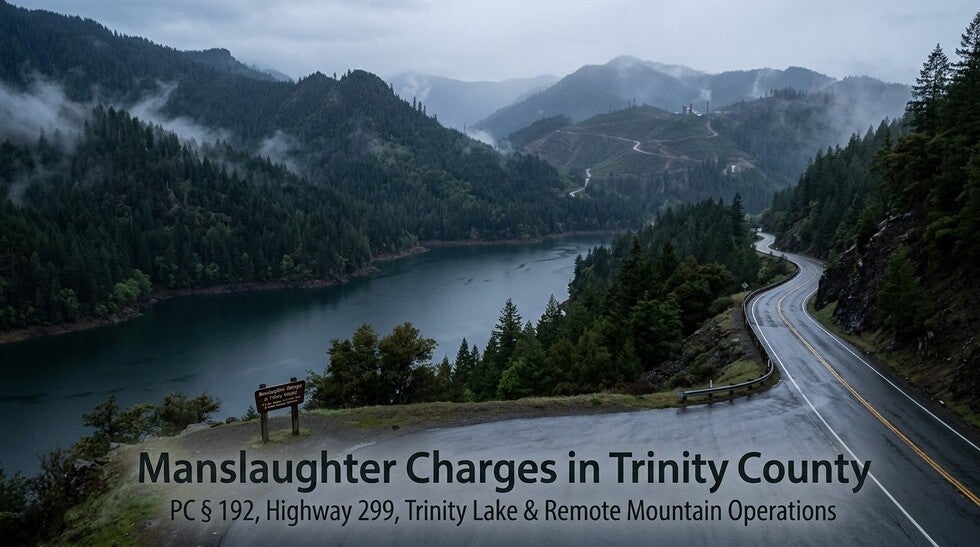
Manslaughter Charges in Trinity County can arise from fatal crashes on Highway 299, boating incidents on Trinity Lake, logging and timber operations, hunting-related accidents, and remote mountain confrontations. These cases are serious because a death occurred, but manslaughter is not the same as murder. The defense often turns on intent, negligence, causation, intoxication evidence, location, prior history, and whether the prosecution can prove the required mental state.
Trinity County cases can involve facts that are easy to misunderstand from a police report alone. A mountain-road collision may involve grades, curves, weather, brake performance, logging equipment, or limited sightlines. A boating incident may involve vessel operation, alcohol testing, lighting, water conditions, and witness timing. A remote-property confrontation may involve years of threats, boundary disputes, mining claims, cannabis-related security concerns, or delayed law enforcement response.
Those facts do not excuse unlawful conduct by themselves, but they can be central to whether the case is murder, voluntary manslaughter, involuntary manslaughter, vehicular manslaughter, vessel manslaughter, or a defensible accident.
Manslaughter Charges in Trinity County under PC § 192
California Penal Code § 192 defines manslaughter as the unlawful killing of a human being without malice. It includes voluntary manslaughter, involuntary manslaughter, and vehicular manslaughter. The difference between these categories can control the defense strategy and the potential sentence.
Voluntary manslaughter generally involves a killing upon a sudden quarrel or heat of passion. It can also arise when a murder charge is reduced because the defendant acted in imperfect self-defense, meaning the defendant actually believed deadly force was necessary, but that belief was legally unreasonable.
Involuntary manslaughter generally involves an unlawful act not amounting to a felony, or a lawful act done in an unlawful manner or without due caution and circumspection, when that conduct results in death. The statute excludes acts committed in the driving of a vehicle, which are addressed separately under vehicular manslaughter provisions.
Vehicular manslaughter under PC § 192(c) focuses on driving conduct that causes death, with different treatment depending on whether the prosecution alleges gross negligence, ordinary negligence, intoxication-related conduct, or a collision caused for financial gain. A broader overview of California Penal Code § 192 manslaughter defense can help explain why the exact charging theory matters from the first day of representation.
Manslaughter versus murder in Trinity County cases
The legal line between manslaughter and murder is often malice. Murder requires malice aforethought, while manslaughter is an unlawful killing without malice. In a real case, that distinction may depend on the defendant's state of mind, prior warnings, intoxication history, threat perception, provocation, or the surrounding circumstances.
For example, a remote-property shooting may be charged as murder, but the evidence may support a voluntary manslaughter theory if the defendant acted during a sudden quarrel, in heat of passion after legally adequate provocation, or under an actual but unreasonable belief in the need for self-defense. The defense must develop the full relationship history, not just the final moments described in the arrest report.
In fatal driving cases, prosecutors may evaluate whether the facts support vehicular manslaughter or a murder theory based on implied malice. Prior DUI education, prior DUI convictions, prior warnings, dangerous driving facts, and intoxication evidence may all be relevant. Understanding the difference between manslaughter and murder is critical because the sentencing exposure, negotiation posture, and trial strategy can change dramatically.
Highway 299 fatal crashes and Watson murder risk
Highway 299 is a major Trinity County corridor, and fatal collisions on mountain roads can involve complicated accident reconstruction issues. Commercial vehicles, logging trucks, steep grades, sharp curves, weather changes, wildlife, road debris, construction zones, and limited escape areas can all matter when the prosecution claims criminal negligence.
In intoxication-related fatal crashes, prosecutors may consider a Watson murder theory. Under California law, a DUI-related fatality may be charged as second-degree murder when the prosecution believes it can prove implied malice, including that the defendant knew the danger to human life and consciously disregarded that danger. A prior DUI advisement is often important evidence, but it does not make a murder charge automatic.
For Trinity County logging drivers and CDL holders, the consequences can extend beyond the criminal case. A fatal collision investigation may affect licensing, employment, insurance, and future commercial driving. The defense should examine the vehicle, load, maintenance records, braking system, speed data, road conditions, driver logs, toxicology evidence, and witness accounts before accepting the prosecution's version of gross negligence or implied malice.
When alcohol or drugs are alleged, the charging decision may involve PC § 191.5 as well as PC § 192. Cases involving vehicular manslaughter while intoxicated under PC § 191.5 require close review of impairment evidence, chemical testing, causation, driving conduct, and whether the prosecution can prove gross negligence or implied malice.
Gross negligence in Highway 299 vehicular manslaughter cases
Gross negligence is more than ordinary carelessness. The prosecution generally must prove conduct that creates a high risk of death or great bodily injury and reflects a disregard for human life or indifference to the consequences. In a mountain-road case, the defense should test whether the conduct was truly criminally negligent or whether the crash resulted from road conditions, mechanical failure, unavoidable hazards, or ordinary negligence.
Accident reconstruction can be essential. Skid marks, vehicle damage, event data, brake condition, tire evidence, grade, curve radius, sight distance, weather, roadway design, lighting, and witness timing may all affect the analysis. A serious crash does not prove gross negligence by itself.
Vehicular manslaughter with gross negligence under PC § 192(c)(1) can be charged as a felony or misdemeanor depending on the facts and prosecutorial discretion. Vehicular manslaughter without gross negligence under PC § 192(c)(2) is generally a misdemeanor. The defense goal may be dismissal, reduction, a non-gross negligence theory, or trial, depending on the evidence. A focused review of California vehicular manslaughter under PC § 192(c) can help frame the difference between felony-level allegations and lesser negligence theories.
Trinity Lake boating and vessel manslaughter
Fatal boating incidents on Trinity Lake can raise vessel manslaughter issues under California Penal Code § 192.5. This statute addresses unlawful killings involving vessel operation, including cases connected to boating under the influence provisions in the Harbors and Navigation Code and cases involving gross negligence or non-gross negligence vessel operation.
The draft phrase “VC § 192.5” should not be used because § 192.5 is a Penal Code section, not a Vehicle Code section. The correct framing is PC § 192.5 for vessel manslaughter, with related boating-under-the-influence conduct often analyzed under the Harbors and Navigation Code.
A Trinity Lake defense should look closely at the vessel, operator conduct, passenger positions, lighting, speed, navigation rules, weather, visibility, witness statements, lake traffic, equipment, and any alcohol or drug testing. If the prosecution relies on a blood or breath result, the defense may examine testing time, absorption, elimination, drinking timeline, medical factors, and whether the result fairly reflects the operator's condition at the time of the incident.
Environmental facts can matter, but they should be handled carefully. Sun exposure, fatigue, dehydration, altitude, and physical exertion may be relevant to witness perception, operator performance, or toxicology analysis in a particular case. They should not be treated as automatic defenses. Expert review may be necessary before making claims about how those factors affected impairment or blood alcohol concentration.
Remote mountain confrontations and voluntary manslaughter theories
Some Trinity County homicide cases arise from confrontations on remote properties, mining claims, timber land, cannabis sites, access roads, or isolated residences. The final incident may appear simple in a police summary, but the defense may need to investigate years of conflict, prior threats, trespass allegations, property disputes, restraining orders, weapons history, and communications between the parties.
Imperfect self-defense can reduce murder to voluntary manslaughter when the defendant actually believed deadly force was necessary, but that belief was objectively unreasonable. The key is not simply that the location was remote. The key is whether the defendant's subjective fear and the surrounding facts support a legally recognized reduction.
Heat of passion may also reduce murder to voluntary manslaughter when legally adequate provocation caused the defendant to act rashly, under the influence of intense emotion, and without due deliberation. California law limits certain provocation arguments, so defense counsel must evaluate the facts carefully before relying on a heat-of-passion theory.
In Trinity County cases, useful evidence may include prior reports, property records, mining claim documents, text messages, videos, neighbor statements, access-road disputes, photos of prior damage, medical records, restraining order history, and evidence showing why the defendant perceived danger at the moment force was used.
Co-defendant cases and resentencing issues
Some homicide cases involve multiple people, and California law has changed significantly in how certain non-killer defendants may be held liable for murder. SB 1437 narrowed felony murder and natural-and-probable-consequences liability, and later changes expanded resentencing procedures for some people previously convicted under theories that may no longer support murder, attempted murder, or manslaughter liability.
A co-defendant is not automatically guilty of murder merely because a death occurred during an underlying crime. The prosecution may need to prove the person was the actual killer, acted with intent to kill, or was a major participant in the underlying felony who acted with reckless indifference to human life, depending on the theory charged.
For older convictions, PC § 1172.6 may provide a resentencing path in qualifying cases. Eligibility depends on the conviction, charging theory, record of conviction, procedural history, and current law. These issues should be reviewed carefully before assuming that a prior Trinity County homicide conviction can or cannot be reopened.
Defense steps after a manslaughter arrest in Trinity County
After an arrest or investigation, the accused person should not speak with Trinity County Sheriff, CHP, California State Parks personnel, investigators, or insurance representatives without defense counsel. Statements about speed, alcohol, road conditions, vessel operation, threats, fear, or intent can become central evidence.
Evidence preservation should begin immediately. In a Highway 299 crash, the defense may need vehicle inspections, event data, maintenance records, photos, measurements, weather information, and accident reconstruction. In a Trinity Lake case, the defense may need GPS data, vessel electronics, photographs, passenger statements, testing records, and boating equipment evidence. In a remote confrontation, the defense may need prior-incident records, messages, property documents, witness interviews, and scene investigation.
State-filed Trinity County manslaughter cases generally proceed in Trinity County Superior Court in Weaverville. The court process may include arraignment, bail or release conditions, discovery, forensic investigation, expert work, motion practice, negotiations, preliminary hearing, and trial. Defense counsel should begin independent investigation before vehicles are repaired, vessels are moved, digital evidence is lost, or witnesses align around one version of events.
How Trinity County context affects strategy
Trinity County facts should not be exaggerated, but they should not be ignored. Remote geography, mountain roads, limited lighting, weather shifts, lake conditions, timber operations, and long-running property disputes can all affect what a reasonable person saw, knew, perceived, or could have avoided.
Other California counties face manslaughter cases with different factual patterns. Comparing defense approaches in places such as Ventura County manslaughter cases and Santa Clara County manslaughter cases shows why local facts, law enforcement practices, road conditions, community witnesses, and courthouse procedure can shape the defense.
The central question remains the same: can the prosecution prove every element beyond a reasonable doubt? In manslaughter cases, that means testing causation, negligence, malice, provocation, self-defense, intoxication, forensic evidence, and witness credibility.
Manslaughter Charges in Trinity County lawyers in California
Manslaughter Charges in Trinity County require immediate investigation and careful legal analysis. Highway 299 collisions, Trinity Lake boating fatalities, remote mountain confrontations, logging-related crashes, and co-defendant homicide allegations each require a different defense plan.
Bulldog Law helps clients facing serious California homicide allegations, including manslaughter, vehicular manslaughter, intoxication-related fatal crashes, and murder charges that may be defensible or reducible under California law. The firm does not promise outcomes, but it can evaluate the evidence, retain appropriate experts, challenge unsupported allegations, and pursue a defense strategy built around the facts of the case.