
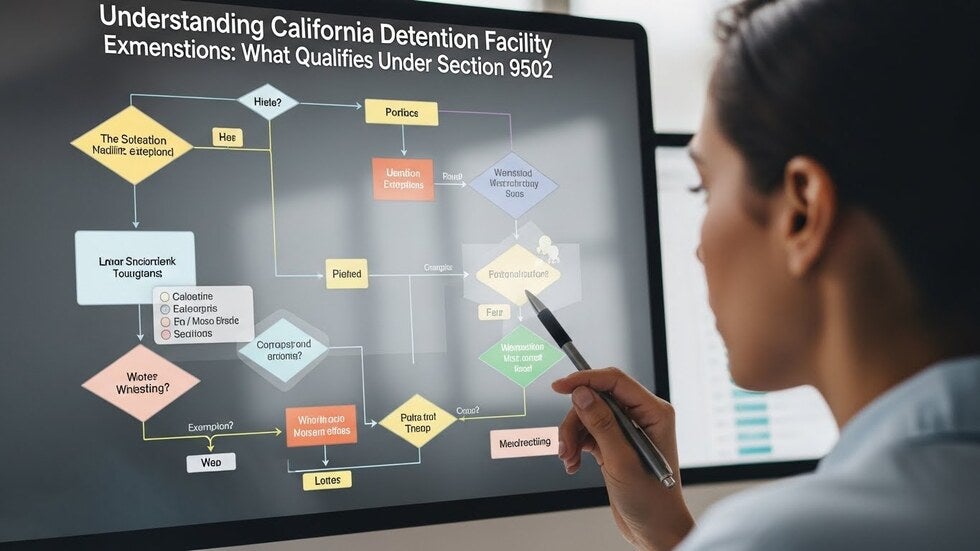
California law establishes specific exemptions that exclude certain facilities from standard detention regulations outlined in Section 9501. Understanding these exemptions is crucial for individuals, families, and legal professionals navigating the complex landscape of California's detention and treatment systems. These distinctions affect the rights of those detained, the obligations of facility operators, and the legal strategies available to defense counsel.
At Bulldog Law, we represent clients whose cases involve various types of detention facilities throughout California. Recognizing which facilities fall under exemptions and which remain subject to standard detention regulations directly impacts our ability to protect clients' rights and develop effective legal strategies.
Facilities Serving Juveniles Under Court Jurisdiction
California law exempts facilities that provide rehabilitative, counseling, treatment, mental health, educational, or medical services to juveniles under juvenile court jurisdiction. These exemptions recognize the fundamental differences between juvenile rehabilitation programs and traditional detention facilities.
Scope of Juvenile Services: The exemption covers a broad range of services designed to address the unique needs of young people in the juvenile justice system. Rehabilitative programs focus on behavior modification and skill development rather than punishment. Counseling services address underlying issues contributing to delinquent behavior. Treatment facilities provide specialized interventions for substance abuse, mental health conditions, or behavioral disorders.
Educational services ensure that juveniles continue their academic progress while receiving other interventions. Medical services address both routine healthcare needs and specific conditions requiring ongoing treatment. The comprehensive nature of these exemptions reflects California's commitment to treating juvenile offenders differently from adults.
Jurisdictional Requirements: The exemption applies specifically to juveniles under juvenile court jurisdiction pursuant to relevant provisions of the Welfare and Institutions Code. This means the juvenile must be formally involved in the juvenile justice system through court proceedings. Facilities serving youth outside the juvenile justice system may not qualify for these exemptions.
For families with children in the juvenile justice system, understanding which facilities qualify for exemptions helps clarify what regulations govern those facilities and what rights and protections apply. Defense attorneys representing juveniles must recognize these distinctions when evaluating placement options and challenging inappropriate conditions.
Mental Health and Evaluation Facilities
California exempts facilities providing evaluation or treatment services to individuals detained or committed by court order for mental health reasons. These exemptions acknowledge that mental health facilities serve fundamentally different purposes than criminal detention facilities.
Court Ordered Evaluation: Some individuals require mental health evaluation to determine competency to stand trial, criminal responsibility, or appropriate treatment needs. Facilities providing these evaluation services operate under different standards than jails or prisons because their primary function involves clinical assessment rather than secure detention.
Treatment Commitments: Courts can order individuals committed to mental health facilities under various legal provisions. Section 1026 governs commitments of individuals found not guilty by reason of insanity. These individuals require treatment in secure mental health facilities rather than incarceration in traditional criminal justice settings.
Divisions 5 and 6 of the Welfare and Institutions Code address civil commitments for individuals experiencing severe mental health crises or requiring treatment for mental health conditions. These provisions allow courts to order treatment when individuals pose dangers to themselves or others due to mental illness or when they cannot care for themselves.
Treatment Focus: The exemption recognizes that mental health facilities prioritize treatment over punishment. Staff members include mental health professionals rather than primarily correctional officers. Programming emphasizes therapeutic interventions, medication management, and stabilization rather than security and control.
For individuals facing potential mental health commitments, understanding these exemptions is essential. At Bulldog Law, we help clients navigate the complex intersection of criminal law and mental health law, ensuring that commitments are appropriate and that clients receive necessary treatment in proper facilities.
Educational and Ancillary Services for Inmates
California law exempts facilities providing educational, vocational, medical, or other ancillary services to inmates in the custody of the Department of Corrections and Rehabilitation or county law enforcement agencies. This exemption covers programs and services offered to individuals already serving sentences or awaiting trial in traditional correctional settings.
Educational Programs: Many correctional facilities offer educational programming including adult basic education, high school equivalency preparation, literacy programs, and sometimes college courses. These educational facilities within or connected to correctional institutions qualify for exemption because they serve inmates under direct correctional supervision.
Vocational Training: Vocational programs teach inmates marketable skills to improve their employment prospects upon release. These programs may include construction trades, computer skills, culinary arts, automotive repair, or other practical skills. Facilities providing these services to inmates under correctional custody qualify for exemption.
Medical Services: Healthcare facilities serving inmate populations provide essential medical and mental health services. These facilities operate differently from community medical facilities because they serve individuals in custody who cannot access services independently.
Direct Supervision Requirement: The exemption applies only when inmates remain in the custody and under direct supervision of correctional authorities. This ensures that the primary responsibility for the individuals remains with the correctional system even when receiving services in specialized facilities.
Licensed Residential Care Facilities
California exempts residential care facilities licensed under Division 2 of the Health and Safety Code from standard detention facility regulations. These facilities serve individuals who need supportive living environments but are not being detained for criminal justice purposes.
Residential care facilities include group homes, assisted living facilities, skilled nursing facilities, and other congregate care settings. These facilities serve elderly individuals, people with disabilities, those recovering from medical conditions, or individuals requiring supportive housing for various reasons.
The exemption recognizes that residential care facilities operate under comprehensive licensing requirements specific to their functions. These facilities focus on providing care and support rather than secure detention. Residents typically retain more autonomy and freedom than individuals in detention facilities, even though they live in supervised settings.
For individuals with family members in residential care facilities, understanding this exemption clarifies that these facilities operate under different regulatory frameworks than detention facilities. However, residents still retain important rights under residential care licensing laws.
School Disciplinary Detention
California law exempts school facilities used for disciplinary detention of pupils from standard detention regulations. This exemption acknowledges that school disciplinary measures serve educational purposes distinct from criminal detention.
Schools may detain students temporarily for disciplinary reasons including detention after school, in school suspension, or brief removal from class. These disciplinary measures aim to address behavioral issues within the educational context and help students understand consequences for misconduct.
The exemption applies specifically to school facilities used for these purposes. Schools must still comply with education code requirements governing student discipline, ensuring that disciplinary measures remain appropriate, proportionate, and consistent with students' educational rights.
Parents whose children face school discipline should understand that while these situations may involve detention, they operate under educational rather than criminal justice frameworks. However, some serious school incidents can result in both school discipline and criminal charges, requiring families to navigate both systems simultaneously.
Public Health Quarantine and Isolation Facilities
California exempts facilities used for quarantine or isolation of persons for public health reasons from standard detention regulations. This exemption recognizes that public health detention serves different purposes than criminal detention.
Public health authorities can order quarantine or isolation when individuals have been exposed to or infected with communicable diseases posing serious public health risks. These measures aim to prevent disease transmission and protect public health rather than punish criminal conduct.
Facilities used for public health quarantine or isolation operate under Division 105 of the Health and Safety Code, which establishes specific procedures and protections for individuals subject to these orders. While these situations restrict personal liberty, they occur within a public health rather than criminal justice framework.
The distinction between public health detention and criminal detention is essential. Individuals subject to public health orders retain different rights and face different legal standards than those detained for criminal reasons. Understanding these differences is crucial when challenging inappropriate detention or advocating for individual rights.
Temporary Merchant Detention
California law exempts facilities used for temporary detention of individuals detained or arrested by merchants, private security guards, or other private persons pursuant to specific code sections. This exemption covers situations where private parties temporarily detain individuals suspected of theft or other offenses before law enforcement arrives.
Merchant Privilege: California law allows merchants to detain individuals reasonably suspected of theft for a limited time to investigate and recover property. This detention must be reasonable in manner and duration. Merchants cannot use excessive force or detain individuals longer than necessary.
Private Security Authority: Licensed security guards and other private persons may also temporarily detain individuals under specific circumstances. These detentions must comply with strict legal requirements regarding reasonableness and duration.
Temporary Nature: The exemption applies only to temporary detention pending law enforcement arrival. Once individuals are transferred to law enforcement custody, standard detention regulations apply. The temporary nature of merchant or private detention distinguishes it from prolonged detention in traditional facilities.
Individuals detained by merchants or private security should understand their rights during these encounters. Excessive detention, use of force, or other violations can result in civil liability for the detaining party. At Bulldog Law, we represent clients who experience unlawful detention by private parties and pursue remedies for violations of their rights, including cases involving California Penal Code Section 529.5 unlawful use or transfer of ID.
Why These Exemptions Matter for Criminal Defense
Understanding facility exemptions is essential for effective criminal defense in several contexts.
Appropriate Placement: Defense attorneys must ensure clients are placed in facilities appropriate to their legal status and needs. Juveniles should be in juvenile facilities, individuals requiring mental health treatment should be in treatment facilities, and pretrial detainees should not be subjected to conditions appropriate only for convicted inmates.
Challenging Improper Detention: When clients are held in facilities that do not qualify for exemptions but fail to meet standard detention requirements, defense counsel can challenge these conditions. Conversely, understanding which facilities properly qualify for exemptions prevents frivolous challenges and focuses advocacy on legitimate concerns.
Negotiating Dispositions: Knowledge of available facility types and their exemptions enables defense attorneys to negotiate creative dispositions. Alternative sentencing to treatment facilities, residential programs, or other exempt facilities may better serve clients while addressing court concerns about public safety.
Protecting Client Rights: Different facility types provide different protections and impose different restrictions. Understanding these distinctions ensures that attorneys can effectively advocate for clients' rights within the specific framework governing their detention.
How Bulldog Law Protects Clients in Various Facilities
At Bulldog Law, our criminal defense practice includes comprehensive understanding of California's various detention and treatment facilities. We recognize how facility exemptions affect our clients and develop strategies accordingly.
We evaluate whether clients are detained in appropriate facilities given their legal status, mental health needs, and other circumstances. When clients face improper detention conditions, we take action to secure their transfer to appropriate facilities or challenge unconstitutional conditions.
Our experience includes representing juveniles in the juvenile justice system, adults requiring mental health treatment, individuals facing criminal charges while in various custody settings, and clients subjected to improper detention by private parties.
Understanding the complex regulatory landscape governing different facility types enables us to provide effective representation addressing our clients' specific situations. We fight to ensure that clients receive appropriate treatment, that their rights are protected, and that detention conditions comply with applicable legal standards.
Conclusion
California's facility exemptions create a complex regulatory landscape requiring careful navigation. Understanding which facilities qualify for exemptions and which remain subject to standard detention regulations is essential for protecting the rights of individuals in custody and developing effective legal strategies.
If you or a loved one is detained in any type of facility in California and has questions about applicable rights and protections, contact Bulldog Law for a consultation. Our experienced criminal defense team understands the distinctions between different facility types and will fight to ensure that you receive appropriate treatment and that your constitutional rights are protected throughout your case.