
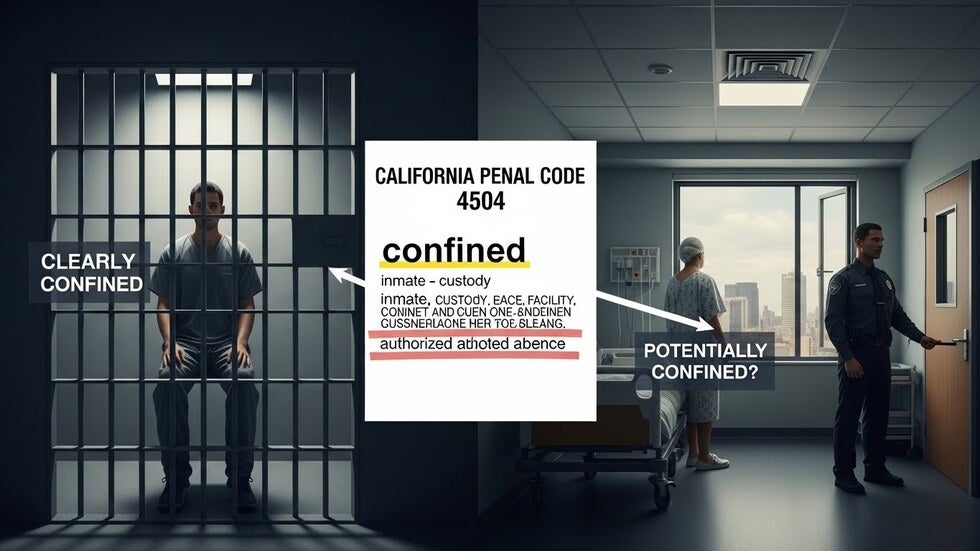
California Penal Code Section 4504 may seem like a simple definitional statute, but it carries profound implications for anyone facing criminal charges related to conduct while incarcerated. This section defines who qualifies as "confined in a state prison" for purposes of applying enhanced penalties under California's prison crimes chapter. From a defense perspective, understanding these definitions can mean the difference between facing standard criminal charges and significantly enhanced consecutive sentences.
Why Definitional Statutes Matter in Criminal Defense
Before diving into the specifics of Section 4504, it is essential to understand why definitional provisions matter so much in criminal law. Prosecutors must prove every element of a charged offense beyond a reasonable doubt, including jurisdictional requirements and status elements. If the prosecution cannot establish that a defendant was legally "confined in a state prison" when an alleged offense occurred, charges under the prison crimes chapter may fail entirely.
Defense attorneys who carefully analyze definitional statutes like Section 4504 often discover arguments that less experienced counsel might overlook. These technical defenses can result in dismissals, charge reductions, or victories at trial based on the prosecution's inability to satisfy seemingly straightforward statutory requirements.
What Constitutes Confinement in State Prison
Section 4504(a) establishes that a person is deemed confined in state prison if they are confined in any facility specified in Section 5003 pursuant to a lawful order. This includes commitments to the Department of Corrections and Rehabilitation or the Division of Juvenile Justice, regardless of the confinement's purpose and regardless of whether the commitment order is ultimately valid.
The statute's language "regardless of the validity of the order" initially appears to foreclose challenges based on improper commitments. However, understanding custody status requires examining exactly what this provision means and what defenses remain available despite this broad language, highlighting important custody legal options in California for affected individuals.
Challenging Jurisdiction and Custody Status
While Section 4504(a) states that confinement status applies "regardless of the validity of the order," this provision has limits. The statute requires that confinement occur "by order made pursuant to law." Defense counsel should investigate whether the commitment order was actually made pursuant to law or whether it was entirely void from inception.
Orders that are merely voidable differ from orders that are completely void. A voidable order has legal effect until set aside by a competent court. A void order, however, never had legal authority and can be challenged at any time. If an inmate's commitment was based on a completely void order lacking any legal foundation, arguments exist that the person was never legally confined for purposes of applying prison crimes statutes.
Defense teams should examine commitment orders, underlying judgments, and whether proper legal procedures were followed. Orders issued by courts lacking jurisdiction, orders based on charges that were previously dismissed, or orders containing fundamental legal errors may be void rather than merely voidable, raising important questions about digital asset jurisdiction in cases involving blockchain or cryptocurrency-related matters.
Temporary Outside Status and Continued Confinement
Section 4504(b) addresses situations where inmates are temporarily outside prison walls or bounds. The statute makes clear that prisoners remain "confined in" prison even when temporarily outside for work details, confinement in local jails pending trial, or other authorized purposes.
This provision creates important defense considerations when clients face charges for conduct occurring while on work crews, during court appearances, or in other situations where they were physically outside the prison facility. Prosecutors will argue that Section 4504(b) means enhanced prison crimes charges apply even to conduct occurring outside prison walls.
However, defense counsel should scrutinize the specific circumstances of temporary outside status. The statute requires that the person be outside "for the purpose of serving on a work detail" or "for any other purpose for which a prisoner may be allowed temporarily outside the walls or bounds of the prison." This language suggests that the temporary outside status must be authorized and purposeful.
The Parole Exception and Its Implications
Section 4504(b) explicitly states that prisoners released on parole are not deemed "confined in" prison for purposes of the prison crimes chapter. This exception is critically important because it means that parolees who commit offenses face standard criminal charges rather than enhanced consecutive sentences under prison crimes statutes.
Understanding parole status becomes essential when defending cases involving individuals recently released from custody. Defense attorneys must verify custody status at the time of alleged offenses to determine whether clients were actually confined or were on parole when conduct occurred.
Documentation establishing parole status includes parole certificates, release dates, and parole officer records. If prosecutors charge someone under prison crimes statutes when that person was actually on parole, this constitutes a fundamental error requiring dismissal or reduction of charges.
Facilities Covered Under Section 5003
Section 4504(a) references facilities specified in Section 5003, which identifies the various prisons and institutions within the California correctional system. Understanding which facilities fall under this designation matters because the prison crimes chapter only applies to conduct occurring in these specific locations.
Penal Code Section 5003 lists state prisons including San Quentin, Folsom, the California Institution for Women, and numerous other facilities throughout California. However, not every correctional facility qualifies. County jails, federal prisons, immigration detention centers, and other institutions may not fall within Section 5003's scope.
Defense counsel must verify where alleged conduct occurred and whether that facility actually qualifies under Section 5003. If offenses occurred in locations not covered by the statute, prosecutors cannot apply enhanced prison crimes penalties.
Division of Juvenile Justice Commitments
Section 4504(a) specifically includes commitments to the Division of Juvenile Justice within its definition of state prison confinement. This means that juveniles committed to DJJ facilities can face prosecution under prison crimes statutes for conduct occurring while in these facilities.
From a defense perspective, this raises important considerations about charging juveniles with serious felonies carrying mandatory consecutive sentences. Defense attorneys should examine whether prosecuting juveniles under these enhancement statutes serves juvenile justice goals or whether alternative approaches better address underlying conduct.
Arguments about proportionality, rehabilitation prospects, and developmental differences between juveniles and adults may support motions to reduce charges or seek alternative dispositions even when technical elements of prison crimes statutes are satisfied.
The "Until Final Judgment" Provision
Section 4504(a) states that confinement status continues "until a judgment of a competent court setting aside the order becomes final." This language addresses situations where inmates challenge their commitments through habeas corpus petitions, appeals, or other legal proceedings.
The provision means that even while legal challenges to commitment orders are pending, individuals remain "confined" for purposes of prison crimes statutes. However, once a court sets aside a commitment order and that judgment becomes final, the person is retroactively deemed to have not been confined.
This creates potential issues for convictions under prison crimes statutes when underlying commitments are later invalidated. Understanding Challenging unlawful convictions status may require examining whether commitment orders supporting prison crimes charges were subsequently set aside, potentially undermining the jurisdictional basis for those convictions.
Defense Strategies Based on Custody Status
Careful analysis of Section 4504 creates several potential defense strategies. First, defense counsel should always verify that clients were actually confined in facilities specified in Section 5003 when alleged offenses occurred. Second, attorneys should examine whether commitment orders were made pursuant to law or were void from inception. Third, defense teams should investigate whether clients were on parole rather than confined when conduct occurred.
Documentation becomes critical. Defense attorneys should obtain commitment orders, prison transfer records, parole certificates, and any other documentation establishing custody status. Discrepancies between prosecution claims and actual custody status can result in charge dismissals or significant reductions.
Practical Applications in Common Scenarios
Consider several common scenarios where Section 4504 analysis matters. An individual charged with assault after being released on parole but not yet formally discharged should not face charges under Section 4502 because parolees are explicitly excluded. A person temporarily housed in county jail for court appearances who commits an offense there may not be "confined in state prison" for purposes of enhanced charges if the county jail does not qualify under Section 5003.
Someone committed under a judgment that a court later determines was void ab initio may have arguments that they were never legally confined, even though Section 4504(a) states that validity of orders does not matter until competent courts make final determinations. These scenarios demonstrate why careful status analysis matters.
Jurisdictional Challenges and Dismissal Motions
When evidence shows that defendants were not actually confined in state prison as defined by Section 4504, defense counsel should file motions to dismiss charges brought under the prison crimes chapter. These motions argue that prosecutors cannot satisfy jurisdictional requirements necessary for enhanced charges.
Successful jurisdictional challenges result in cases being prosecuted under standard criminal statutes rather than prison crimes provisions. This eliminates mandatory consecutive sentencing requirements and often reduces potential sentences by years.
Burden of Proof on Prosecution
Prosecutors bear the burden of proving beyond a reasonable doubt that defendants were confined in state prison as defined by Section 4504 when alleged offenses occurred. Defense attorneys should never stipulate to custody status but should require that prosecutors present evidence establishing this element.
Cross examination of prosecution witnesses about custody status, documentation supporting confinement claims, and the specific facility where conduct occurred can reveal weaknesses in the prosecution's case. When prosecutors cannot adequately establish confinement status, reasonable doubt exists about essential elements.
Collateral Consequences of Status Determinations
Beyond the immediate criminal case, custody status determinations under Section 4504 can affect other legal matters including parole violations, civil rights claims, and administrative proceedings. Understanding how custody status affects various aspects of a client's situation allows defense attorneys to provide comprehensive representation.
Working with Correctional Records
Obtaining accurate correctional records becomes essential for analyzing Section 4504 issues. Defense teams should request complete institutional files, transfer records, parole documents, and any other records establishing custody status during relevant time periods.
These records sometimes contain errors, inconsistencies, or information contradicting prosecution claims. Thorough review may reveal that clients were actually on parole, housed in non Section 5003 facilities, or subject to void commitment orders.
Conclusion
California Penal Code Section 4504 defines who qualifies as confined in state prison for purposes of applying enhanced criminal penalties under prison crimes statutes. While this may seem like a straightforward definitional provision, careful analysis reveals multiple defense opportunities based on custody status, jurisdictional requirements, and the parole exception.
Defense attorneys who thoroughly investigate custody status and challenge prosecution claims when evidence does not support confinement under Section 4504 can achieve significant victories for their clients. Whether obtaining dismissals of improperly charged cases, reducing charges to eliminate mandatory consecutive sentences, or establishing that clients were on parole when conduct occurred, attention to definitional statutes makes a real difference in case outcomes. When facing any charges under California's prison crimes chapter, securing experienced defense counsel who understands these technical requirements becomes essential to protecting your rights and achieving the best possible result. Contact Bulldog Law at (888) 928-1609 to speak with experienced attorneys who can guide you through complex prison crime charges and defend your rights.