
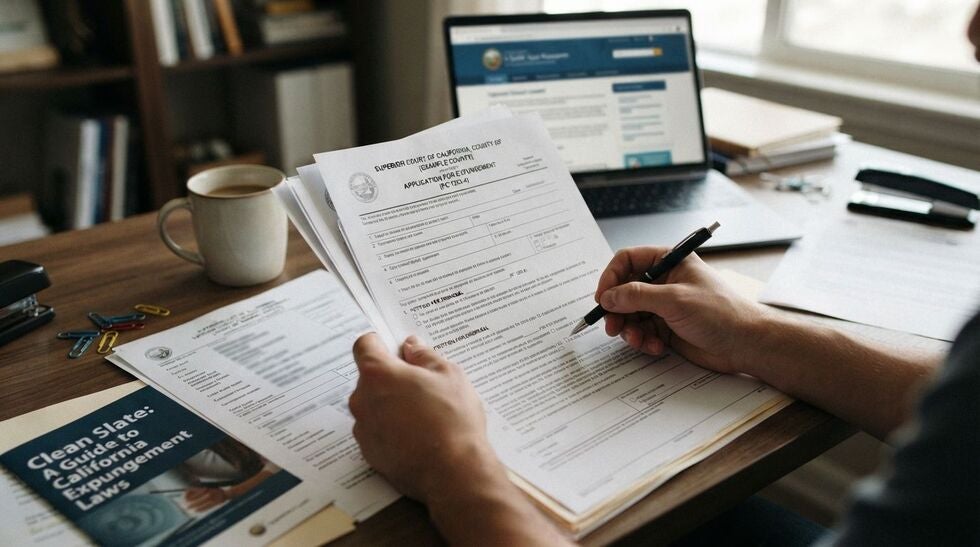
A past conviction can follow you for years, affecting your job applications, your housing options, and how people see you. But in California, there's a legal process that can change all of that. It's called expungement, and it could be one of the most valuable things you do for your future.
What Does It Mean to Expunge a Record?
To expunge a record means to have a past conviction legally dismissed, so that it no longer shows up as a conviction on most background checks.
In California, expungement works under Penal Code § 1203.4. When a court grants an expungement, it reopens the case, withdraws your guilty or no-contest plea, enters a not-guilty plea, and then dismisses the case. After that, the conviction is legally gone for most purposes, and you can lawfully state you were not convicted of that offense.
Here's something that trips people up: California expungement does not physically erase or destroy the record. The case still exists in the system. But it gets updated to show a dismissal rather than a conviction. For the vast majority of private employers who run background checks, seeing a "dismissed" case is a world away from seeing a conviction. That difference can open doors that were previously closed.
According to the California Legislative Information page for Penal Code § 1203.4, once a dismissal is granted, the defendant is released from all penalties and disabilities resulting from the offense, with specific exceptions related to firearms and certain licensing requirements.
So expungement isn't magic. But it's a real, meaningful form of relief that can change how the world responds to your past.
Who Is Eligible for Expungement in California?
The good news is that eligibility is broader than most people expect. Most people who completed probation for a misdemeanor or an eligible felony can seek expungement. Here's a breakdown of the general requirements:
Completed Probation: You must have successfully completed probation for the offense, or received an early termination of probation. If your case was resolved without probation, you may still qualify after a waiting period.
Not a State Prison Sentence: The offense generally must not be one that sent you to state prison. Cases involving county jail time under PC 1170(h), thanks to criminal justice realignment, may qualify even if they once would not have.
Not Currently Charged: You cannot be currently facing charges, on probation, or serving a sentence for another offense at the time you file.
Not an Excluded Offense: Certain serious offenses, particularly some sex crimes involving children, are excluded from expungement by statute. There is no workaround for these.
Both misdemeanors and many felonies can be expunged. And here's a powerful strategy worth knowing: for a felony that is a "wobbler" (meaning it could have been charged as either a misdemeanor or a felony), it is often possible to first reduce it to a misdemeanor under Penal Code § 17(b), and then expunge it. The result is stronger than expungement alone.
If you're not sure whether your specific conviction qualifies, The Bulldog Law's expungement and post-conviction relief page walks through eligibility in more detail and can help you figure out your options.
How Do You Get Your Record Expunged in California?
Getting your record expunged involves a few key steps. It's not as complicated as many people fear, but the details matter.
Step 1 – Confirm Eligibility. Start by reviewing the conviction, the sentence, and whether probation was completed. This tells you whether the case qualifies under Penal Code § 1203.4. For a wobbler felony, you'd also evaluate whether a § 17(b) reduction makes sense first.
Step 2 – File the Petition. You file a petition with the court that handled the original case. If you're also seeking a wobbler reduction, that motion is often filed at the same time. As noted in official court instructions, petitioners typically complete forms available through the Judicial Council of California, and it often helps to include a declaration explaining why granting the petition serves the interests of justice.
Step 3 – Serve and Respond. The prosecutor is notified and given the chance to respond. The judge then reviews the petition, the completion of probation, and any objections.
Step 4 – Court Decision. If the petition is granted, the court dismisses the conviction, and the record is updated to reflect a dismissal rather than a conviction.
One important thing: there is no deadline to petition for expungement. A conviction from ten or twenty years ago can still be expunged today, as long as you meet the eligibility requirements. An attorney can prepare the petition and appear at the hearing on your behalf, which is especially helpful if the facts of your case are complicated.
If you've been wondering how to start this process, The Bulldog Law blog has a straightforward guide on how an expungement works that breaks it down step by step.
What Does Expungement Not Do?
This is where people sometimes get disappointed, and it's important to set realistic expectations upfront.
It does not restore firearm rights. If your conviction resulted in a loss of gun rights, a standard expungement under Penal Code § 1203.4 does not restore them. Those rights require separate, additional relief.
It does not remove all disclosure obligations. If you're applying for a government job or a professional license (like a contractor's license, nursing license, or teaching credential), you may still be required to disclose the conviction, even after expungement. What changes is how it's characterized, not whether it needs to be mentioned at all. For private sector employment, you generally do not need to disclose a dismissed conviction.
It does not seal the record from law enforcement. Courts and law enforcement agencies can still see the case. In a future criminal prosecution, a prior conviction can still be referenced even after expungement.
For some people, additional or alternative relief may be available, such as a § 17(b) reduction, a certificate of rehabilitation, or newer automatic record relief laws. An attorney can help you figure out which combination of relief gives you the strongest outcome.
Is California Record Relief Now Automatic?
California has made significant changes in recent years that help more people clear their records, sometimes without filing anything at all.
Recent laws, including AB 1076 and subsequent legislation, created automatic relief that clears or seals many eligible arrests and convictions without requiring a petition. This was a major shift, previously, the burden was entirely on the person to file and pursue relief.
However, automatic relief doesn't reach every case. Its effect on background checks can differ from a granted petition. And some people benefit from affirmatively petitioning even when automatic relief has applied, for example, to also reduce a felony to a misdemeanor under § 17(b), which produces a cleaner result.
Honestly, this is one area where talking to an attorney makes a real difference. The interaction between automatic relief, petitioned dismissals, and felony reductions can be confusing, and the right combination depends on your specific record. The Bulldog Law's criminal defense team can review your record and tell you exactly where you stand.
How Expungement Affects Employment
Let's talk about the practical impact, because this is usually why people pursue expungement in the first place.
For private employers, an expunged conviction typically shows up on a background check as "dismissed" rather than as a conviction. In most cases, you are legally permitted to answer "no" when asked if you have been convicted. This single change can make an enormous difference when applying for jobs.
California law also restricts employers from asking about or considering certain sealed or expunged records under the Fair Chance Act (AB 1008). This gives expungement even more practical weight in the job market.
For licensed professions, the rules vary by licensing board. Some boards are prohibited from denying a license based solely on an expunged conviction; others still require disclosure and may weigh it differently. The important thing is that expungement still changes the conversation, even in fields where you must disclose it.
If a drug-related conviction has been affecting your job prospects, this is especially relevant. Many of The Bulldog Law's clients who come in for drug crimes defense later return to pursue expungement once their case is resolved, and the difference it makes in their daily lives is significant.
You can also read more about how the expungement process has been easing in recent years in this Bulldog Law blog post: easing the expungement process.
Frequently Asked Questions
What does it mean to expunge your record?
In California, expunging your record means the court withdraws your guilty or no-contest plea, enters a not-guilty plea, and dismisses the case under Penal Code § 1203.4. The conviction is legally dismissed, and for most purposes, especially private employment, you can state you were not convicted. It does not physically erase the record, but it updates the record to show a dismissal rather than a conviction. That difference matters a great deal on background checks.
How do you get your record expunged in California?
You confirm eligibility, generally, you must have completed probation, have no current charges, and not be excluded by the nature of your offense. Then you file a petition under Penal Code § 1203.4 with the court that handled the original case. The prosecutor is allowed to respond, and a judge makes the final decision. If granted, the conviction is dismissed and the record is updated. For a felony wobbler, it is often possible to first reduce it to a misdemeanor under § 17(b) before petitioning. There is no deadline to file.
Can a felony be expunged in California?
Yes, many felonies can be expunged, as long as you completed probation and did not serve time in state prison for the offense (though some realignment cases may qualify), and the offense is not one that is legally excluded. For felonies that are "wobblers," it is often possible to first reduce the felony to a misdemeanor under Penal Code § 17(b) and then expunge it, which produces a stronger result. An attorney can confirm whether your specific felony qualifies.
Does expungement restore gun rights in California?
No. A standard expungement under Penal Code § 1203.4 does not restore firearm rights that were lost due to a conviction. Restoring gun rights requires separate legal relief and depends on the nature of the conviction. This is one of the most common misconceptions about what expungement does.
Is there a deadline to file for expungement in California?
No. There is no deadline to petition for expungement in California. A conviction from many years ago can still be expunged today, as long as the eligibility requirements are met. The sooner you pursue it, the sooner you can begin benefiting from the change in your record.
Expungement can meaningfully improve your employment prospects and give you a genuine fresh start, and there is no deadline to pursue it.
This article is general information, not legal advice. Eligibility for expungement depends on the specific facts of your record and conviction.
For more on expungement, record reduction, and clearing your record, visit The Bulldog Law criminal defense blog. To discuss your record, you can reach The Bulldog Law at (888) 928-1609.