
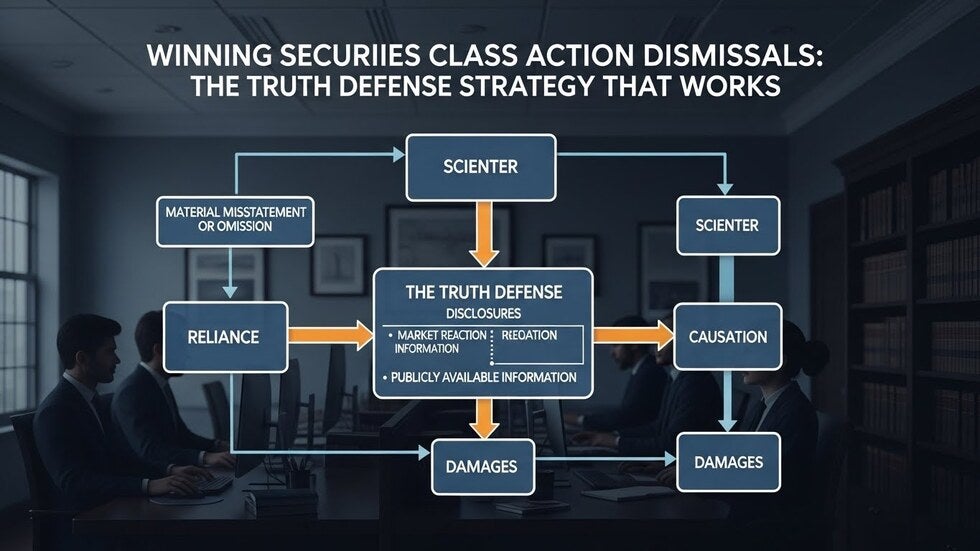
When companies face securities class action lawsuits, the pressure can be overwhelming. These cases accuse executives of deliberately misleading investors, seeking enormous damages that threaten corporate stability and personal reputations. Yet the vast majority of these lawsuits follow predictable patterns, and with the right defensive strategy, many can be dismissed before ever reaching discovery or trial.
The key to successful defense lies not in technical legal maneuvers or procedural technicalities, but in a straightforward principle: defending the truth of what company executives actually said. This approach forms the foundation for all other arguments and gives judges the confidence they need to dismiss meritless litigation early in the process.
Why Truth Matters More Than Legal Technicalities
Filing a motion to dismiss is virtually automatic in securities class action defense, and in nearly every case it represents sound strategic thinking. The Private Securities Litigation Reform Act of 1995 created stringent pleading standards specifically designed to weed out frivolous lawsuits before companies incur the massive costs of discovery.
Most dismissal motions focus on four main arguments: the complaint fails to plead false or misleading statements, challenged statements receive protection under statutory safe harbors for forward looking statements, statements were not made with scienter even if adequately pleaded as false, and the complaint inadequately pleads loss causation.
Among these arguments, challenging falsity allegations stands paramount. When executives can honestly say "I didn't lie," everything else in the defense becomes stronger. This emphasis on truth encompasses clients' most fundamental responses to litigation: they reported accurate facts, made forecasts reflecting their best judgment at the time, expressed genuinely held opinions about their businesses, and issued financial statements resulting from robust reporting processes.
The Reform Act and subsequent case law provide defense attorneys with broad latitude to attack falsity allegations. Effective falsity analysis begins by examining each challenged statement individually and matching it with the facts plaintiffs allege demonstrate falsity. Defense counsel can then support statement truthfulness in numerous ways within proper motion to dismiss standards.
Strategic Approaches to Defending Statement Accuracy
Successful falsity challenges employ multiple complementary strategies. Defense counsel should demonstrate that alleged facts don't actually undermine challenged statements because of timing or substance mismatches. Placing allegedly false or misleading statements in full context often reveals they were not misleading at all.
Attorneys can point to incorporated documents or judicially noticeable facts that contradict plaintiffs' theories. Identifying gaps, inconsistencies, and contradictions in plaintiff allegations undermines their entire case narrative. Showing that plaintiff assertions lack sufficient detail under Reform Act standards forces courts to recognize pleading deficiencies.
Attacking allegations that plaintiffs characterize as facts but actually represent opinions, innuendo, speculation, or unsupported conclusions strips away the veneer of certainty plaintiffs try to create. These arguments must be supplemented by robust presentation of relevant factual background that defines and frames any argument based on the complaint, incorporated documents, and judicially noticeable facts.
The Supreme Court's decision in Omnicare v. Laborers District Council Construction Industry Pension Fund makes clear that courts must consider statements' full context when determining whether they are misleading. This requirement benefits defendants because broader context helps courts better understand challenged statements and makes them seem fairer than they might appear in isolation.
How Falsity Arguments Strengthen Scienter Defense
Many motions to dismiss fail to make forceful arguments against falsity supported by specific challenges to plaintiff alleged facts. Some motions superficially assert that allegations are too vague to satisfy pleading standards without engaging in detailed statement defense using available facts. Others simply attack confidential witness credibility without addressing in sufficient detail the information attributed to them.
Still other motions fall back on puffery doctrine, arguing that even if false, challenged statements were immaterial. By focusing on these approaches, briefs may leave judges with impressions that defendants concede falsity or rely on technicalities, with the real defense being that false statements were not made with scienter.
This strategy proves risky for several reasons. Detailed, substantive arguments against falsity rank among the strongest arguments defendants can make. They provide foundation for the rest of the motion. Weak falsity arguments undermine scienter arguments and fail to paint the best possible picture for judges, which ultimately helps judges feel comfortable granting dismissal motions.
The Scienter Element Requires Connection to Falsity
Scienter requires plaintiffs to demonstrate that each defendant said something knowingly or recklessly false. To do this, plaintiffs must tie scienter allegations to each particular challenged statement. Generally alleging that defendants had a general motive to lie is insufficient.
When analyzing scienter allegations, effective defense counsel asks "Scienter as to what?" This question often unlocks strong arguments against scienter because complaints often make scienter allegations largely detached from falsity allegations. Frequently this occurs because falsity allegations are insufficient to begin with. Many motions to dismiss cannot point out this lack of connection because they don't focus on falsity rigorously and thoroughly.
Focusing on falsity also matters to scienter because of how courts analyze these elements. Although falsity and scienter are separate elements that should be analyzed separately, courts often analyze them together. Arguing lack of falsity thus provides essential ingredients for this combined analysis.
Even when courts analyze falsity and scienter separately, proper scienter analysis requires foundational falsity analysis. Scienter analysis asks whether defendants knew particular statements were false. Without understanding exactly why challenged statements were false and what facts allegedly demonstrate that falsity, scienter analysis meanders into examination of knowledge of facts that may or may not prove speakers' states of mind regarding those statements.
Scienter Shortcuts Require Strong Falsity Defense
The tendency to combine scienter and falsity is exemplified by what we call scienter shortcuts: the corporate scienter doctrine and the core operations inference of scienter. Under these doctrines, courts draw inferences about what defendants knew based on falsity allegations' prominence. The more blatant the falsity, the more likely courts are to infer scienter.
Superficial falsity arguments weaken defendants' ability to attack these scienter shortcuts, which plaintiffs assert more routinely. Strong falsity challenges demonstrate that even if statements are false, they represent close calls at worst, making it difficult for plaintiffs to contend that defendants must have known of the falsity.
Making Judges Comfortable With Dismissal
Thoroughly arguing lack of falsity represents good strategy even when better alternative dismissal grounds exist and falsity challenges are unlikely to succeed as independent dismissal grounds. Judges are human and feel better about dismissing cases based on other grounds when they feel comfortable that no false statement existed to begin with.
Courts are often reluctant to dismiss complaints solely on safe harbor grounds because that appears to give a license to lie. It makes sense to also argue that forward looking statements were not false in the first place. Similarly, even if lack of scienter is the best dismissal basis, defending on the basis that no one said anything wrong proves more effective than appearing to concede falsity and being left to contend "but they didn't mean to."
In most cases, judges have enough latitude under pleading standards to dismiss if they believe that is the right result. The pivotal fact is whether judges feel cases really involve fraud. Motions to dismiss that vigorously defend the truth of what defendants said are more likely to make judges feel that no fraud really occurred.
Conversely, if defendants make arguments that essentially concede falsity and rely solely on arguments that falsity was immaterial, wasn't intentional, or is not subject to challenge under safe harbors, judges may stretch to find ways to allow cases to continue.
Put simply, judges are more likely to dismiss cases in which defendants say "I didn't lie" than cases in which defendants argue "I may have lied, but I didn't mean to," "I may have lied, but it doesn't matter," or "I may have lied, but the law protects me anyway." Even when complaints might ultimately be dismissed on other grounds, strong falsity challenges are essential to help judges feel they have reached just and equitable results.
The Omnicare Revolution in Opinion Statement Defense
The Supreme Court's Omnicare decision held that opinion statements are false under federal securities laws only if speakers don't genuinely believe them, and they are misleading only if they omit information that, in context, would cause statements to mislead reasonable investors.
This ruling was a significant victory for defense practice for two primary reasons. The Court made clear that opinions are false only if not sincerely believed by speakers when expressed, a concept sometimes called subjective falsity. The Court thus explicitly rejected possibilities that opinion statements could be false because external facts show opinions to be incorrect, companies failed to disclose contrary facts, or companies didn't disclose that others disagreed with their opinions.
This ruling resolved two decades of confusing and conflicting case law regarding what makes opinion statements false, which had often permitted meritless securities cases to survive dismissal motions. Omnicare declared that whether opinion statements and by clear implication, fact statements were misleading always depends on context.
The Court emphasized that showing statements to be misleading is no small task for plaintiffs, and that courts must consider not only full statements being challenged and contexts in which they were made but also other company statements and other publicly available information, including relevant industry customs and practices.
Although Omnicare arose from a Section 11 claim under the Securities Act, all its core concepts are equally applicable to Section 10b and other securities claims with similar falsity elements. Due to its holdings' importance and the detailed way it explains them, Omnicare is the most significant post Reform Act Supreme Court case to analyze the falsity element of securities class action claims.
Navigating the Safe Harbor for Forward Looking Statements
Public companies often labor under misunderstandings that the Reform Act's safe harbor protects them from liability for guidance and projections if they simply follow statutory requirements. But the safe harbor is not so safe. Some judges think the Reform Act goes too far, so they go to great lengths to avoid the statute's plain language.
However, companies and their securities litigation defense counsel can usually work around this judicial attitude and take advantage of statutory protections with the right approach to preparing and defending company disclosures.
The safe harbor was a key component of Congress's 1995 reforms to statutes governing securities class actions. Congress sought to encourage issuers to disseminate relevant information to the market without fear of open ended liability. The safe harbor straightforwardly says that forward looking statements are not actionable if they are accompanied by meaningful cautionary statements identifying important factors that could cause actual results to differ materially from those in forward looking statements, or are immaterial, or were made without actual knowledge of their falsity.
Yet courts' application of the safe harbor has been anything but straightforward. Courts have committed basic legal errors in attempts to nullify it. Foremost among these is the tendency to collapse the three prongs, essentially reading "or" to mean "and," and to hold that actual knowledge that forward looking statements are false means that cautionary language can't be meaningful.
Courts also engage in other types of legal gymnastics, such as straining to convert forward looking statements into present tense declarations, in order to take statements out of the safe harbor. Beyond prominent instances of judicial error, judges frequently evade the safe harbor by simply avoiding defendants' safe harbor arguments, choosing either to treat the safe harbor as a secondary issue or to avoid dealing with it altogether.
The Dual Approach to Forward Looking Statement Defense
The root of these problems is that many judges don't like the idea that the safe harbor allows companies to escape liability for knowingly making false forward looking statements. Indeed, some courts have explicitly questioned the safe harbor's effect, calling it a curious statute that grants within limits a license to defraud.
This judicial antipathy for the safe harbor won't change. So it is up to companies to draft cautionary statements that will be effective in the face of this skepticism, and it is up to securities defense counsel to make safe harbor arguments that resonate with dubious judges.
For these reasons, we take a dual approach to defending forward looking statements. Forward looking statements are also opinions under Omnicare, so we start by arguing that forward looking statements are not false in the first place. We have found that judges who believe that forward looking statements are not false and are thus assured that they were not knowingly dishonest are more comfortable applying the safe harbor.
We then argue the safe harbor as an additional basis for dismissal and use that discussion to demonstrate that company safe harbor cautionary statements show that it really did its best to warn of risks it faced. Judges can tell if company risk factors aren't thoughtful and customized. Too often, risk factors become part of SEC filing boilerplate and don't receive careful thought with each new disclosure.
Risk factors that don't change from period to period, especially when it's apparent that risks have changed, are less likely to be found meaningful. Even though many risks don't fundamentally change every quarter, facets of those risks often do, or there might be another more specific risk that could be added.
We can help convince judges of defendants' candor and good faith, as well as safe harbor applicability, by demonstrating thoughtful evolution of tailored risk factors over time. Ultimately, the least effective arguments are those that rest on safe harbor literal terms, which create impressions that defendants are trying to skate on technicalities.
Focusing Scienter Analysis on Knowledge of Falsity
Scienter allegations are of two types, with the second being far more prevalent: allegations pleading facts about what defendants knew in attempts to plead that they knew challenged statements were false, and allegations that defendants must have meant to lie based on circumstantial considerations such as stock sales, corporate transactions, temporal proximity of challenged statements to truth disclosures, and relationship of challenged statement subjects to company core operations.
As with falsity, the primary flaw in most defense arguments against scienter is their failure to engage in fact specific analysis of complaint allegations about what defendants knew regarding each specific challenged statement. All too often, defendants allow themselves to be drawn onto plaintiffs' preferred ground of battle, focusing on arguing about sufficiency of circumstantial evidence plaintiffs use to create impressions that defendants must have done something wrong.
Circumstantial scienter allegations are simply ways to try to make educated guesses about what speakers knew or intended. But the Reform Act's scienter standard requires particularized pleading yielding strong inferences that defendants lied on purpose, a very high standard at the motion to dismiss stage.
So it makes no sense for defense counsel not to approach the issue directly by demonstrating that speakers did not lie and holding plaintiffs to strict standards of showing specific scienter as to each challenged statement. For this reason, all effective motions to dismiss start by testing complaint allegations that defendants actually knew, or were intentionally reckless about not knowing, the facts establishing falsity.
This means that for each statement and each defendant, motions to dismiss must isolate statements and reasons complaints allege they were false, and analyze what complaints allege each defendant knew about those facts at the time they made each challenged statement. Without this careful attention to each challenged statement, scienter inquiry is vague and becomes more about whether defendants seem bad or had generally bad motives than about whether they lied on purpose.
Building the Complete Defense Strategy
Securities class actions can be defeated at the motion to dismiss stage with the right approach. We do not rely on technicalities or gotchas. They send the wrong signal to judges, and they do not work in most cases. Instead, we emphasize that our clients told the truth.
Building on a strong foundational argument, effective securities defense presents courts with a full spectrum of viable paths to dismissal. By defending the truthfulness of challenged statements while strategically invoking all available legal protections, companies maximize their chances of early dismissal and avoid the substantial costs, operational disruption, and reputational risk associated with prolonged securities litigation. For experienced guidance on securities litigation defense, early dismissal strategies, and risk management for public and private companies, Contact Us or call (888) 928-1609 for a confidential consultation.