
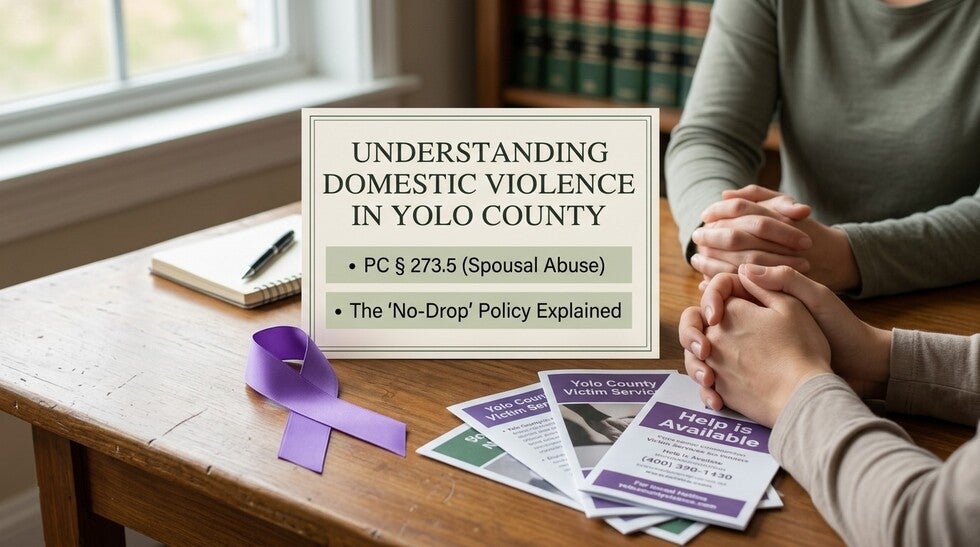
Domestic Violence in Yolo County cases can move forward even when the alleged victim later does not want prosecution. Police reports, 911 recordings, body camera footage, injury photographs, medical records, witness statements, and officer observations may become the foundation of the case. The charging decision belongs to the prosecutor, not to the complaining witness.
That does not mean every domestic violence arrest becomes a conviction. It means the defense must start immediately. A Yolo County case may involve Woodland agricultural families, UC Davis students, West Sacramento workers, Davis housing disputes, immigration concerns, firearms consequences, family court restraining orders, school discipline, and employment background checks.
Domestic Violence in Yolo County and the no-drop approach
Many domestic violence prosecutions are handled under a so-called no-drop approach. In practical terms, prosecutors may continue the case based on independent evidence even if the alleged victim changes their position, refuses contact, or asks that charges be dismissed.
California law requires law enforcement agencies to adopt domestic violence response policies, including procedures for reports, arrests, evidence, and victim assistance. California Penal Code 13701 domestic violence response policies explain why the evidence collected at the scene can become more important than later private conversations between the parties.
The defense should obtain and review every piece of early evidence. Body camera footage, 911 audio, photographs, statements, medical records, and dispatch notes can show injury, but they can also reveal confusion, intoxication, inconsistent statements, mutual combat, self-defense, or lack of probable cause.
PC 273.5 corporal injury charges
Penal Code 273.5 applies when prosecutors allege that a person willfully inflicted corporal injury resulting in a traumatic condition on a spouse, former spouse, cohabitant, former cohabitant, fiancé, dating partner, former dating partner, or co-parent. A traumatic condition can include visible injury, swelling, bruising, redness, or other injury caused by force.
PC 273.5 can be charged as a felony or misdemeanor depending on the facts, injuries, prior record, and prosecutor's decision. Felony exposure can include two, three, or four years. A misdemeanor can carry up to one year in county jail. The court may also impose protective orders, fines, probation, counseling, restitution, and other terms.
When prosecutors allege great bodily injury in a domestic violence case, sentencing exposure can rise sharply. Penal Code 12022.7 great bodily injury allegations in domestic violence cases can change negotiation, preliminary hearing strategy, and trial risk.
PC 243(e)(1) domestic battery
Penal Code 243(e)(1) is commonly charged when prosecutors allege unlawful touching against an intimate partner but do not need to prove a visible traumatic injury. It is a misdemeanor, but it can still carry serious consequences.
A domestic battery conviction may lead to jail exposure, probation, a criminal protective order, counseling, fines, firearm restrictions, immigration concerns, professional consequences, and problems in family court. A misdemeanor label should not cause anyone to treat the case lightly.
In many cases, the defense focuses on whether the touching happened, whether it was willful, whether the accused acted in self-defense, whether the relationship qualifies under the statute, and whether the evidence is reliable.
Domestic Violence in Yolo County and protective orders
A domestic violence arrest may lead to an Emergency Protective Order, criminal protective order, or family court Domestic Violence Restraining Order. These orders can control contact, residence, children, pets, firearms, move-out terms, school pickup, workplace access, and digital communication.
Protective order violations can create new criminal exposure even when the underlying case is defensible. A defendant should not respond to texts, calls, social media messages, or third-party requests if an order prohibits contact.
Family court orders can also include more than a basic stay-away provision. additional relief available through domestic violence restraining orders can affect housing, custody, finances, property, and daily life while the criminal case is still pending.
When a person seeks or responds to a DVRO, DVRO e-filing in California can affect timing, service, hearing preparation, and coordination between family court and criminal court.
Family court and Rule 5.215 issues
Domestic violence allegations can create parallel family court consequences. A criminal case may involve a no-contact order, while a family court case addresses custody, visitation, exchange logistics, residence, and long-term restraining orders.
California family courts have specific protocols for domestic violence matters, including safety, mediation, custody, and restraining order procedures. California Rule 5.215 family court domestic violence protocols can matter when a criminal defense strategy may also affect custody and parenting time.
A defendant should not assume that dismissal in criminal court automatically ends family court restrictions. The standards, evidence, and goals can be different. The defense should coordinate both tracks carefully.
UC Davis students and parallel conduct proceedings
When a UC Davis student is arrested for a domestic violence allegation, the criminal case may be only one part of the problem. A student conduct review, campus housing issue, no-contact directive, Title IX-related concern, or campus stay-away condition may begin separately.
The university process can affect housing, enrollment, financial aid, internships, classes, athletic participation, graduate programs, and campus access. A student should not submit a written statement or attend a disciplinary meeting without understanding how that statement could be used in the criminal case.
Defense planning should consider the criminal record, school record, immigration status, professional licensing goals, and whether a protective order affects campus access.
Woodland, West Sacramento, immigration, and firearm consequences
Domestic violence convictions can carry serious federal consequences. A qualifying domestic violence conviction may trigger firearm restrictions under federal law. Noncitizens may face deportability, inadmissibility, denial of benefits, or difficulty with future visas depending on the statute, facts, sentence, and record of conviction.
Woodland agricultural workers, H-2A families, DACA recipients, lawful permanent residents, UC Davis international students, and West Sacramento workers should obtain immigration analysis before any plea. A result that seems manageable in state court may create long-term immigration damage.
The same caution applies to CDL holders, warehouse workers, port-adjacent employees, public employees, healthcare workers, teachers, students, and licensed professionals whose background checks may flag a domestic violence conviction.
Evidence Code 1109 and prior domestic violence allegations
Domestic violence cases can involve prior incidents. California Evidence Code 1109 may allow prosecutors, in certain circumstances, to introduce prior domestic violence evidence to show propensity, subject to limits and judicial balancing.
This can change the entire case. A trial that should focus on one incident may expand into older allegations, prior police calls, restraining orders, texts, photos, or witness testimony. People v. Kerley and Evidence Code 1109 defense can be important when prosecutors try to use prior conduct to strengthen a weak current allegation.
The defense should challenge whether the prior incident qualifies, whether it is too remote, whether it is more prejudicial than probative, whether the evidence is reliable, and whether limiting instructions are required.
Self-defense and bilateral injury evidence
Many domestic violence cases involve two people claiming injury, both parties yelling, property damage, intoxication, prior threats, or conflicting statements. The defense should not assume the first person to call 911 is always the legal victim.
Important self-defense evidence includes:
- Photographs of the accused person's injuries.
- Medical records and treatment notes.
- 911 recordings and dispatch logs.
- Body camera video.
- Texts, voicemails, and prior threats.
- Witnesses who heard or saw the incident.
- Evidence of property damage or forced entry.
- Prior false accusations or motive to exaggerate.
Photographs should be taken quickly because bruising, redness, scratches, and swelling can change within hours. Evidence preservation should begin before the first court appearance whenever possible.
Multidisciplinary teams and survivor-related evidence
Some domestic violence cases involve medical providers, advocates, social workers, law enforcement, prosecutors, child welfare, schools, shelters, or mental health professionals. These coordinated responses may create records and witnesses that affect both sides of the case.
The defense should understand what each participant did and what records exist. domestic violence multidisciplinary teams can affect how reports are created, shared, and interpreted in a criminal case.
In rare cases, post-conviction relief may become relevant when a survivor of abuse was convicted after acting under coercion, trauma, or fear. habeas corpus relief for domestic violence survivors reflects a separate but important issue: domestic violence can affect not only accusations, but also defenses, trauma evidence, and later challenges to convictions.
Possible resolutions and limits of diversion
Yolo County domestic violence cases may resolve through dismissal, reduction, plea negotiation, trial, deferred sentencing alternatives where legally available, mental health diversion if the statutory criteria are met, or other case-specific outcomes. There is no automatic domestic violence diversion that guarantees dismissal for every first offense.
If probation is granted in a qualifying domestic violence case, California law generally requires specific probation conditions, including a batterer intervention program, protective order terms, and other requirements. A 52-week program is commonly required, but completing classes does not automatically erase the case unless the court has approved a lawful dismissal pathway.
The defense goal is to avoid unnecessary conviction consequences when the evidence is weak, negotiate the safest legally available record when risk remains, and protect immigration, firearms, employment, school, and family court interests.
Yolo County Superior Court and what to expect
Yolo County criminal cases are generally handled at Yolo County Superior Court, located at 1000 Main Street, Woodland, CA 95695. A domestic violence case may involve arraignment, protective orders, release conditions, discovery, pretrial conferences, motions, negotiations, preliminary hearing in felony cases, trial, sentencing, and probation if there is a conviction.
Domestic violence restraining order cases may proceed separately in family court. A person may have to manage both criminal and family court calendars while also complying with every order in place.
Yolo County Superior Court, the Yolo County District Attorney, law enforcement agencies, UC Davis, family court services, probation, and victim services are independent public institutions. Bulldog Law is not affiliated, endorsed, partnered, connected, or associated with any court, prosecutor, police agency, university, probation department, victim services office, or government entity.
For comparison with another rural and foothill court setting, Tuolumne County domestic violence defense under PC 273.5 shows how the same California statutes can present different local evidence, court, and community issues.
What to do after a domestic violence arrest in Yolo County
- Comply with every protective order, even if the other person contacts you first.
- Do not discuss the incident by phone, text, email, social media, or third parties.
- Photograph your own injuries immediately and again over the next several days.
- Preserve texts, call logs, photos, videos, voicemails, and witness information.
- Do not ask the alleged victim to drop charges or change a statement.
- If you are a UC Davis student, do not respond to a conduct inquiry without legal advice.
- If you are not a U.S. citizen, get immigration analysis before any plea discussion.
- If firearms, employment, licensing, CDL, or custody rights matter, raise those issues immediately.
Domestic Violence in Yolo County lawyers in California
Bulldog Law defends clients facing PC 273.5, PC 243(e)(1), restraining orders, protective orders, great bodily injury allegations, prior domestic violence evidence, UC Davis student conduct issues, immigration consequences, firearm consequences, family court overlap, and Yolo County domestic violence prosecutions.
Domestic Violence in Yolo County requires a defense that begins with the scene evidence, not with assumptions about whether the alleged victim will cooperate. The right strategy reviews 911 calls, body camera footage, injuries, self-defense evidence, protective orders, immigration status, school consequences, employment risks, and every available path to avoid a permanent record where the facts and law support it.