
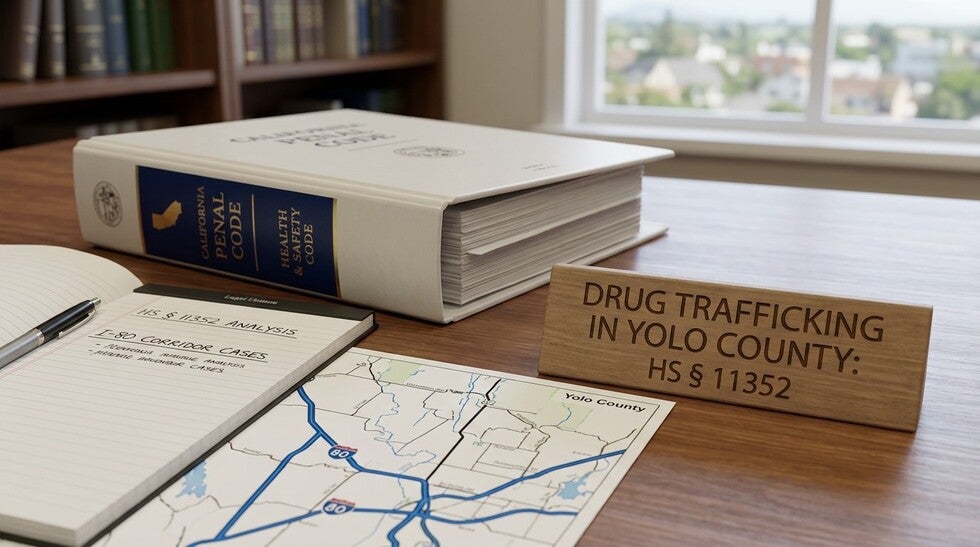
Drug trafficking in Yolo County often turns on what happened during a vehicle stop on Interstate 80 and whether prosecutors can prove transportation for sale under California Health and Safety Code section 11352. Because Yolo County sits between the Bay Area and Sacramento, law enforcement may treat some I-80 stops as trafficking investigations, but the prosecution still has to prove the stop was lawful, the search was lawful, and the accused person transported a qualifying controlled substance with the required intent.
An HS § 11352 case can affect far more than a criminal record. A conviction may bring prison exposure, immigration consequences, professional licensing issues, university discipline, and employment problems. For agricultural workers, UC Davis students, commercial drivers, and non-citizens, the defense strategy should begin early and should not assume that the police report tells the full story.
Drug trafficking in Yolo County under HS § 11352
Health and Safety Code section 11352 is one of California's main laws for sale and transportation offenses involving certain controlled substances. It can apply to conduct such as transporting, importing, selling, furnishing, administering, giving away, offering to do those acts, or attempting to transport or import a covered controlled substance.
For transportation allegations, California law limits “transport” to transportation for sale. That distinction matters. A person who possesses a controlled substance for personal use while traveling is not guilty of HS § 11352 transportation unless the prosecution can prove the required sales-related intent. The case may still involve other charges, but transportation for sale requires more than movement from one place to another.
Common Yolo County HS § 11352 allegations involve substances such as cocaine, heroin, fentanyl, oxycodone, or other covered narcotics. The exact substance matters because drug identity can affect the charge, sentencing exposure, immigration analysis, and potential federal consequences.
California drug cases can also overlap with custody-related charges when law enforcement alleges that drugs entered a jail, prison, or detention setting. A person accused of moving drugs into a correctional environment may face a different defense analysis than a highway stop, especially when the facts involve drug distribution in correctional facilities rather than alleged transportation on a public roadway.
The I-80 corridor and the first defense question
Many Yolo County drug trafficking cases begin with a traffic stop on I-80 near Davis, Woodland, West Sacramento, or surrounding freeway corridors. The first defense question is usually simple: why was the vehicle stopped?
Police generally need a lawful basis to stop a vehicle. In a traffic case, that often means an observed Vehicle Code violation or other facts supporting reasonable suspicion. A stop should not be based only on a generalized drug courier profile, a hunch, the fact that the vehicle was traveling between two cities, or assumptions about the driver or passengers.
The defense should compare the officer's stated reason for the stop against available evidence, including:
- Dash camera video or body camera video
- CHP or police reports
- Dispatch records and radio traffic
- License plate reader or surveillance references
- Vehicle Code allegations
- Timing of the stop, detention, questioning, and search
- Any claimed consent to search
- Canine deployment records, if a drug dog was used
If the stop, detention, or search violated constitutional protections, a Penal Code section 1538.5 motion may seek suppression of the evidence. If the court excludes the drugs or key statements, the prosecution may have a much harder time proving HS § 11352. Suppression does not automatically end every case, but it can be the central issue in an I-80 transportation prosecution.
Drug trafficking in Yolo County and the transportation for sale element
Even when the stop survives review, the prosecution still must prove transportation for sale. That is not the same as proving possession. It is also not the same as proving that the person drove on I-80 with drugs in the vehicle.
Prosecutors often rely on circumstantial evidence to argue sales intent. That evidence may include quantity, packaging, scales, cash, pay-owe sheets, text messages, multiple phones, location history, or statements by occupants. But each piece of evidence must be examined in context. Quantity alone does not always prove sales intent, and packaging may reflect how the substance was purchased rather than how it was going to be sold.
In Woodland and surrounding agricultural communities, cash income, shared housing, infrequent shopping trips, and travel between job sites can complicate assumptions about money, movement, and possession. A defense lawyer may need to explain why the prosecution's interpretation is not the only reasonable interpretation.
For UC Davis students, the context can be different. A student may face allegations based on group travel, shared housing, peer communications, or social distribution claims. The line between personal use, social sharing, and commercial sales can be fact-specific. Student conduct proceedings may also move separately from the criminal case, so statements made to a university investigator can create risks in court.
Penalties and consequences for HS § 11352
HS § 11352 is generally charged as a felony. The standard sentencing triad is three, four, or five years, but transportation between noncontiguous counties can expose a person to three, six, or nine years. Enhancements, prior convictions, drug quantity allegations, probation issues, and other facts can change the practical risk in a particular case.
These cases may also create consequences beyond custody. A conviction can affect employment, housing, professional licensing, security clearances, student status, and immigration. Non-citizens need immediate immigration-informed criminal defense because controlled substance and trafficking-related convictions can trigger deportability, inadmissibility, mandatory detention, and loss of eligibility for important forms of relief.
The immigration analysis must be precise. Not every state drug conviction is analyzed the same way under federal immigration law, and the exact statute, record of conviction, controlled substance, plea language, and sentence can matter. Still, an HS § 11352 transportation-for-sale or sales conviction can create severe immigration danger, especially when the offense involves a federally controlled substance and conduct treated as trafficking.
For H-2A workers, DACA recipients, lawful permanent residents, students, and other non-citizens in Yolo County, the defense should address immigration consequences before any plea is entered. A plea that seems favorable in criminal court may be disastrous in immigration court or during a future visa, adjustment, or reentry process.
West Sacramento undercover operations and entrapment issues
Some Yolo County trafficking cases begin with undercover operations, informants, controlled buys, or alleged transportation arrangements in West Sacramento or nearby commercial areas. Entrapment may be an issue when law enforcement conduct would likely cause a normally law-abiding person to commit the offense.
California entrapment law focuses primarily on police conduct. It is not enough that an officer provided an opportunity or used a lawful undercover technique. The defense becomes stronger when the evidence shows pressure, repeated requests after refusal, appeals to sympathy, unusually attractive promises, or law enforcement conduct that appears to manufacture a crime rather than investigate one.
In an undercover HS § 11352 case, the defense may examine:
- Who first suggested transportation or sale
- Whether an informant was paid or received leniency
- How many times the accused person refused or hesitated
- Whether law enforcement increased the quantity or seriousness of the conduct
- Whether recordings match the police report
- Whether the accused person had any prior sales-related conduct before police involvement
Entrapment is not available in every undercover case, and it should not be raised casually. When the facts support it, however, it can become a major defense issue.
When a Yolo County case becomes a federal drug trafficking case
Most HS § 11352 cases in Yolo County are prosecuted in state court, but some drug transportation allegations can draw federal attention. Federal prosecution becomes more likely when the case involves large quantities, interstate conduct, organized trafficking allegations, firearms, overdose-related facts, wire communications, federal task forces, or distribution networks crossing county or state lines.
Federal drug cases usually involve different statutes, sentencing rules, discovery issues, and mandatory minimum risks. A California state case under HS § 11352 should not be treated as identical to a federal prosecution under 21 U.S.C. § 841. Defense planning should account for whether the facts suggest possible federal adoption or parallel investigation.
Different California regions see different federal enforcement patterns. Border-region prosecutions may involve importation and federal agency investigations, while Central Valley cases may focus on distribution routes, stash locations, or agricultural-area transportation allegations. The defense issues in San Diego federal drug trafficking cases, Imperial County federal drug trafficking prosecutions, and Bakersfield federal drug trafficking investigations show why venue, agency involvement, and the alleged route can change the defense strategy.
Custody, contraband, and related drug allegations
A Yolo County trafficking arrest can lead to additional accusations if drugs are allegedly found during booking, jail intake, probation contact, or a custodial search. Those charges are different from HS § 11352 and require a separate analysis of knowledge, possession, control, search procedures, and where the alleged contraband was found.
For example, a person accused of having drugs after being taken into custody may need to challenge whether they knowingly possessed the item, whether officers properly searched them before transport, and whether the alleged contraband was actually under their control. In those situations, drug contraband possession in custody can become a separate legal issue from the original I-80 transportation allegation.
Are diversion or second-chance options available?
Not every drug case is eligible for diversion, treatment, or a second-chance program. HS § 11352 transportation for sale is a serious felony allegation, and sales-related conduct often limits options that may be available in simple possession cases. However, the defense should still evaluate whether the facts support a reduction, dismissal of sales allegations, treatment-based resolution, or another negotiated outcome.
First-time defendants, students, and people with substance use issues should not assume that the initial charge controls the entire future of the case. If the evidence of sales intent is weak, the defense may be able to argue that the case is closer to personal use than trafficking. In the right circumstances, California second-chance options for first-time drug offenders may be part of a broader discussion about charge reduction, treatment, and long-term record consequences.
What to do after an HS § 11352 arrest in Yolo County
After a drug trafficking arrest, the most important step is to avoid making the case worse. Do not explain the drugs, the trip, the passengers, the money, or the purpose of travel without legal advice. Statements that seem harmless during a roadside stop can later become the prosecution's proof of knowledge, possession, or intent to sell.
If the arrest happened on I-80, try to remember the officer's stated reason for the stop. Write down the location, time, lane of travel, weather, traffic conditions, passengers, whether a canine was used, and whether anyone consented to a search. These details may become important in a suppression motion.
Non-citizens should tell their lawyer about immigration status immediately. UC Davis students should avoid responding to campus disciplinary inquiries before coordinating the criminal defense. Commercial drivers should address licensing and employment consequences early. Agricultural workers should preserve work records, housing records, pay records, and travel facts that may help explain the circumstances.
Drug trafficking in Yolo County lawyers in California
Bulldog Law defends clients facing drug trafficking in Yolo County, including HS § 11352 transportation-for-sale allegations, I-80 stop cases, West Sacramento undercover investigations, UC Davis student cases, and matters involving immigration-sensitive consequences. Our defense approach begins with the stop, the search, the substance, the transportation allegation, and the prosecution's proof of sales intent.
A charge is not a conviction. In Yolo County drug cases, the difference between transportation for sale and personal use can depend on details that are easy to overlook. Bulldog Law works to identify constitutional issues, challenge unsupported trafficking allegations, protect clients from unnecessary collateral consequences, and pursue the strongest available defense based on the facts.