
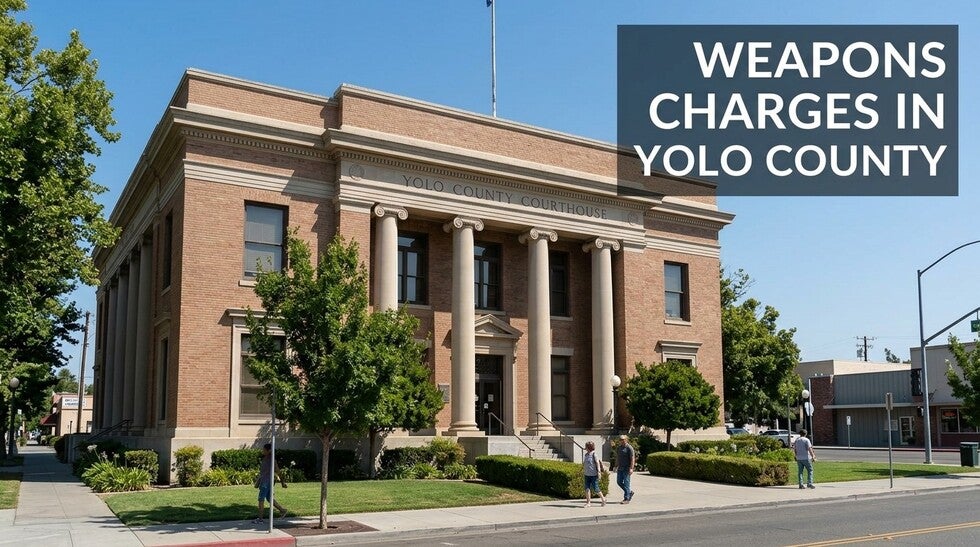
Weapons Charges in Yolo County can arise from traffic stops on I-80, firearm transport mistakes near Cache Creek hunting areas, West Sacramento industrial work commutes, Davis student incidents, Woodland agricultural employment, or a prior conviction that makes firearm possession legally dangerous. California weapons laws apply even when a driver, worker, hunter, or traveler believed they were acting lawfully.
Penal Code 25400 is California's concealed firearm law. It generally applies to carrying a concealed pistol, revolver, or other firearm capable of being concealed on the person or in a vehicle without lawful authorization. Other statutes may apply when the weapon is loaded, located in a restricted place, possessed after a disqualifying conviction, or connected to another alleged crime.
Weapons Charges in Yolo County under PC 25400
PC 25400 can be charged when prosecutors allege that a person carried a concealed firearm in a vehicle, carried a concealed firearm on their person, or caused a concealable firearm to be concealed in a vehicle. The prosecution must prove knowledge of the firearm and the facts that made the possession unlawful.
A PC 25400 case may be charged as a misdemeanor or felony depending on the facts. Prior convictions, firearm ownership status, loaded status, gang allegations, stolen firearm allegations, prohibited-person issues, or other aggravating facts can increase exposure.
California firearm law uses many definitions that changed through statutory recodification. California Penal Code section 16005 and the Deadly Weapons Recodification Act can matter when a case turns on which modern statute replaced an older weapons provision.
I-80 travelers and out-of-state carry permits
Yolo County sits on a major route between the Bay Area, Sacramento, Lake Tahoe, Reno, and other western states. Drivers entering California with firearms may assume their home state's permit or carry rules still apply. That assumption can lead to arrest.
California generally does not recognize concealed carry permits from other states. A valid Nevada, Arizona, Utah, or other out-of-state permit may explain why the person believed they were acting lawfully, but it is not the same as California authorization.
For an I-80 traveler with no criminal history, a valid out-of-state permit, locked luggage, clear travel plans, and no threatening conduct, those facts can be powerful mitigation. But the first defense question is often the stop itself. If the vehicle stop, search, or seizure was unlawful, the firearm evidence may be challenged.
Locked container transport and common mistakes
California law provides ways to lawfully transport firearms, but the rules are strict. A concealable firearm generally should be unloaded and transported in a locked container or the trunk. A glove box or center console is not a locked container for this purpose.
Ammunition should be handled carefully and should not be placed in the firearm. Keeping ammunition separate from the firearm is often the safest practice, although the exact legal issue depends on the statute charged and the facts of transport.
Common mistakes include:
- Keeping a handgun in a backpack, purse, center console, or glove box.
- Driving into California with an out-of-state carry permit.
- Leaving a loaded firearm in the cab after hunting.
- Carrying for workplace security without California authorization.
- Failing to understand how prior convictions affect firearm rights.
- Assuming a rifle or shotgun is governed by the same rule as a handgun in every situation.
Weapons Charges in Yolo County and Cache Creek hunting
Hunters traveling to or from Cache Creek, rural Yolo County, or nearby wildlife areas may face weapons charges when a firearm is loaded, accessible, improperly stored, or transported in violation of California law. A valid hunting license and lawful hunting purpose help explain the conduct, but they do not excuse every transport violation.
A hunter returning from a lawful trip may be treated differently from someone carrying a weapon for intimidation or criminal purpose. The defense should preserve the hunting license, tags, route, location, firearm type, storage method, ammunition location, and any evidence showing lawful sporting use.
If the firearm was loaded in a public place or vehicle, prosecutors may consider Penal Code 25850 in addition to or instead of PC 25400. If the issue involves a nonconcealable rifle or shotgun, the defense should carefully review whether the charged statute actually fits the firearm and transport facts.
Woodland agricultural workers, prior DV convictions, and federal risk
Woodland's agricultural workforce includes people who may keep firearms for lawful hunting, remote property work, wildlife concerns, or personal security. But a prior domestic violence conviction can create serious federal firearm consequences.
A qualifying misdemeanor or felony domestic violence conviction may trigger the federal firearm prohibition often called the Lautenberg Amendment. California expungement, the age of the conviction, or the fact that the case was a misdemeanor may not eliminate federal risk. If a person subject to a federal firearm prohibition possesses a gun, federal prosecution may be possible.
For H-2A workers, lawful permanent residents, visa holders, DACA recipients, and other noncitizens, a weapons case can also create immigration concerns. No plea should be entered until both state and federal firearm consequences are reviewed.
West Sacramento industrial corridor and workplace protection claims
West Sacramento workers in warehousing, freight, logistics, and industrial jobs may carry firearms because of late-night shifts, isolated lots, cash handling, or personal safety concerns. Those concerns may be real, but California law does not create a general personal-protection exception to concealed firearm rules.
Good-faith protection concerns can be relevant to negotiation, diversion discussions where available, and sentencing mitigation. They do not automatically defeat PC 25400. The defense should focus on whether the firearm was actually concealed, whether the accused knew it was present, whether the stop and search were lawful, whether the person was legally prohibited, and whether a safer noncriminal resolution is available.
Restricted locations: airports, transit, court, and custody
Some weapons cases become more serious because of location. Airports, public transit facilities, court buildings, schools, government buildings, jails, and prisons can trigger special rules.
If a person is accused of having a weapon in an airport terminal, California Penal Code 171.5 airport terminal weapons defense may require reviewing screening areas, signage, knowledge, travel context, and whether the item was actually prohibited.
Public transportation has its own risks. California public transit weapon charges under PC 171.7 can involve stations, buses, light rail, trains, security checkpoints, and items that may be lawful elsewhere but prohibited in a transit setting.
Weapons in custody are treated especially seriously. California Penal Code 4502 weapon possession in custody applies in a very different setting from ordinary vehicle possession and can carry severe consequences.
Deadly weapons, assault allegations, and nuisance weapon laws
Not every weapons case is just possession. Prosecutors may add assault, threats, brandishing, resisting arrest, domestic violence, robbery, or gang allegations if they claim the weapon was used or displayed.
The difference between possession and use matters. Assault with a deadly weapon versus assault with a firearm can change penalties, strike exposure, firearm restrictions, and trial strategy.
Some items may also be treated as nuisance weapons subject to seizure or destruction. California nuisance weapon laws under PC 18010 can matter when the fight is not only about conviction, but also about whether the government can keep or destroy property.
If a conviction occurs, firearm surrender rules may follow. California weapon surrender requirements under PC 18000 can affect how firearms are relinquished, transferred, stored, or forfeited after a prohibited conviction or court order.
Defenses to PC 25400 and Yolo County firearm allegations
Weapons defense is fact-specific. A strong defense may involve constitutional motions, firearm classification, storage evidence, lawful transport, lack of knowledge, lack of concealment, or a challenge to aggravating allegations.
- The stop or search was unlawful.
- The firearm was unloaded and lawfully transported.
- The firearm was in a locked container or trunk.
- The accused did not know the firearm was present.
- The firearm belonged to another occupant.
- The item was not a firearm or not a concealable firearm under the charged statute.
- The firearm was not concealed.
- The accused had lawful authorization.
- The prosecution cannot prove possession or control.
- The facts support reduction, diversion, or a non-firearm resolution.
How Yolo County compares to other California weapons cases
California weapons statutes are statewide, but local facts matter. Yolo County cases often involve I-80 travel, college communities, hunting routes, agricultural work, and West Sacramento industrial employment. Other counties present different patterns.
For comparison, Bakersfield weapons charges under PC 25400 may involve Central Valley vehicle stops, rural work, and Kern County enforcement patterns. Sacramento County weapons charges under PC 25400 may involve urban traffic stops, public transit, state buildings, and cross-county commuting.
Coastal and rural cases can look different. Ventura County weapons defense under PC 25400 may involve coastal travel, workplace access, and vehicle searches. Mariposa County weapons cases under PC 25400 may involve hunting, rural roads, tourism, and firearm transport misunderstandings near public lands.
Yolo County Superior Court and what to expect
Weapons cases in Yolo County are generally handled through Yolo County Superior Court's Criminal Division at 1000 Main Street, Woodland, CA 95695. The process may include arraignment, bail or release conditions, discovery, firearm testing, motions to suppress, negotiations, preliminary hearing in felony cases, trial, sentencing, and weapon surrender or return proceedings.
The court may impose conditions requiring no firearm possession while the case is pending. A defendant should comply strictly. Possessing another firearm after release can create new charges and make the existing case harder to resolve.
Yolo County Superior Court, prosecutors, law enforcement agencies, the California Department of Justice, federal agencies, and public offices are independent entities. Bulldog Law is not affiliated, endorsed, partnered, connected, or associated with any court, prosecutor, police agency, sheriff's office, DOJ office, federal agency, or government institution.
What to do after a weapons arrest in Yolo County
- Do not make statements about the firearm, ownership, purpose, or storage without legal counsel.
- Write down the exact reason the officer gave for the stop.
- Document where the firearm was located and whether the container was locked.
- Preserve out-of-state permits, hunting licenses, tags, and firearm purchase records.
- Identify every passenger or person who had access to the vehicle or bag.
- If you have any domestic violence conviction, tell your lawyer immediately.
- If you are not a U.S. citizen, get immigration analysis before any plea.
- Do not possess or purchase firearms while the case is pending if any order prohibits it.
Weapons Charges in Yolo County lawyers in California
Bulldog Law defends clients facing PC 25400 concealed firearm charges, loaded firearm allegations, unlawful transport cases, hunting-related firearm arrests, I-80 traveler cases, prior-conviction firearm issues, restricted-location weapons charges, firearm surrender issues, and related weapons offenses in Yolo County and throughout California.
Weapons Charges in Yolo County require a defense that starts with the stop, the search, the firearm type, the storage method, the person's legal status, and the location. The facts that look bad in a police report may have a lawful transport explanation, a hunting context, a mistaken out-of-state permit assumption, a constitutional search problem, or a mitigation record that changes the outcome.